

Biosensor-based real time label free interaction analysis using bio-layer interferometry (BLI) has become an indispensable tool in research and development for the selection and production of biologics that target a specific binding partner. Traditionally, immunoglobulin and non-immunoglobulin-based scaffolds are used to create libraries of molecules, which are subsequently screened.
Characterization of the molecule’s binding properties such as kinetics and affinity parameters (ka, kd, KD) are essential during the screening process to be able to rank hits and choose the best candidates to advance lead selection in the discovery process. Later, for example during cell line development (CLD) and subsequent scale up and production, interaction measurements are used for in-process checks and quality control.
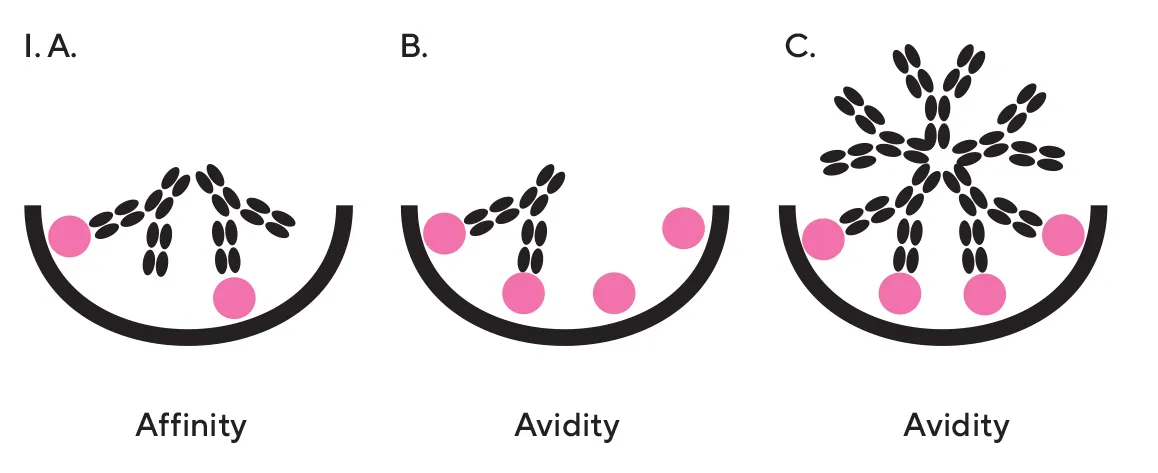
Figure 1: I) Affinity and avidity as observed in biological systems with a binding of antibodies to membrane/surface bound proteins and receptors. II) Illustration of avidity observed in binding assays performed using sensor surface bound biomolecules. Illustrated is the binding of an antibody (bivalent) to surface bound antigen where the bivalent analyte can form a bridged complex resulting in a lower apparent dissociation rate of the complex formed than expected.