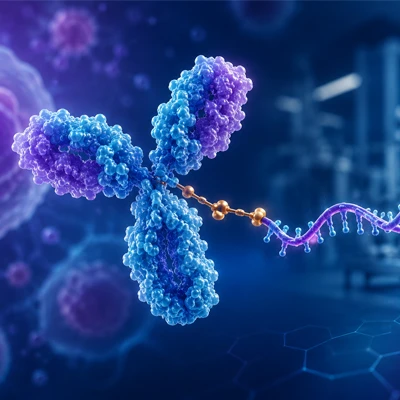
Next-Generation ADCs: Process Development Strategies for Antibody-Oligonucleotide Conjugates
Abstract: Antibody-oligonucleotide conjugates are expanding the possibilities of targeted therapeutics beyond traditional ADC applications. However, their complexity introduces new challenges in process development, manufacturing, scale-up, and CMC strategy. This article explores key considerations for developing robust, scalable processes that can help accelerate clinical readiness while reducing development and manufacturing risks.
The Next Evolution of ADCs Is Already Here
For years, antibody-drug conjugates (ADCs) have been one of the most exciting areas in biopharmaceutical development. By combining the targeting power of antibodies with highly potent payloads, ADCs have transformed how researchers think about precision medicine, particularly in oncology.
But the ADC landscape is changing.
A new generation of conjugates is emerging—one that extends far beyond traditional cytotoxic payloads. Antibody-oligonucleotide conjugates (AOCs) are rapidly gaining attention as researchers explore ways to deliver RNA therapeutics, antisense oligonucleotides, siRNA molecules, and other nucleic acid-based treatments directly to specific tissues and cell types.
The promise is enormous. Diseases that were once difficult to treat through conventional biologics or small molecules may become addressable through highly targeted oligonucleotide delivery platforms.
Yet as exciting as these opportunities are, they introduce a new set of development and manufacturing complexities.
The challenge is no longer simply proving the science. The challenge is translating innovative molecular designs into robust, scalable, and regulatory-ready manufacturing processes.
This is where successful ADC process development becomes a decisive factor.
|
Discover how developers are overcoming the biggest manufacturing and scale-up challenges in antibody-oligonucleotide conjugates by accessing our latest technical paper. |
Why Antibody-Oligonucleotide Conjugates Are Different
Traditional ADCs typically combine three core components:
- An antibody
- A linker
- A small-molecule payload
Antibody-oligonucleotide conjugates introduce a much more complex payload architecture.
Oligonucleotides possess unique physicochemical characteristics that differ significantly from conventional ADC payloads. They can be larger, more negatively charged, structurally sensitive, and often require specialized handling throughout development and manufacturing.
These differences impact nearly every aspect of development, including:
- Conjugation chemistry
- Analytical characterization
- Purification strategies
- Process robustness
- Stability assessment
- Scale-up considerations
- Regulatory documentation
What works for a traditional ADC may not be sufficient for an antibody-oligonucleotide conjugate.
As a result, organizations pursuing these next-generation therapeutics must rethink how they approach process development from the earliest stages.
The Hidden Manufacturing Challenge
Scientific innovation often captures headlines.
Manufacturing challenges rarely do.
Yet many promising bioconjugate programs encounter delays not because the biology fails, but because development teams discover unforeseen manufacturing obstacles later in the program.
Some common issues include:
Conjugation Efficiency
Achieving consistent conjugation between antibodies and oligonucleotide payloads can be significantly more challenging than attaching traditional small molecules.
Variability in conjugation efficiency may affect:
- Product consistency
- Biological performance
- Process yields
- Regulatory acceptance
Even minor deviations can create substantial downstream challenges.
Product Heterogeneity
Bioconjugates naturally contain multiple molecular species.
Controlling heterogeneity becomes increasingly important as product complexity grows.
Development teams must establish robust strategies to manage:
- Drug-to-antibody ratios
- Oligonucleotide loading distributions
- Aggregation levels
- Product-related impurities
Without careful control, heterogeneity can become a major barrier during clinical development.
Analytical Complexity
One of the most underestimated aspects of ADC CMC development is analytical characterization.
Traditional biologics assays often require significant adaptation to characterize next-generation conjugates effectively.
Organizations may need sophisticated analytical approaches capable of evaluating:
- Conjugation efficiency
- Payload integrity
- Stability profiles
- Molecular distribution
- Critical quality attributes
Building these capabilities early can substantially reduce development risk later.
Why Early Process Development Matters More Than Ever
Many development teams focus heavily on demonstrating proof-of-concept efficacy.
While this is understandable, manufacturability should be considered alongside biological performance from the very beginning.
Early-stage ADC process development can influence:
- Development timelines
- Clinical readiness
- Manufacturing costs
- Scale-up feasibility
- Regulatory success
A molecule that performs exceptionally well in the laboratory but cannot be manufactured consistently at scale may face significant hurdles on its path to patients.
Forward-thinking organizations increasingly integrate process development activities early to identify potential bottlenecks before they become costly problems.
This proactive approach allows teams to:
- Evaluate manufacturing risks
- Optimize conjugation strategies
- Improve process robustness
- Generate scalable workflows
- Strengthen CMC packages
Ultimately, early investment in process understanding can accelerate clinical progression.
Building Scalability Into the Process
One of the most common mistakes in bioconjugate development is assuming that a successful laboratory process will naturally translate into commercial manufacturing.
In reality, ADC scale up manufacturing requires careful planning.
Processes that appear straightforward at small scale can behave very differently when transferred to larger production environments.
Factors such as:
- Mixing conditions
- Reaction kinetics
- Raw material variability
- Purification performance
- Product stability
can all change during scale-up.
For antibody-oligonucleotide conjugates, these challenges may become even more pronounced due to the unique characteristics of nucleic acid payloads.
Successful organizations build scalability into development programs from the outset rather than treating scale-up as a later-stage exercise.
This mindset reduces technology transfer risks and creates a smoother path toward clinical and commercial manufacturing.
The Growing Importance of CMC Strategy
In today's competitive development environment, regulators expect comprehensive
understanding of product quality and process control.
This places increasing importance on ADC CMC development.
A strong Chemistry, Manufacturing, and Controls strategy helps establish confidence that the product can be consistently produced while maintaining quality, safety, and efficacy.
For next-generation conjugates, CMC activities often involve:
- Defining critical quality attributes
- Establishing control strategies
- Developing analytical methods
- Demonstrating process consistency
- Managing product variability
Organizations that develop robust CMC frameworks early often position themselves for more efficient regulatory interactions later.
As molecular complexity increases, so does the value of comprehensive process knowledge.
Why Specialized Expertise Is Becoming Essential
The rise of advanced bioconjugates has created a growing demand for specialized development and manufacturing expertise.
Few organizations possess deep experience across all relevant disciplines, including:
- Antibody engineering
- Oligonucleotide technologies
- Conjugation chemistry
- Process development
- Analytical characterization
- Regulatory strategy
As a result, many developers are increasingly seeking antibody conjugation services that provide integrated support across the entire development lifecycle.
The right development partner can help organizations:
- Identify manufacturing risks early
- Optimize conjugation approaches
- Accelerate development timelines
- Improve process scalability
- Strengthen regulatory readiness
Perhaps most importantly, experienced teams can leverage lessons learned from previous programs, helping avoid challenges that may not be obvious during initial development stages.
Beyond Oncology: Expanding Therapeutic Possibilities
One reason antibody-oligonucleotide conjugates are generating so much excitement is their potential to expand beyond traditional oncology applications.
Researchers are increasingly exploring these platforms for:
- Neuromuscular disorders
- Inflammatory diseases
- Genetic disorders
- Rare diseases
- Metabolic conditions
The ability to deliver oligonucleotide therapeutics selectively to specific tissues could unlock entirely new treatment paradigms.
However, broader therapeutic applications also mean broader manufacturing requirements.
Development platforms must become increasingly flexible, adaptable, and scalable to support diverse product pipelines.
This makes process innovation just as important as therapeutic innovation.
The Future Will Belong to Manufacturable Innovation
The next generation of bioconjugates promises to reshape the therapeutic landscape.
But scientific breakthroughs alone will not determine success.
The programs that advance most efficiently toward the clinic will be those supported by robust development strategies, scalable manufacturing processes, and strong CMC foundations.
For antibody-oligonucleotide conjugates, process development is no longer a downstream consideration. It is a critical enabler of clinical success.
Organizations that address manufacturing challenges early can reduce risk, accelerate timelines, and create a clearer path from discovery to patient impact.
As the industry moves beyond conventional ADC formats, the ability to develop and manufacture increasingly sophisticated bioconjugates will become a defining competitive advantage.