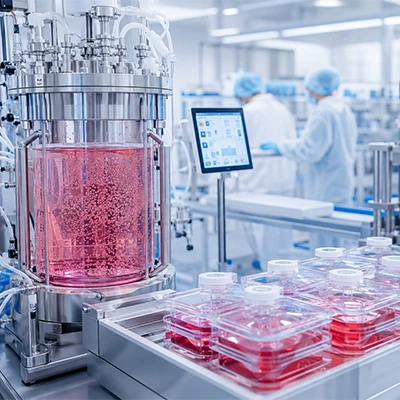
Cell Therapy Manufacturing at Scale: Strategies for Faster Development and Commercial Readiness
Scaling cell therapy manufacturing requires more than scientific innovation—it demands robust processes, automation, regulatory compliance, and commercial readiness. This article explores strategies for accelerating development through optimized process design, GMP manufacturing, CDMO partnerships, and scalable production technologies, helping biopharmaceutical companies efficiently transition from clinical development to successful commercial manufacturing.
Introduction:
Cell therapies are redefining the future of medicine by offering personalized treatments for cancer, autoimmune disorders, genetic diseases, and regenerative medicine applications. As the number of clinical trials and regulatory approvals continues to grow, manufacturers face an increasingly complex challenge: transitioning from small-batch clinical production to large-scale commercial manufacturing without compromising product quality, patient safety, or regulatory compliance.
Unlike traditional biologics, cell therapies involve living cells that are highly sensitive to process variations, environmental conditions, and handling techniques. Consequently, manufacturing scalability has become one of the biggest bottlenecks preventing promising therapies from reaching patients faster.
Today, organizations are investing in cell therapy manufacturing services, partnering with experienced cell therapy CDMO services providers, implementing GMP cell therapy manufacturing standards, and optimizing cell therapy process development to achieve scalable cell therapy production that supports commercial success.
This article explores the critical strategies that pharmaceutical companies, biotechnology innovators, and manufacturing partners are adopting to accelerate development while preparing for commercial-scale production.
Why Manufacturing Has Become the Competitive Advantage
Scientific breakthroughs alone no longer determine the success of a cell therapy program. Manufacturing readiness now plays an equally important role.
Many promising therapies fail to progress because manufacturing processes developed during early clinical phases cannot efficiently support commercial demand. Manual workflows, inconsistent raw materials, operator-dependent procedures, and fragmented supply chains often result in higher production costs and limited scalability.
Commercial success requires manufacturing platforms capable of delivering:
- Consistent product quality
- Regulatory compliance
- Faster batch release
- Lower cost of goods (COGs)
- Reliable supply chains
- Global manufacturing capabilities
Organizations that address manufacturing challenges early significantly reduce development risks and improve their commercialization timelines.
Understanding the Complexity of Cell Therapy Manufacturing
Cell therapy production differs substantially from conventional pharmaceutical manufacturing.
Manufacturing typically involves:
- Cell collection
- Cell isolation
- Genetic modification (where applicable)
- Cell expansion
- Harvesting
- Washing and formulation
- Cryopreservation
- Storage
- Distribution
Every step introduces variability that must be tightly controlled.
Unlike synthetic drugs, living cells respond to even minor environmental changes.
Temperature fluctuations, media composition, operator handling, and processing times can all influence product potency.
This complexity makes robust cell therapy process development essential from the earliest stages of product development.
Building Manufacturing Scalability from Day One
One of the most common mistakes companies make is designing manufacturing processes solely for clinical trials.
Clinical manufacturing often prioritizes flexibility over efficiency, relying heavily on manual operations. While suitable for producing limited batches, these approaches become unsustainable during commercialization.
Successful manufacturers instead develop scalable processes that remain effective across all development phases.
Key considerations include:
Standardized Manufacturing Protocols
Creating reproducible manufacturing procedures reduces variability while simplifying technology transfer between development and commercial facilities.
Closed-System Processing
Closed manufacturing systems minimize contamination risks while reducing cleanroom requirements and labor-intensive operations.
Platform Technologies
Reusable manufacturing platforms enable organizations to standardize workflows across multiple cell therapy programs, reducing development time for future products.
These approaches support long-term scalable cell therapy production without requiring complete process redesigns.
The Growing Importance of Cell Therapy CDMO Partnerships
Many biotechnology companies possess exceptional scientific expertise but limited commercial manufacturing capabilities.
Rather than investing hundreds of millions of dollars in dedicated facilities, organizations increasingly rely on specialized cell therapy CDMO services to accelerate development.
An experienced CDMO provides:
- Process development expertise
- GMP manufacturing infrastructure
- Analytical testing
- Regulatory support
- Technology transfer
- Commercial manufacturing capabilities
This partnership allows therapy developers to focus on clinical innovation while leveraging manufacturing specialists with proven operational experience.
In addition, CDMOs often possess established relationships with equipment vendors, raw material suppliers, and regulatory agencies, reducing project risks throughout development.
Optimizing Cell Therapy Process Development
Process development establishes the foundation for commercial manufacturing success.
Instead of viewing development as a series of isolated experiments, leading manufacturers implement systematic optimization strategies.
Critical process parameters include:
Cell Expansion
Optimizing cell growth conditions improves yields while maintaining cell functionality and phenotype.
Variables include:
- Culture media
- Cytokine concentrations
- Oxygen levels
- Temperature
- Feeding schedules
- Bioreactor conditions
Gene Modification Efficiency
For engineered therapies, improving transduction or gene editing efficiency directly influences manufacturing productivity.
Harvest and Formulation
Optimized harvesting minimizes cell stress while maximizing viability and recovery.
Cryopreservation
Reliable freezing protocols preserve cell functionality throughout storage and transportation.
A robust cell therapy process development strategy ensures that manufacturing performance remains consistent from clinical batches through commercial production.
Automation Is Transforming Cell Therapy Manufacturing
Manual manufacturing has long been a defining characteristic of cell therapy production.
However, manual operations increase:
- Human error
- Batch variability
- Labor costs
- Production time
- Contamination risks
Automation is rapidly changing this landscape.
Modern manufacturing platforms integrate:
- Automated cell expansion
- Closed-system cell washing
- Digital batch records
- Electronic quality monitoring
- Automated sampling
- Process analytics
Automation improves reproducibility while reducing operator intervention, enabling manufacturers to increase throughput without sacrificing quality.
As commercial demand grows, automation becomes a necessity rather than a competitive advantage.
Learn More about Next-Generation Manufacturing Strategies
As cell therapy pipelines expand, manufacturers must adopt more flexible, automated, and scalable production approaches to meet commercial demand.
The webinar "Next-Gen Cell Therapy Manufacturing: Leveraging Flexibility and Automation for Success" explores practical strategies for overcoming manufacturing bottlenecks through adaptable solutions, innovative technologies, optimized workflows, modular manufacturing approaches, and next-level automation.
If you're evaluating ways to accelerate commercialization while maintaining quality and regulatory compliance, you can watch the webinar here:
https://www.pharmafocusamerica.com/promotion/thermofisher-next-gen-cell-therapy-manufacturing-watch-webinar
Achieving GMP Cell Therapy Manufacturing
Regulatory expectations continue to evolve as more cell therapies receive approval.
Implementing GMP cell therapy manufacturing involves much more than operating within cleanrooms.
Manufacturers must establish comprehensive quality systems covering:
- Facility qualification
- Equipment validation
- Personnel training
- Environmental monitoring
- Raw material control
- Documentation practices
- Process validation
- Product traceability
Because cell therapies are patient-specific in many cases, maintaining chain of identity and chain of custody throughout manufacturing is equally critical.
Advanced digital tracking systems help ensure every product reaches the correct patient while maintaining complete regulatory documentation.
Digital Manufacturing and Data Integration
Digital transformation is becoming central to large-scale manufacturing.
Modern facilities increasingly utilize:
- Manufacturing Execution Systems (MES)
- Laboratory Information Management Systems (LIMS)
- Electronic Batch Records (EBR)
- Digital Quality Management Systems (QMS)
- Real-time process monitoring
These technologies provide:
- Improved traceability
- Faster deviation investigations
- Reduced documentation errors
- Enhanced regulatory readiness
- Better production forecasting
Data-driven manufacturing also enables continuous process improvement through advanced analytics and predictive maintenance.
Managing Raw Material Variability
Cell therapy manufacturing depends on highly specialized raw materials including:
- Cell culture media
- Growth factors
- Cytokines
- Viral vectors
- Single-use consumables
- Cryoprotectants
Variability among suppliers can significantly affect product quality.
Leading manufacturers reduce risk by:
- Qualifying multiple suppliers
- Performing incoming material testing
- Establishing long-term procurement agreements
- Implementing supplier quality audits
Reliable raw material strategies improve manufacturing consistency while reducing supply chain disruptions.
Scaling Through Modular Manufacturing Facilities
Traditional pharmaceutical manufacturing facilities often require years to design and construct.
Cell therapy companies increasingly favor modular manufacturing facilities that offer:
- Faster deployment
- Flexible expansion
- Standardized equipment layouts
- Lower capital investment
- Easier global replication
Modular cleanrooms allow manufacturers to increase production capacity incrementally as clinical demand evolves.
This flexibility is especially valuable for rapidly growing therapy portfolios.
Decentralized Manufacturing Models
Certain autologous therapies require manufacturing close to treatment centers because patient cells have limited transportation windows.
Decentralized manufacturing networks help reduce logistics challenges while improving patient access.
These distributed manufacturing models rely heavily on:
- Standardized equipment
- Automated workflows
- Digital monitoring
- Remote quality oversight
Consistent manufacturing across multiple facilities requires harmonized operating procedures and integrated quality systems.
Quality by Design (QbD) for Cell Therapy
Quality cannot be tested into a product after manufacturing.
Instead, successful organizations implement Quality by Design principles throughout development.
QbD involves:
- Identifying critical quality attributes
- Understanding process variability
- Defining acceptable operating ranges
- Continuous process monitoring
- Risk-based decision making
This systematic approach improves manufacturing robustness while simplifying regulatory submissions.
Reducing Manufacturing Costs without Compromising Quality
One of the largest barriers to widespread adoption of cell therapies remains manufacturing cost.
Manufacturers are pursuing multiple strategies to reduce cost per dose:
- Automation
- Closed manufacturing systems
- Improved cell yields
- Optimized media usage
- Standardized consumables
- Reduced batch failures
- Digital process monitoring
- Efficient facility utilization
Lower manufacturing costs ultimately improve therapy accessibility while strengthening commercial sustainability.
The Expanding Role of Cell Therapy Manufacturing Services
The growing complexity of advanced therapies has significantly increased demand for specialized cell therapy manufacturing services.
Comprehensive manufacturing partners now provide end-to-end capabilities including:
- Early process development
- Analytical method development
- Clinical manufacturing
- GMP production
- Quality control testing
- Regulatory documentation
- Commercial manufacturing
- Global supply chain management
Integrated service providers reduce project complexity while helping developers shorten timelines from discovery through commercialization.
Preparing for Commercial Readiness
Commercial readiness requires more than successful clinical trial results.
Manufacturers must simultaneously prepare for:
- Facility expansion
- Regulatory inspections
- Technology transfer
- Workforce development
- Supply chain resilience
- Process validation
- Market forecasting
- Global distribution
Organizations that integrate commercial planning during early development significantly reduce delays following regulatory approval.
Commercial manufacturing readiness is no longer viewed as a final milestone—it is an ongoing strategy that begins during product development.
Conclusion
The future of cell therapy depends as much on manufacturing innovation as it does on scientific discovery. As therapies move toward broader clinical adoption, manufacturers must develop production systems capable of delivering high-quality products efficiently, consistently, and at commercial scale.
Investments in cell therapy process development, advanced automation, digital manufacturing platforms, and flexible facility designs are transforming how therapies progress from research laboratories to patients. At the same time, partnering with experienced cell therapy CDMO services providers and leveraging comprehensive cell therapy manufacturing services allows organizations to accelerate development while minimizing operational risks.
Ultimately, achieving GMP cell therapy manufacturing and enabling scalable cell therapy production requires a proactive strategy that integrates quality, flexibility, automation, and regulatory readiness from the earliest stages of development. Companies that embrace these principles will be best positioned to meet growing market demand, reduce time-to-market, and deliver life-changing therapies to patients worldwide.