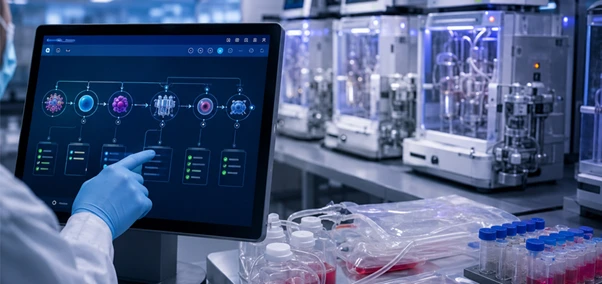
CAR-T Cell Manufacturing Automation Software: End-to-End Workflow Integration with CTS Cellmation Software
CAR-T manufacturing demands precision across leukapheresis, selection, transduction, expansion, and formulation. This article examines how CAR-T cell manufacturing automation software connects modular instruments into a GMP-compliant, end-to-end workflow—reducing manual touchpoints, minimizing variability, and enabling real-time process control. It also highlights how Gibco CTS Cellmation Software delivers this digital orchestration at scale.
Introduction:
Chimeric antigen receptor T-cell (CAR-T) therapy has moved from experimental promise to clinical reality, offering durable remission for patients with certain blood cancers who have exhausted other treatment options. Yet behind every CAR-T infusion lies a manufacturing process of extraordinary complexity — one that must be repeated, patient by patient, with unwavering consistency. As the field scales from a handful of approved therapies to a growing pipeline of autologous and allogeneic products, manufacturers are discovering that the biggest bottleneck isn't the biology. It's the workflow. This is where CAR-T cell manufacturing automation software is reshaping how developers think about process design, control, and scale.
The Manufacturing Challenge behind Cell and Gene Therapy
CAR-T manufacturing is unlike traditional biologics production. Each batch is typically derived from a single patient's own T cells (or, in allogeneic approaches, from a healthy donor), meaning there is no room for batch failure, no ability to simply "make more" if something goes wrong, and an unforgiving timeline dictated by a patient's clinical status. The process itself spans multiple unit operations — leukapheresis, cell selection, activation, viral transduction, expansion, harvest, and formulation — each performed on different pieces of equipment, often in different rooms, sometimes by different operators across different shifts.
Historically, these steps have been connected by paper batch records, manual data transcription, and human judgment calls at every handoff. That approach worked when cell therapy was a niche, academic pursuit. It does not scale. Manual touchpoints introduce variability, increase the risk of contamination, slow down technology transfer between sites, and make it extraordinarily difficult to maintain the kind of process consistency that regulators — and patients — require. This is precisely the gap that a cell therapy manufacturing digital automation platform is designed to close.
Why Automation Software Matters More Than Automation Hardware
It's tempting to think of automation purely in terms of hardware: closed, modular instruments that replace open manual processing steps. Modular instrumentation is indeed a critical part of the equation, offering the flexibility to reconfigure a suite for different products or scales without a full facility redesign. But hardware alone doesn't solve the orchestration problem. A cleanroom full of best-in-class closed instruments still requires someone — or something — to sequence the steps, transfer data between systems, enforce process parameters, and generate the audit trail regulators will scrutinize.
That's the role of software. A well-designed CAR-T cell therapy process orchestration software layer sits above the individual instruments, coordinating them into a single, cohesive workflow. Instead of an operator manually keying in cell counts from one device before starting the next step on a separate machine, the software captures data automatically, applies decision logic, and initiates the next process step when — and only when — predefined criteria are met. The result is a process that behaves less like a collection of disconnected machines and more like a single, intelligent manufacturing system.
GMP Compliance Is Non-Negotiable
Every design decision in cell therapy manufacturing has to be made with Good Manufacturing Practice (GMP) requirements in mind. Regulators expect complete traceability: who did what, when, under which parameters, and with what materials. Achieving this manually — through handwritten batch records and spreadsheet reconciliation — is labor-intensive and error-prone, and it becomes a genuine liability as production scales toward commercial volumes.
A true GMP-compliant CAR-T manufacturing workflow software solution builds compliance into the process itself rather than bolting it on afterward. Electronic batch records are generated automatically as the process runs. Deviations are flagged in real time rather than discovered during a post-hoc review. Access controls, audit trails, and electronic signatures are native to the system, not manual add-ons. This shifts quality assurance from a reactive, retrospective exercise to a proactive, continuous one — which matters enormously when a single manufacturing slot represents a specific patient waiting for treatment.
From Fragmented Steps to a Connected System
The real promise of automation software is realized when it stops being applied to individual unit operations and starts functioning as a genuine end-to-end cell therapy manufacturing automation system. Consider what this looks like in practice:
- Data flows automatically between the cell selection device, the bioreactor, and the formulation/fill system, eliminating manual transcription and the errors that come with it.
- Process parameters are enforced programmatically, so a deviation in one step can trigger an alert or hold before it propagates downstream.
- Batch records assemble themselves in real time, rather than being reconstructed after the fact from disparate paper logs.
- Technology transfer accelerates, because a digitally defined workflow can be replicated across sites or scaled from process development to commercial manufacturing with far less manual reconfiguration.
- Operators are freed from repetitive administrative tasks, allowing them to focus on the process oversight and troubleshooting that genuinely require human judgment.
This kind of integration doesn't just make manufacturing more convenient — it directly addresses the four outcomes that matter most to any cell therapy developer: reducing error and variability, eliminating unnecessary manual touchpoints, increasing efficiency and scalability, and enabling far better process control, monitoring, and data management.
See how this looks in a real manufacturing environment. Gibco CTS Cellmation Software was purpose-built to bring this level of digital automation and integration to CAR-T cell manufacturing — connecting modular instruments into a single orchestrated workflow while maintaining GMP-level data integrity throughout. If you're evaluating how to reduce manual touchpoints, improve process control, and prepare your workflow for scale, the white paper below walks through exactly how Cellmation Software achieves it.
Download the white paper to learn more and see how end-to-end digital automation can support your CAR-T manufacturing goals.
What to Look for in a Digital Automation Platform
Not all software platforms marketed toward cell therapy manufacturers deliver true end-to-end integration. When evaluating a cell therapy manufacturing digital automation platform, a few capabilities separate genuinely transformative solutions from incremental improvements:
Instrument-agnostic connectivity. The platform should be able to integrate with the modular instruments already in use — or planned for future use — rather than locking a manufacturer into a single vendor's hardware ecosystem for the entire process.
Configurable process logic. Every developer's CAR-T construct and process is different. The software needs to support configurable workflows and decision trees rather than a rigid, one-size-fits-all sequence, so it can adapt as the process evolves from early development through late-stage clinical and commercial production.
Real-time monitoring and alerting. Process control isn't just about capturing data after the fact; it's about surfacing meaningful deviations the moment they occur, so operators can intervene before a batch is compromised.
Robust data management and audit readiness. Given the regulatory scrutiny cell therapies face, the software should generate audit-ready electronic records automatically, with full traceability from starting material to final product.
Scalability across sites and scales. As programs move from a single clinical manufacturing suite to multiple commercial sites — or from small-scale autologous batches to larger allogeneic runs — the software architecture needs to scale without requiring a ground-up redesign.
The Bigger Picture: Software as a Strategic Asset
It's worth stepping back to appreciate why this shift matters so much for the cell and gene therapy field as a whole. Every CAR-T developer is, in effect, competing on manufacturing reliability as much as on clinical efficacy. A therapy that works brilliantly in a clinical trial but cannot be manufactured consistently at commercial scale will struggle to reach the patients who need it. Regulatory agencies have made clear that process consistency and data integrity are central to approval and ongoing compliance, not afterthoughts to be addressed once a product reaches the market.
CAR-T cell manufacturing automation software addresses this reality head-on by turning manufacturing from a collection of manual, loosely connected steps into a coordinated, data-rich, auditable system. It reduces the burden on skilled operators, shortens technology transfer timelines, and — perhaps most importantly — reduces the risk that a manufacturing error, rather than a biological limitation, stands between a patient and their treatment.
As the CAR-T field matures and competition intensifies, the organizations that invest early in robust process orchestration and digital automation will be better positioned to scale efficiently, satisfy regulatory expectations, and ultimately deliver therapies to more patients, more reliably. Digital automation isn't simply a nice-to-have efficiency upgrade — it's becoming a foundational requirement for any organization serious about bringing a cell therapy to commercial success.
Conclusion
The path from a patient's blood draw to an infused CAR-T product is long, technically demanding, and unforgiving of error. Modular instrumentation has given manufacturers the flexibility to build scalable, closed processing suites, but flexibility alone isn't enough. What connects those instruments into a genuinely reliable, GMP-compliant, and scalable process is software — intelligent orchestration that reduces manual touchpoints, enforces process control, and generates the data integrity regulators and patients both depend on. As more organizations look to bring CAR-T and other cell therapies to market, adopting a true end-to-end automation platform may prove to be one of the most consequential decisions they make.