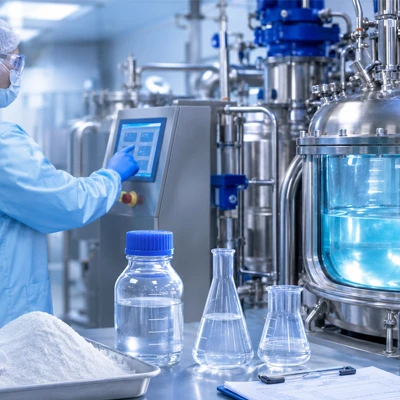
Critical Considerations for Buffer Preparation in Biomanufacturing: Scale-Up, Compliance, and Outsourcing Strategies
Buffer preparation is a foundational element of biomanufacturing that directly impacts product quality, process consistency, and regulatory compliance. As biologics, cell and gene therapies, and mRNA-based products continue to reshape the pharmaceutical landscape, manufacturers face increasing pressure to scale buffer operations while maintaining GMP standards and operational efficiency. This article explores the critical aspects of buffer preparation, including scale-up challenges, regulatory requirements, outsourcing strategies, and emerging technologies that support modern biomanufacturing.
Critical Considerations for Buffer Preparation in Biomanufacturing: Scale-Up, Compliance, and Outsourcing Strategies
Biopharmaceutical manufacturing has evolved significantly over the past decade, driven by breakthroughs in monoclonal antibodies, vaccines, recombinant proteins, cell and gene therapies (CGTs), and nucleic acid-based therapeutics. While much attention is often focused on active pharmaceutical ingredients (APIs), cell cultures, and downstream purification technologies, one essential component quietly supports every stage of production—buffer preparation.
Buffers maintain the optimal pH, conductivity, and chemical environment required throughout upstream and downstream processing. They are used in media preparation, chromatography, filtration, viral inactivation, cleaning, and formulation processes. A poorly prepared buffer can compromise product quality, reduce yields, interrupt production schedules, and trigger costly batch failures.
As manufacturing scales from laboratory research to commercial production, buffer preparation becomes increasingly complex. Organizations must balance production flexibility, regulatory compliance, sustainability goals, and cost efficiency while ensuring uninterrupted supply.
Today, many manufacturers are reevaluating traditional in-house operations and increasingly adopting Outsourced Buffer Preparation for Biomanufacturing to improve scalability, reduce operational burdens, and accelerate product commercialization.
Why Buffer Preparation Matters More Than Ever
Every biologics manufacturing process relies on dozens—sometimes hundreds—of buffer solutions. Unlike conventional pharmaceutical manufacturing, biologics involve living systems that are highly sensitive to environmental changes.
Critical process steps dependent on buffers include:
- Cell culture media preparation
- Chromatography purification
- Protein stabilization
- Viral filtration
- Ultrafiltration and diafiltration
- Product formulation
- Equipment cleaning and sanitization
Even minor variations in pH, osmolarity, conductivity, or ionic strength can significantly affect protein structure, purification efficiency, and product stability.
As therapeutic pipelines become more diverse, manufacturers require flexible buffer strategies capable of supporting multiple products across different production scales.
Scale-Up Challenges in Buffer Preparation
Moving from pilot-scale production to commercial manufacturing is rarely a straightforward expansion of volume. Buffer preparation presents several technical and operational challenges during scale-up.
Managing Larger Buffer Volumes
Commercial biomanufacturing often requires thousands of liters of buffer for a single production batch. Larger volumes increase complexity in:
- Mixing efficiency
- Powder dissolution
- Temperature control
- Homogeneity validation
- Storage logistics
Maintaining identical buffer characteristics across significantly larger volumes requires carefully engineered preparation systems.
Raw Material Quality
Buffer quality begins with raw material selection. Manufacturers must verify:
- Pharmaceutical-grade chemicals
- Supplier qualification
- Traceability
- Batch consistency
- Contamination control
Changes in raw material suppliers can affect buffer performance and regulatory documentation.
Equipment Selection
Buffer preparation equipment must support:
- Automated mixing
- Precise dosing
- Real-time monitoring
- Closed processing
- CIP/SIP compatibility
Modern facilities increasingly deploy single-use mixing systems that improve flexibility while reducing cleaning validation requirements.
Process Standardization
As production expands across multiple manufacturing sites, standardized buffer preparation procedures become essential for maintaining consistent product quality worldwide.
GMP Buffer Preparation: A Regulatory Imperative
Regulatory agencies expect manufacturers to demonstrate complete control over buffer preparation processes. GMP Buffer Preparation extends beyond simply following standard operating procedures—it encompasses comprehensive quality systems designed to ensure product safety and consistency.
Key GMP considerations include:
Documentation
Every preparation step should be documented, including:
- Material lot numbers
- Weighing records
- Mixing times
- Temperature
- pH adjustments
- Conductivity measurements
- Final release testing
Equipment Qualification
Preparation systems require:
- Installation Qualification (IQ)
- Operational Qualification (OQ)
- Performance Qualification (PQ)
Routine calibration and preventive maintenance further support compliance.
Personnel Training
Operators should receive ongoing training covering:
- GMP principles
- Contamination prevention
- Equipment operation
- Documentation practices
- Deviation management
Quality Control Testing
Finished buffers undergo testing for:
- pH
- Conductivity
- Osmolality
- Microbial contamination
- Endotoxin levels
- Appearance
Consistent analytical verification ensures process reliability before buffers enter production.
Scale Smarter with Proven Buffer Preparation Strategies
As buffer preparation becomes increasingly complex during commercial scale-up, selecting the right operational strategy is critical for maintaining efficiency, compliance, and production flexibility.
Looking for practical guidance?
Thermo Fisher Scientific's white paper explores proven approaches for optimizing scalable buffer preparation, covering topics such as buffer volume planning, GMP material specifications, storage and stability, flexible manufacturing workflows, and sustainable production practices. Whether evaluating in-house operations or outsourced models, the guide provides valuable insights for improving operational performance while reducing manufacturing risks.
Explore the white paper: https://www.pharmafocuseurope.com/promotion/thermofisher-maximizing-scale-up-white-paper
The Growing Role of Outsourcing in Buffer Manufacturing
As biologics pipelines expand, many organizations are reconsidering whether buffer preparation should remain an internal activity.
Increasingly, companies are adopting Outsourced Buffer Preparation for Biomanufacturing to gain operational flexibility while allowing internal teams to focus on core manufacturing activities.
Outsourcing offers advantages including:
- Reduced capital investment
- Lower facility utilization
- Faster production scaling
- Improved resource allocation
- Access to specialized expertise
Rather than building dedicated buffer preparation infrastructure, manufacturers can leverage experienced external partners capable of delivering validated buffer solutions.
Contract Buffer Manufacturing: Meeting Modern Production Demands
The rise of specialized service providers has accelerated adoption of Contract Buffer Manufacturing across the biopharmaceutical industry.
Contract manufacturers provide comprehensive capabilities including:
- Buffer formulation
- Large-scale preparation
- Sterile filtration
- Packaging
- Quality testing
- Documentation support
- Global logistics
These providers often operate highly automated GMP-compliant facilities designed specifically for buffer production.
Benefits include:
Increased Manufacturing Capacity
Buffer production no longer competes with critical manufacturing operations for facility space.
Reduced Operational Risk
Experienced providers maintain validated systems, minimizing process variability.
Faster Project Timelines
Companies launching clinical or commercial products can avoid lengthy facility expansion projects.
Regulatory Expertise
Established providers possess extensive experience supporting regulatory inspections and customer audits.
Buffer Outsourcing for CDMOs
Contract Development and Manufacturing Organizations (CDMOs) face unique operational challenges. They manage multiple customer projects simultaneously, each with different formulations, production schedules, and quality requirements.
For these organizations, Buffer Outsourcing for CDMOs has become an increasingly attractive strategy.
Benefits include:
Improved Facility Utilization
Production suites remain dedicated to high-value manufacturing instead of buffer preparation.
Greater Scheduling Flexibility
External suppliers can deliver buffers according to changing manufacturing timelines.
Reduced Inventory Management
Just-in-time buffer delivery decreases storage requirements.
Enhanced Customer Responsiveness
CDMOs can rapidly onboard new projects without expanding infrastructure.
Outsourcing also supports multi-product facilities where cleaning validation and changeover times can become operational bottlenecks.
Custom Buffer Formulation Services for Specialized Therapies
Modern therapeutics increasingly require highly specialized buffer systems.
Standard formulations may no longer meet the needs of:
- Cell therapies
- Gene therapies
- mRNA vaccines
- Viral vectors
- Personalized medicines
- Protein therapeutics
As a result, demand for Custom Buffer Formulation Services continues to grow.
These services may include:
- Formulation optimization
- Stability studies
- Analytical development
- Scale-up support
- Regulatory documentation
- Process validation
Customized formulations help manufacturers maximize product stability while meeting unique manufacturing requirements.
Digitalization and Automation in Buffer Preparation
Industry 4.0 technologies are transforming buffer manufacturing.
Modern systems now integrate:
- Automated recipe management
- Real-time monitoring
- Electronic batch records
- Process analytics
- Digital quality documentation
- Predictive maintenance
Automation reduces manual intervention while improving consistency across production batches.
Advanced sensors continuously monitor:
- pH
- Conductivity
- Temperature
- Mixing performance
- Solution concentration
These digital capabilities strengthen regulatory compliance while supporting data-driven process optimization.
Sustainability Considerations
Environmental sustainability has become a strategic priority across biopharmaceutical manufacturing.
Buffer preparation contributes significantly to:
- Water consumption
- Energy usage
- Chemical waste
- Packaging waste
Manufacturers are implementing several sustainability initiatives, including:
- Buffer concentrates
- Single-pass preparation systems
- Optimized batch sizing
- Water recycling
- Energy-efficient mixing technologies
- Single-use systems where appropriate
Outsourcing can also reduce environmental impact by consolidating production into highly efficient centralized facilities.
Risk Management throughout the Buffer Lifecycle
Effective risk management extends across the entire buffer preparation process.
Potential risks include:
- Raw material shortages
- Microbial contamination
- Mixing failures
- Equipment downtime
- Documentation errors
- Transportation delays
Organizations increasingly perform comprehensive risk assessments covering:
- Supplier qualification
- Business continuity planning
- Secondary sourcing
- Inventory management
- Transportation validation
- Process redundancy
Well-defined contingency plans reduce disruptions that could delay manufacturing campaigns.
Choosing the Right Outsourcing Partner
Selecting a buffer manufacturing partner requires more than evaluating production capacity.
Important considerations include:
GMP Compliance
The provider should demonstrate mature quality systems supported by successful regulatory inspections.
Technical Expertise
Experience across multiple therapeutic modalities provides greater flexibility for evolving projects.
Scalability
The partner should support development, clinical, and commercial manufacturing without requiring technology transfer.
Global Supply Chain
Reliable logistics capabilities ensure uninterrupted buffer availability across manufacturing locations.
Quality Systems
Comprehensive documentation, change control, deviation management, and analytical testing are essential.
Long-term strategic partnerships often provide greater value than transactional supplier relationships.
Future Trends in Buffer Preparation
Several trends are expected to shape the future of buffer manufacturing:
- Increased adoption of continuous bioprocessing
- Greater automation through artificial intelligence
- Expanded use of digital twins
- Modular manufacturing facilities
- Smart inventory management
- Higher demand for personalized formulations
- Growth in outsourced manufacturing ecosystems
As therapeutic pipelines become increasingly diverse, buffer preparation strategies must evolve to support greater flexibility while maintaining stringent quality standards.
Manufacturers that embrace digital technologies, standardized workflows, and strategic outsourcing will be better positioned to meet future production demands.
Conclusion
Buffer preparation is no longer a routine operational activity—it has become a strategic pillar of successful biomanufacturing. As biologics manufacturing scales globally and advanced therapies continue to emerge, organizations must ensure that buffer processes are robust, compliant, and capable of supporting increasingly complex production requirements.
Implementing GMP Buffer Preparation, leveraging Custom Buffer Formulation Services, adopting Contract Buffer Manufacturing, and embracing Outsourced Buffer Preparation for Biomanufacturing enable manufacturers to improve operational efficiency while maintaining product quality and regulatory compliance. Likewise, Buffer Outsourcing for CDMOs provides the flexibility needed to optimize facility utilization and accelerate project delivery.
By integrating scalable technologies, digital process control, sustainability initiatives, and strategic outsourcing partnerships, biopharmaceutical companies can build resilient manufacturing operations that support innovation while delivering safe, high-quality therapies to patients worldwide.