Sponsored by:

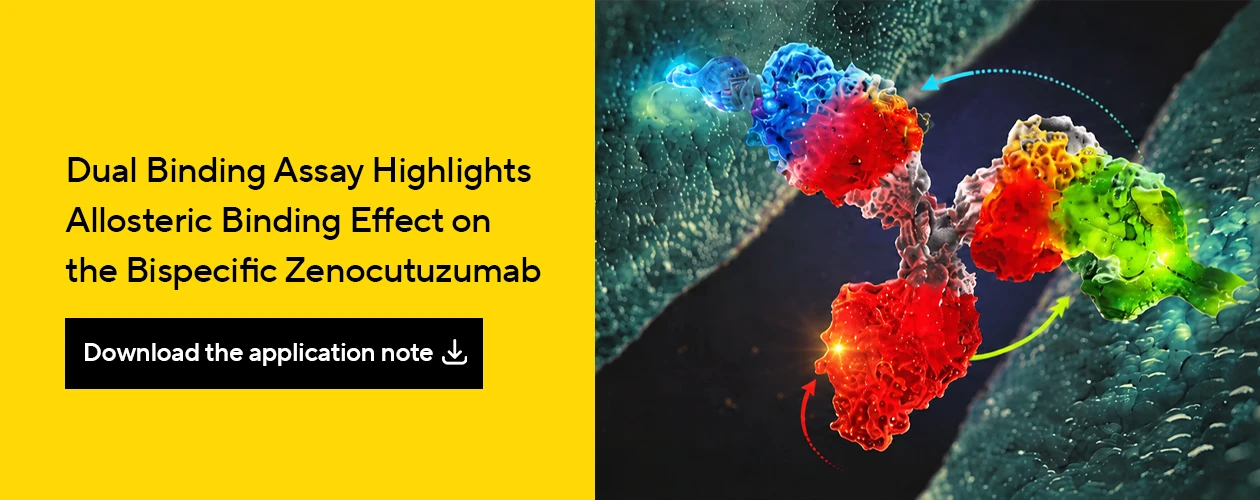
Bispecific Molecules: Advancing Precision Therapeutics Through Dual-Target Binding and Biolayer Interferometry
Bispecific molecules are designed to bind two targets, but in practice one binding event can modulate the other. This application note shows how Octet BLI based assay formats enable a more quantitative functional characterization of bispecifics beyond a simple “binds/doesn’t bind” outcome.
Bispecific molecules are designed to bind two targets, but in practice one binding event can modulate the other. This application note shows how Octet BLI based assay formats enable a more quantitative functional characterization of bispecifics beyond a simple “binds/doesn’t bind” outcome.
Using a HER2 × HER3 bispecific antibody (zenocutuzumab) as an example, we demonstrate a dual binding approach that measures both interactions within a single workflow and compares sequential binding (A→B vs B→A) to reveal binding order effects that conventional endpoint assays may fail to detect. The study also shows how the same format can be adapted to estimate the proportion of correctly-assembled, functionally active dual binding bispecific species in mixed samples during protein engineering and optimization.
Key Takeaways
- Dual binding in a single assay workflow: Assess binding to both targets in one Octet BLI experiment.
- Binding order and interdependence insight: Compare A→B vs B→A binding sequences to evaluate interdependence and binding order effects.
- Quantification of functional bispecific content: Estimate changes in the fraction of correctly assembled bispecifics with functional dual binding during optimization.