Post-Translational Modifications in Drug Discovery: From Molecular Regulation to Clinical Impact
For decades, the central dogma of molecular biology has anchored our understanding of cellular function: DNA to RNA to protein. But this linear view is incomplete. A growing body of evidence shows that much of biology's complexity is written after a protein is made, through chemical alterations known as post-translational modifications (PTMs). More than 650 distinct PTM types have now been identified, including well-known modifications such as phosphorylation, acetylation, methylation, ubiquitination, and glycosylation. Far from being minor biochemical footnotes, PTMs govern protein activity, stability, localization, and interactions. They are central regulators of nearly every cellular process, and increasingly, of disease itself.
Dysregulated PTMs are now recognized as hallmarks of major disease areas. In cancer, aberrant phosphorylation drives oncogenic signaling through receptors like EGFR, while faulty ubiquitination can stabilize tumor-promoting proteins or degrade tumor suppressors. In Alzheimer's disease, hyperphosphorylation of tau underlies neurofibrillary tangle formation. In Parkinson's disease, phosphorylation and ubiquitination of alpha-synuclein drive pathogenic aggregation. PTMs also sit at the heart of metabolic disorders such as type 2 diabetes, as well as inflammatory and autoimmune conditions, where they shape immune gene expression and signaling intensity. This broad reach makes PTMs an unusually rich source of drug targets and biomarkers.
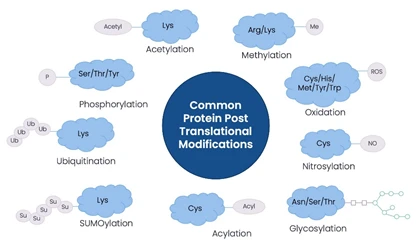
Figure: Common types of post-translational modifications
Targeting PTMs, however, is not straightforward. Four challenges stand out:
- Dynamic and reversible regulation: PTMs are governed by opposing enzyme pairs, such as kinases and phosphatases, making them constantly moving targets.
- Detection limitations: many PTMs occur at low, sub-stoichiometric abundance, which strains even advanced mass spectrometry and enrichment techniques.
- Off-target effects: drugs that modulate PTM-regulating enzymes, particularly kinase inhibitors, can act across many tissues and pathways, producing unintended side effects.
- Context dependence: a single PTM can have opposite functional consequences depending on tissue and disease context. STAT3 phosphorylation, for instance, promotes tumor growth in breast and lung cancer but suppresses it in colorectal cancer.
Meeting these challenges requires a complementary analytical toolkit. Mass spectrometry remains the gold standard for unbiased, site-specific PTM discovery, while antibody-based methods such as ELISA and immunofluorescence support validation, targeted screening, and spatial localization. No single technique covers every need, so modern PTM research increasingly integrates biochemical, imaging, and computational approaches side by side.
Despite these hurdles, PTMs have already reshaped drug discovery and development. They inform target identification and validation, as seen in the clinical success of kinase inhibitors like Imatinib. PTM signatures, from phosphorylated tau to altered glycans, serve as powerful diagnostic and prognostic biomarkers. PTMs also explain mechanisms of drug action and resistance, and they guide the design and quality control of biologics and biosimilars, notably antibody glycosylation. They are engineered directly into therapeutics to improve stability and half-life, as with PEGylation and Fc-fusion approaches. Emerging modalities such as PROTACs, molecular glues, and other targeted protein degradation technologies exploit the ubiquitin-proteasome system to eliminate previously “undruggable” disease proteins altogether.
Looking ahead, artificial intelligence and machine learning are transforming PTM research. Deep learning frameworks, increasingly combined with AlphaFold-derived structural models, can predict PTM sites, model how modifications reshape drug-binding pockets, and support explainable, interpretable predictions that build clinical trust. These tools are also informing next-generation biotherapeutics, including CAR-T cell engineering, where modulating PTMs such as palmitoylation can reduce T-cell exhaustion and improve therapeutic durability.
As personalized medicine moves beyond static genomic profiles toward dynamic, functional readouts of protein activity, PTMs are emerging as an essential lens on disease biology. Recognizing this shift, Excelra has developed a curated PTM-focused database that unifies modification sites, regulatory enzymes, and disease associations into a single, actionable framework, helping researchers translate the growing complexity of the “PTM code” into precise, real-world therapeutic strategies.
Want the full picture? Download the complete whitepaper for the full analysis, including detailed disease tables, FDA-approved PTM-targeted drugs, and emerging AI/ML prediction tools: Download the Whitepaper
Download '.pdf' Format of the whitepaper.