The landscape of pharmaceutical development has undergone significant transformation over the past ten years. The industry now operates with two distinct models. First are the major biopharmaceutical corporations that vertically integrate the complete drug development pipeline from initial discovery through market launch, employing robust internal control mechanisms throughout their organizational structure. In contrast, a significant portion of early-stage development work is increasingly being conducted by emerging biotech organizations of small to medium size, many functioning as virtual enterprises with minimal physical infrastructure.
These more compact organizations encounter distinct objectives, motivations, and obstacles when compared to established pharmaceutical companies. Rather than pursuing full commercialization of a novel therapeutic, their strategic aim often involves generating sufficient scientific interest to facilitate acquisition of their assets or the entire business entity. Unlike larger firms with specialized development teams, responsibility typically concentrates among a handful of key personnel, sometimes consolidated to a single individual. As a result, these companies rely on contract development/manufacturing partners and independent consultants to develop stage-appropriate chemistry, manufacturing, and controls (CMC) strategies that correspond with their particular business goals. Crafting effective CMC programs for such companies represents a distinctive challenge requiring individualized approaches, as standardized templates prove inadequate. The development of suitable programs necessitates careful consideration of multiple variables including financial resources, regulatory guidance, and strategic timing constraints.
In CMC development, the segmented model is vulnerable to knowledge loss and strategic inconsistency when frequent acquisitions occur, as new management may shift direction based on incomplete information gathered during due diligence. Stemming from differences of end goals in the segmented model, the final few handovers from Phase 3 to scale up and commercialization become critical for product quality. Early development in this case may not follow comprehensive experimental frameworks similar to large corporations. Therefore, any loss of knowledge, lack of risk assessments and absence of data can have potentially detrimental impact on product robustness if not launch.
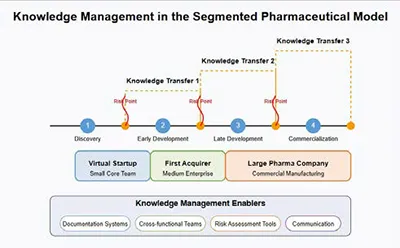
The trio of mutually supportive ICH guidelines (Q8, Q9, and Q10) collectively address quality and risk management in pharmaceutical development and manufacturing processes. Q8 outlines pharmaceutical development through Quality by Design principles, focusing on understanding product attributes and process parameters to ensure consistent quality; Q9 provides a framework for quality risk management to identify, assess, and control risks throughout the product lifecycle; and Q10 establishes a comprehensive pharmaceutical quality system that incorporates the elements of Q8 and Q9 while emphasizing continual improvement. It's important to note that these ICH guidelines represent recommended best practices rather than strict regulatory requirements, offering flexibility in implementation approaches. Smaller pharmaceutical companies often face implementation challenges due to limited resources, segmented business models, and project-based operations at third party organizations that may not align with the comprehensive frameworks designed with larger, integrated operations in mind. This presents a potential risk specially in late-stage manufacturing process development where lack of an early Drug Substance (DS) or Drug Product (DP) optimization strategy could result in failures at scale and during process validation. Therefore, guidelines and industry standards in CMC development must be looked at from a new lens of making them work for the segmented business model such that small virtual entities can adapt and ensure clinical and well as commercial success.
The realization of this holistic approach focuses on several key areas:
The Enablers:
ICH Q10 describes knowledge management and quality risk management as the enablers for implementing robust Pharmaceutical Quality System. These are of increased importance in an acquisition scenario based on how far along the product is in the clinic. A study "Role of Knowledge Management in Development and Lifecycle Management of Biopharmaceuticals" highlights knowledge management (KM) as a critical enabler for quality in biopharmaceutical production. In the Quality by Design (QbD) paradigm, organizations need structured KM strategies to effectively review, utilize, and transfer knowledge from disparate sources to assess critical quality attributes and facilitate continuous improvement. Organizations need well-defined KM indicators and frameworks to measure success and guide implementation. Defining a KM strategy is crucial because it provides direction for organizations to handle uncertainty in rapidly evolving environments. An effective strategy helps pharmaceutical companies integrate knowledge from four key sources: prior knowledge, development studies, technology transfer, and manufacturing experience. Strategic KM approaches can transform tacit knowledge into explicit information, enhance innovation, facilitate regulatory compliance, and ultimately accelerate development and commercialization of biopharmaceuticals through improved process understanding.
Begin with the end in mind:
The ICH Q8 (R2) guideline outlines a comprehensive framework for developing pharmaceutical products with consistent quality. Here's a concise overview focusing on how smaller companies can implement these principles efficiently:
The guideline emphasizes that quality cannot be tested into products but must be built in by design. It introduces Quality by Design (QbD), a systematic approach that begins with predefined objectives and emphasizes product and process understanding. This forms the basis of safeguarding a program in a segmented business model from changing ownership and tech transfer scenarios. Key Development Elements include:
1. Quality Target Product Profile (QTPP): Define the desired quality characteristics considering safety, efficacy, and route of administration, dosage form, and stability. Small companies should invest time upfront establishing this profile to provide clear direction.
2. Critical Quality Attributes (CQAs): Identify physical, chemical, biological, or microbiological properties that should be within appropriate limits to ensure product quality. Focus on identifying the truly critical attributes rather than trying to control everything.
3. Risk Assessment: Use science-based risk management to identify which material attributes and process parameters may affect product CQAs. Prioritize by focusing on high-risk areas first.
4. Design Space: Establish the multidimensional combination of input variables and process parameters that provide assurance of quality. Working within this space is not considered a change, offering operational flexibility. Small companies can define narrower but adequate design spaces to simplify operations.
5. Control Strategy: Develop a planned set of controls derived from product and process understanding. A well-designed control strategy allows smaller companies to efficiently ensure quality without excessive testing.
Manufacturing Process Development
The guideline emphasizes selecting manufacturing processes based on critical formulation attributes and available equipment. Process development should identify critical parameters that require monitoring or control. Companies with limited resources should focus on understanding critical process parameters rather than exhaustive studies of all variables.
Implementation Approaches
The guideline provides flexibility in implementation, acknowledging both minimal and enhanced approaches:
• Minimal Approach: Primarily empirical, with fixed processes and end-product testing focus
• Enhanced Approach: Systematic with multivariate experiments, adjustable processes within design space, and risk-based control strategies
Small companies can adopt a hybrid approach, implementing enhanced methods for critical aspects while using minimal approaches elsewhere.
Maximum Impact with Limited Resources
1. Prioritize Risk: Focus resources on highest-risk aspects of your product and process
2. Start Simple: Begin with simplified design spaces and expand as understanding increases
3. Leverage Prior Knowledge: Use existing knowledge and platform technologies where possible
4. Strategic Testing: Design experiments to maximize information while minimizing resource use
5. Focus on Control Strategy: A well-designed control strategy can compensate for limitations in other areas
This helps create a framework that can be scaled to fit different organizational capabilities while maintaining quality standards.
Identify and Manage risk:
The ICH Q9 quality risk management guideline offers a comprehensive framework for pharmaceutical companies to systematically handle quality risks. For modest-sized organizations with limited resources, adapting this framework requires strategic focus rather than attempting full-scale implementation. The essence of quality risk management lies in its scientific approach to decision-making that prioritizes patient safety through the assessment, control, communication, and review of quality risks.
Firms should embrace the guideline's core philosophy that the level of formality, documentation, and effort should correspond to the significance of the risk. This principle allows for flexible implementation tailored to company size and resources. Rather than viewing quality risk management as an additional regulatory burden, one should see it as a way to allocate their limited resources more effectively.
The process begins with clearly articulating what constitutes a risk to product quality. Manufacturers benefit from focusing on identifying hazards specific to their operations and products, using simple assessment techniques to determine likelihood and severity. A pragmatic approach involves categorizing risks using qualitative descriptors such as "high," "medium," and "low" to create a manageable framework for prioritization.
Risk control represents the area where virtual companies can achieve the greatest impact. By directing resources toward mitigating the most significant risks first, organizations can maximize quality improvements while maintaining operational efficiency. The key is developing appropriate risk acceptance criteria that balance regulatory compliance with practical business considerations.
Communication serves as the connective tissue of effective risk management. Even in compact businesses, establishing clear channels for sharing risk information between stakeholders ensures consistent understanding of quality priorities. This doesn't require sophisticated systems—regular team meetings and straightforward documentation can suffice. The ongoing nature of risk management demands periodic review, but small groups can tailor the frequency based on risk severity. Higher-risk areas warrant more frequent reassessment, while stable processes with established controls might require less frequent attention. Rather than implementing all available risk management tools, these entities should select methods appropriate to their context. Simple facilitation techniques like flowcharts and checklists offer structured approaches without excessive resource demands. For critical processes, more detailed methods like Failure Mode Effects Analysis can be selectively applied.
Integration into existing quality systems represents another opportunity for efficiency. Specialized manufacturers should incorporate risk thinking into current procedures rather than creating parallel systems. This might involve adding risk assessment components to change control procedures, supplier evaluations, or production planning. Implementation works best when starting small—perhaps with a single critical process—and expanding gradually. Cross-functional input remains important even in compact teams, as diverse perspectives strengthen risk identification and assessment. Documentation should be streamlined but sufficient to demonstrate thoughtful risk-based decision making. Templates and standardized formats help maintain consistency without creating burdensome paperwork. The focus should remain on documenting decisions that impact product quality rather than documenting for documentation's sake.
Ultimately, quality risk management for pharmaceutical startups works best when viewed as a way of thinking rather than a separate activity. By focusing efforts where they matter most, independent producers can achieve regulatory compliance while improving product quality and patient safety—proving that effective risk management isn't about company size but about strategic implementation.
Conclusion: The Human Element as the Critical Success Factor
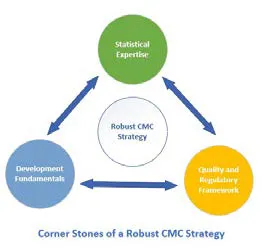
The segmented business model of pharmaceutical development presents unique challenges for small, virtual companies navigating the complex landscape of drug development. While ICH guidelines Q8, Q9, and Q10 provide valuable frameworks for quality management, their implementation requires more than technical knowledge—it demands exceptional human skills within matrix teams where diverse expertise converges. The success of small pharmaceutical companies hinges on the seamless integration of multidisciplinary perspectives. When statisticians, formulation scientists, manufacturing specialists, and regulatory experts collaborate effectively, they create an ecosystem where knowledge preservation and strategic consistency become self-sustaining despite organizational transitions. This collaborative framework serves as a safety net against the knowledge fragmentation that often occurs during acquisitions or handoffs. Matrix teams in virtual pharmaceutical companies must develop unique competencies beyond technical expertise. The statistician who can translate complex data into actionable insights for formulation scientists, the manufacturing specialist who anticipates scale-up challenges during early development, and the regulatory expert who builds quality considerations into every process—these professionals transcend traditional role boundaries to ensure product success.
Effective communication stands as perhaps the most critical skill in this environment. Team members must possess the ability to translate their specialized knowledge into language accessible to colleagues from different disciplines. This translation capability ensures that critical information isn't lost during knowledge transfers and that risk assessments remain comprehensive rather than siloed. Leadership in this context requires cultivating a culture where knowledge sharing is valued and rewarded. Small company executives must recognize that their greatest asset isn't just the molecule—it's the collective understanding of that molecule's behavior across different conditions and scales. Leaders who facilitate transparent communication, encourage thorough documentation, and prioritize knowledge management create the conditions for successful technology transfers and scale-up operations.
The most successful small pharmaceutical companies approach CMC development with a dual mindset: technical rigor paired with cross functional intelligence. They build networks of expertise that extend beyond company boundaries to include contract partners and consultants who become extensions of their core team. These relationships, when managed effectively, provide access to specialized knowledge and capabilities without requiring massive internal infrastructure.
As the pharmaceutical landscape continues to evolve, the small companies that thrive will be those that invest in developing both the technical systems and people skills necessary to implement ICH guidelines in practical, resource-conscious ways. By fostering environments where cross-functional expertise converges seamlessly, these organizations can deliver innovative therapies that maintain quality throughout development, scale-up, and commercialization—ultimately fulfilling their promise to patients regardless of organizational transitions.
References:
1. Rathore AS, Garcia-Aponte OF, Golabgir A, Vallejo-Diaz BM, Herwig C. Role of Knowledge Management in Development and Lifecycle Management of Biopharmaceuticals. Pharm Res. 2017 Feb;34(2):243-256. doi: 10.1007/s11095-016-2043-9. Epub 2016 Oct 26. PMID: 27785590; PMCID: PMC5236082.
2. ICH Q8: "Pharmaceutical Development" (ICH Q8(R2))
3. ICH Q9: "Quality Risk Management" (ICH Q9)
4. ICH Q10: "Pharmaceutical Quality System" (ICH Q10)