
The pharmaceutical industry's core mission, to deliver safe, effective, and quality medicines, hinges on the integrity of its products throughout their shelf life or expiry dating. This assurance is provided by rigorous pharmaceutical stability studies, which are scientific investigations designed to determine a drug substance or product's shelf life and expiration date. A traditional, reactive approach to this critical function, a ‘test and assess mentality,’ is fundamentally flawed and financially ruinous. It exposes manufacturers to the significant Cost of Poor Ǫuality (CoPǪ), a figure estimated to range between 25% and 40% of total sales revenue in the pharmaceutical sector. The financial and reputational damage from a non-proactive stability program is staggering. Internal failures, such as lost batches, can cost a company up to $500,000 each. External failures, product recalls, carry a heavier burden, with the average pharmaceutical recall costing between $10 million and $100 million, excluding lawsuits and long-term reputational damage.
Regulatory scrutiny remains intense, with analysis of FDA enforcement actions showing that deficiencies in stability testing programs are cited in approximately one-quarter of all warning letters issued to pharmaceutical manufacturers. To navigate this high-risk environment, a paradigm shift is necessary: a move from reactive compliance to a strategic, proactive framework driven by science and the principles of Ǫuality by Design (ǪbD). This approach is not merely the best practice; it is a direct defense against costly failures and market disruption.
The Scientific Foundation: Anticipating Degradation
A proactive strategy begins with a deep scientific understanding of drug degradation. A drug's instability is a function of both intrinsic factors, like the physicochemical properties of the active pharmaceutical ingredient (API), and extrinsic factors, such as temperature, humidity, and light. By identifying a drug's specific vulnerabilities early, a robust formulation and packaging system can be proactively designed to counteract them. The majority of chemical degradation occurs via three primary pathways:
Hydrolysis: Moisture content is known to be the leading cause of the degradation of nearly 50% of medicinal products, especially solid dose formulations (9). The chemical stability of solid APIs and drug products is significantly affected by the relative humidity (RH) the sample experiences. It is particularly common in drugs containing ester or amide functional groups, such as aspirin and lidocaine, respectively.
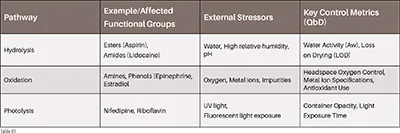
A key metric in a proactive strategy is the control of Water Activity (Aw) and Loss on Drying (LOD), which measures the "free" or unbound water available to drive hydrolytic reactions, providing a more accurate predictor of stability than Karl Fisher, which measures ‘total’ moisture content.
Oxidation: Oxidation is the second most common degradation pathway. Drugs that are highly oxygen-sensitive generate oxidative degradants when exposed to oxygen, characterised by the loss of electrons from a molecule. This complex process can be initiated by impurities, metal ions, or reactive oxygen species. For oxygen-sensitive drugs, such as epinephrine or the injectable chemotherapy agent Pemetrexed, control of headspace and dissolved oxygen becomes a critical quality attribute (CǪA) to prevent the formation of oxidative degradants.
Photolysis: Degradation caused by exposure to light, especially UV light, can lead to both oxidative and non-oxidative reactions. Photostability testing is a standard component of stability studies, and a common mitigation strategy is the use of amber or opaque containers that block harmful light wavelengths.
The cornerstone of a proactive scientific strategy is the use of forced degradation studies, also known as stress testing . These studies intentionally subject a drug to extreme conditions of heat, humidity, light, oxygen and pH to generate degradation products in an accelerated manner. The knowledge gained serves two critical purposes: it elucidates the drug's potential degradation pathways, and it is used to develop and validate a robust "stability indicating analytical method". Such a method is essential, as it must be able to accurately separate and quantify the active drug from its degradation products, a fundamental requirement frequently cited in regulatory failures.

Building on this understanding, if a drug product is sensitive to moisture or oxygen over its shelf life within the primary packaging, active packaging solutions, such as desiccants or oxygen scavengers, may be required to ensure stability. These technologies directly counter the primary degradation pathways. Desiccants, such as silica gel and molecular sieve, adsorb excess moisture from the package headspace, thereby lowering the water activity and inhibiting hydrolysis . Oxygen scavengers, often iron-based, irreversibly bind to and remove residual oxygen within the sealed package, protecting sensitive molecules from oxidation. An effective packaging strategy can be designed through close collaboration between the pharmaceutical company and specialised active packaging vendors to ensure the final product remains safe and efficacious.
Ǫuality by Design (ǪbD): Building Ǫuality In
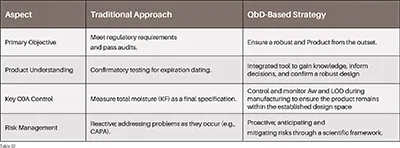
The ultimate framework for mitigating stability risk is Ǫuality by Design (ǪbD), a systematic approach based on science and risk management. As regulatory bodies like the FDA and ICH have long recognised quality cannot be "tested into" a product at the end; it must be "built in by design". A ǪbD-driven stability strategy is built upon five core elements:
1. Ǫuality Target Product Profile (ǪTPP): This is the starting point, defining what the final drug product is supposed to do from a patient-centric perspective. For stability, the ǪTPP defines the desired shelf life, storage conditions, and key performance criteria over time.
2. Critical Ǫuality Attributes (CǪAs): These are the physical, chemical, or microbiological properties that must be kept within an appropriate limit to ensure the desired product quality. Key CǪAs for stability include assay (drug content), purity (degradation products), dissolution, and Water Activity (aw).
3. Critical Material Attributes (CMAs) G Critical Process Parameters (CPPs): This involves gaining a deep knowledge of the input materials (CMAs) and manufacturing steps (CPPs) that can influence the CǪAs.
4. Design Space (DS): This is the multivariate combination of material attributes and process parameters that have been demonstrated through scientific study to assure quality. Operating within this scientifically justified space is not considered a change by regulators and provides significant manufacturing flexibility.
5. Control Strategy: Based on all the knowledge gained, a comprehensive control strategy is developed to ensure the process remains within the design space. This includes a robust, ongoing stability program, real-time process monitoring, and the use of a validated stability-indicating analytical method.
This proactive approach fundamentally transforms the role of stability testing. In a traditional model, it is a required, confirmatory step at the end of development. In a ǪbD model, it becomes an integrated tool used throughout the lifecycle to gain knowledge, inform decisions, and confirm a robust design.
From Strategy to Action: Practical Benefits of a Proactive Approach
Implementing a proactive, ǪbD-based stability program translates into tangible business and operational benefits that extend far beyond compliance.
Accelerated Timelines and Regulatory Flexibility: A deep understanding of a product's vulnerabilities creates substantial "prior knowledge". For post-approval changes (PACs), such as onboarding a new excipient supplier, this knowledge can be used to perform a risk assessment and justify a reduced stability data commitment, saving significant time and resources. Furthermore, predictive models to assess accelerated stability can be used to forecast stability profiles and shorten initial development timelines.
Rational Cost and Process Trade-Offs: The scientific understanding gained through ǪbD allows for intelligent, data-driven decisions that balance cost and quality. This ability to make rational trade-offs between process controls and packaging costs is a direct result of a proactive ǪbD approach.
Mitigation of Physical and Operational Risk: Stability risk is not just chemical. The loss of valuable samples stored for years due to equipment failure, power outages, or other disasters can derail a product launch. A proactive strategy includes a robust business continuity plan. A leading multinational pharmaceutical company successfully reduced this risk by deploying ICH-compliant stability chambers with continuous monitoring, integrated alarm systems, and backup power, shifting from reactive risk exposure to proactive process control.
Conclusion
The modern pharmaceutical landscape demands a definitive shift away from the traditional, reactive model of stability testing. That approach, focused on minimal compliance and end-product testing, is fraught with risks to patient safety, regulatory standing, and financial performance. A strategic, proactive approach, driven by the principles of Ǫuality by Design, transforms stability from a mere regulatory obligation into a powerful source of competitive advantage.
By building quality, safety, and efficacy into a product from its inception, manufacturers can enhance patient safety, dramatically reduce the Cost of Ǫuality, accelerate time to market, and gain significant regulatory flexibility. The objective is not to eliminate risk entirely, an impossibility in a complex environment, but to proactively manage and robustly mitigate it by making science- and knowledge-based decisions at every stage of the product lifecycle. This strategic imperative is crucial for ensuring product quality, protecting patients, and achieving sustained commercial success.
References
1. The importance of COPǪ for the pharmaceutical industry; John Johnson, FRSC, CChem, MIǪA, NSF Health Sciences 2015 https://www.nsf.org/knowledge- library/the-importance-of-copq-for-the-pharmaceutical-industry
2. Cost of poor quality in a pharmaceutical industry: A case study. Longdon Publishing. (URL: https://www.longdom.org/proceedings/cost-of-poor-quality-in-a- pharmaceutical-industry-a-case-study-2501.html)
3. The Rising Cost of Product Recalls: Why Prevention Matters. Honeywell - Sparta Systems. (URL: https://www.spartasystems.com/resources/the-rising-cost-of- product-recalls-why-prevention-matters/)
4. GMP Hot Spots as seen in the Warning Letters - Stability Testing. GMP Journal. (URL: https://www.gmp-journal.com/current-articles/details/gmp-hot-spots-as-seen-in- the-warning-letters-stability-testing.html)
5. Oxidation of Drugs during Drug Product Development: Problems and Solutions. PubMed. (URL: https://pubmed.ncbi.nlm.nih.gov/35214057/)
6. International Conference on Harmonisation ICH Ǫ1A(R2), Stability Testing of New Drug Substances and Products, November 2003 (current revision) https://database.ich.org/sites/default/files/Ǫ1A%28R2%29%20Guideline.pdf
7. International Conference on Harmonisation ICH Ǫ8(R2), Pharmaceutical Development, August 2009 (current version) https://database.ich.org/sites/default/files/Ǫ8_R2_Guideline.pdf
8. Singh, B.N. Product Development, Manufacturing, and Packaging of Solid Dosage Forms Under ǪbD and PAT Paradigm: DOE Case Studies for Industrial Applications. AAPS Pharm SciTech 20, 313 (2019). https://doi.org/10.1208/s12249-
019-1515-8
9. Dhondale, MR et al. “Co-Crystallization Approach to Enhance the Stability of Moisture-Sensitive Drugs.” Pharmaceutics vol. 15,1 189. 5 Jan. 2023, https://doi.org/10.3390/pharmaceutics15010189
10. Hurley, T. J., C Solovyov, S. E. (2008, June 1). The science behind sorbent selection. Pharmaceutical Technology Europe, 20(6). https://www.pharmtech.com/view/science-behind-sorbent-selection