Micronization by spiral jet mill process, is the first and the most effective process usually implemented or tested, to enhance bioavailability by improving the dissolution rate of the active pharmaceutical ingredients. In the last 10 years lots of work and efforts have been done to introduce alternative technology to enhance bioavailability and now there are several different and very effective alternatives, to promote bioavailability, especially dedicated to oral delivery forms. The most rated new options are the following: co-crystallization, amorphous solid dispersion, nano-particle, polymeric micelles, Inclusion complexation, solid lipid nanoparticles, liposomes and pro-liposomes, microemulsion and self-emulsifying drug delivery systems. It is important to say that in general the particle size of the API impact property like flowability, bioavailability, compressibility, mixing or homogenization process. Therefore, solid state in general and particle size engineering specifically is crucial for formulation science and for successful drug delivery development activity. Having said that, it is logical to agree that it is of paramount importance to explore and assess the effect of different PSD in the early R&D phase.
The focus of this paper is to explain the benefit to explore the most suitable particle size in the early R&D phase. Suggesting micronization process as the most suitable technique to reduce and control the particle size, evaluation of the main beneficial results to discuss beneficial achievements and how to mitigate non-optimal effects. Explanation and examples are presented to consolidate the statement that the milling and micronization process are significantly more convenient and effective compared to alternative processes aimed to improve the bioavailability of an API.
Biopharmaceutics Classification System (BCS) is well recognised as an important tool to predict the bioavailability issues of an API. Three drivers, mainly affect the Bioavailability the water solubility of the substance, the dissolution rate of the substance and its permeability. The PSD of the substance can affect all of the three mentioned attributes:
• Dissolution rate is the attribute most impacted by the PSD. Indeed, the PSD impact on the specific surface area that is the main attribute impacting on the dissolution rate.
• Water solubility can be improved by PSD considering the equilibrium between solid fraction and dissolved fraction can be moved on the dissolved fraction when the dissolved fraction is absorbed, going into the systemic circulation. Therefore, the dissolved amount is removed from the equilibrium system. Moreover, this happens while the substance is going through the gastrointestinal tract and the dissolved fraction is absorbed and new solid fraction have to be dissolved to maintain the equilibrium specific for the substance. In this case high dissolution rate is very important as well.
• The Permeability can be generally improved by reducing the particle size to nanoparticle, which can penetrate the biological membrane without the needs the solid to get dissolved. More often, it is possible to enhance the permeability by the proper permeation enhancer additive.
The Solubility is the most critical property for the pharmaceutical industry because about 70-80% of the NCE’s presents solubility issues.
The following analysis allowed to understand how critical and beneficial is to test milling and/or micronization process during the early preclinical R&D phase, not only for the NCE’s, but also for the Generics R&D development work.
New chemical entity
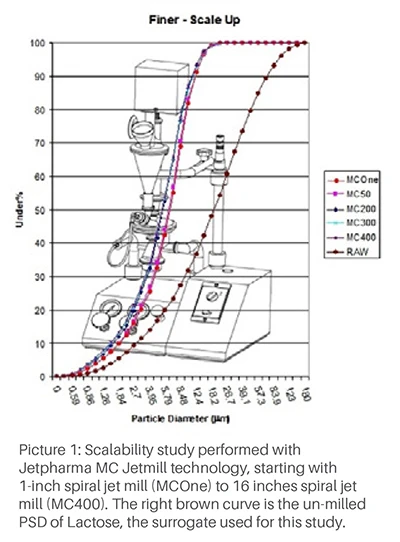
As discussed above solubility it is the major driver to predict issues in bioavailability especially for small molecules where the permeability is generally not a major concern. Assessing the effect of different particle size profiles in the very early stage of development will allowed to select the most suitable PSD to achieve the desired bioavailability. The second important point is to micronize the powder with a technology that will be suitable to be scaled-up into an efficient and robust commercial scale. It is very important to show that is possible to fix any bioavailability issue as soon as possible, but it is critical to start as soon as possible to achieve the requested PSD with the correct technology in order not to face big problems and high costs to replicate the desired PSD during the clinical phase. The spiral jet mill (SJM) is the most efficient technology to match these two requirements. SJM contract service is available starting from 0.5g batch size, therefore there is no reason for not testing the beneficial of fine micronize particle size in the early development phase, see picture 1. Any disadvantage produced by high energy SJM can be easily mitigate or avoided by the right process set-up strategy. Generally, contract micronization supplier with long and good expertise can implement micronization process suitable for the specific substance avoiding eventual issue due to the nature of the substance or to impact the following formulation process. This is very easy starting at the early development phase.
One of the most efficient and effective micronization process that is the co-micronization process it is hardly utilised to achieve the best bioavailability, mainly because it is considered too late in the development process. Most of the issues easily avoided with the co-micronization process have to be accepted simply because too late to change the micronization strategy.
Generic drug development
Generally, during the R&D work, done to implement a generic drug, the most important property to be implemented is not the bioavailability, but the bioequivalence with the original drug registered by the originator. Once the bioequivalence is achieved lots of time and cost is saved. Developing a generic product, most of the time the major concern is to keep the development cost as low as possible. The development time to complete all the activity to demonstrate the bioequivalence is the most important, but in the same time the most undertaken, success factor. Micronization or other outsourced activity cost is not as critical as the experience and capability of the selected supplier for the outsourced activity. The possibility to assess different technologies to find the most suitable to reproduce the drug performance obtained by the originator is the first. In this case it is very important to be able to replicate the PSD profile and to have the knowledge to understand what process or technology adjustment to be applied to achieve the needed result. Very often failing to achieve that means to start the development from beginning with a new supplier and this is the real risk to increase the cost or to fail the development activity.
Additional consideration for NCE’s and Generics
Milling and micronization process is not beneficial only to improve bioavailability by enhancing dissolution rate and solubility, but is also important to guarantee easy and robust formulation process by delivery consistent and high controlled PSD profile to secure the robustness of the formulation process and linked dissolution rate and quantity uniformity results of the final drug including the BCS Class I category.
It is also very important to standardize robust process whenever the bioavailability performance is achieved with many of the new technology implemented in the recent time like co-grinding, polymeric hot melt extrusion, etc..
Having a consistent and controlled PSD is the first step to implement repeatable and robust formulation process and starting as early as possible it is possible to achieve the most from the milling and micronization variety of configuration.
Improving the bioavailability will also allow for reducing the toxic effect of the API by reducing the dosage needed to guarantee the appropriate systemic dose profile. This is to be consider in addition to the cost savings obtained by reducing the dosage in the formulation recipe.
Conclusion
Most of the solubility issues can be fixed by selecting the most suitable PSD in the early development phase. To reduce the failure risk or reduce the development time it is critical to select a suitable micronization partner with long experience and solid expertise. The availability of the right selection of technology it is also very important. The scalability and technology transfer capability it is also a key factor to achieve quickly the requested development result. Let the scientist and technician to be in contact with the contract micronization supplier and the right choice will be easily made.
References:
1. Kalepu, S. & Nekkanti, V. (2015). “Insoluble drug delivery strategies: review of recent advances and business prospects.” Drug Development and Industrial Pharmacy.
o Open access (PMC). Quote: “About 40% of drugs with market approval and nearly 90% of molecules in the discovery pipeline are poorly water-soluble.” PMC
o Peer-reviewed review with open access, often used to support the “very high proportion in discovery/pipeline are poorly soluble” claim.
2. Bhalani, D. V. et al. (2022). “Bioavailability Enhancement Techniques for Poorly Water-Soluble Drugs.” Pharmaceutics (PMC).
o Provides a survey of approaches and notes that a large fraction of NCEs are poorly soluble (figures quoted vary by source; the paper discusses ~40% insoluble but reviews broader literature). PMC
3. Narala, S. et al. (2021). “Pharmaceutical co-crystals, salts and co-amorphous systems” (review).
o Abstract/summary states: “Approximately 80% of new chemical entities (NCE) within the pipeline have been claimed to be poorly water-soluble…” ScienceDirect
4. Lonza – industry overview “Small-molecule trends and challenges” (2023, Lonza knowledge center).
o Industry / CDMO viewpoint: “around 80% of all small molecule drugs in the development pipeline are described as having minimal aqueous solubility.” lonza.com
5. Drug-Dev / American Pharmaceutical Review (industry articles, various years)
o Several trade pieces summarize the industry consensus and quote ranges such as 70–80% or >80% of pipeline NCEs being poorly soluble (examples: Drug-Dev feature pieces, American Pharmaceutical Review). Drug Development and Delivery+2Drug Development and Delivery+2
6. Dr. Richard Johnson: Drug Development & Delivery, Issue March/April2026. https://drug-dev.com/bioavailability-solubility-formulation-strategies-for-tackling-poor-oral-bioav…
Read the full article — it's free
Register with Pharma Focus Europe to unlock expert insights, research articles and in-depth industry analysis.