
In today's ever-evolving global context, the demand for novel medications to combat emerging pathogens and rare diseases has reached unprecedented levels. The intensified focus on addressing these challenges has propelled continuous advancements in drug development. However, the pharmaceutical and biotechnology industries are facing numerous hurdles in bringing novel active pharmaceutical ingredients (APIs) to market as life-saving medicinal products. The primary challenge lies in finding a molecule that not only effectively targets the desired condition but also meets stringent safety and efficacy standards. Nevertheless, this objective represents just one aspect of the complex process. Equally critical is formulating and precisely delivering the molecule to its intended site of action.
Drug discovery and the subsequent development process are often a lengthy, expensive, and incremental process. The pharmaceutical sector invests billions in this endeavour, underscoring its significance, with substantial resources allocated to rigorous screening and testing protocols. Despite significant efforts, accurately predicting the timeline from conceptualization to market availability remains a formidable challenge. In this landscape, capsules emerge as a beacon of promise, offering a versatile pathway to expedite various stages of drug development. They streamline manufacturing processes, reinforce proof-of-concept demonstrations, and help mitigate the demand for expensive materials and testing protocols.
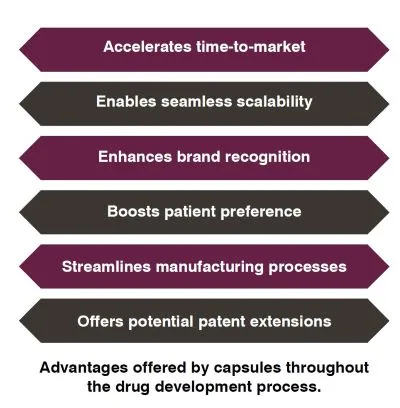
Capsules play a pivotal role in modern pharmaceutical innovation by supporting drug development across all stages, from preclinical research to market release, and continuing more during its lifecycle. With the typical drug development process spanning a lengthy duration of 12 to 15 years, the utilization of capsules emerges as a favoured strategy, presenting scientists with an expedited pathway to market entry. Capsules serve as a cornerstone in the initial phases of concept formulation, offering a minimal yet effective solution amidst the intricacies of early-stage development. Their versatility simplifies the product development process, enabling researchers to navigate complexities with greater ease and efficiency, ultimately driving innovation and progress in drug development.
Capsules' Influence on Expediting Drug Development Timelines
1. Preclinical Testing Efficiency:
The journey of drug development begins with the synthesis of a novel molecular entity (NME), marking the discovery of compounds of interest. However, the real test lies in evaluating these compounds for efficacy and safety. This involves initial thorough testing on animals before even considering human trials. The aim is to sift through a multitude of byproducts and pinpoint the most promising candidates for deeper investigation.
Capsules as a preferred choice for drug development, offer a straightforward solution to the challenge of administering NMEs to non-human subjects, as they can contribute to the efficiency and precision of the testing process. They enable precise dosing, ensuring accurate measurement and delivery of NMEs in predefined amounts, which is essential for reliable data interpretation. They provide a protective environment for NMEs, particularly those sensitive to moisture or acid. By encapsulating these compounds directly into the capsule shell, researchers can ensure the stability of the substances during delivery to the gastrointestinal tract in the early stage of development. This rationalizes the formulation process by eliminating the need for additional steps like coating or extensive formulation efforts. This not only saves time but also reduces costs associated with the preclinical testing phase.
Additionally administering capsules to animals is generally less stressful than alternative methods. The ease of capsule administration reduces potential discomfort for the animals, contributing to more consistent and humane preclinical testing. The availability of capsules in different sizes enables tailored dosing based on the specific needs of the experiment and the size of the animals involved in preclinical studies, thereby increasing adaptability.
2. Precision dosing for clinical trial
In some instances where candidate compounds are costly during the early stages of selection and synthesis, limiting the usage of API for initial evaluation, precision dosing through capsules for clinical trials proves to be an advantageous option. This approach facilitates the exploration and innovation in the early stages of drug development. They enable direct testing of products under investigation for clinical efficacy without the need for extensive formulation efforts. In Phase 1 clinical trials, capsules containing very small amounts of the drug compound can be directly administered to human subjects for safety testing. This technique helps in the rapid manufacturing of drugs products by placing pure drug in capsules for oral and pulmonary dosing in Phase 1 studies. This is particularly beneficial for highly potent, low-dose applications where precision dosing is essential, and can be extended to other products. This process eliminates the need for excipient blends and associated testing and evaluation, minimizing the timelines for the first human study compared to conventional formulation routes. By bypassing specific formulation steps like excipient compatibility testing, companies can gather critical clinical trial data sooner. This early data helps in identifying viable candidates and meeting aggressive project timelines effectively.
Furthermore, this approach provides formulators with the time to address environmental and physicochemical challenges associated with the pure drug, which are necessary for formulation development. Conducting physicochemical studies concurrently with clinical studies allows formulators to optimize formulation parameters while clinical trials are ongoing. This parallel approach reduces the overall timeline of the drug development process by overlapping activities that would traditionally be sequential. It is advantageous in circumstances where there is an urgent need for the medication, such as in the case of emerging pathogens or rare diseases.
Available in various sizes and colour, capsules facilitate easy identification and blinding protocols crucial for clinical trials. Researchers can effortlessly distinguish between different formulations, doses, or placebos, ensuring accurate data collection while maintaining participant blinding, thus enhancing the integrity and reliability of clinical trial outcomes. This versatility not only facilitates logistical aspects but also contributes significantly to the efficiency and rigor of the clinical trial process.
3. Formulation feasibility
In drug development, feasibility is a paramount concern as researchers strive to establish proof of concept and evaluate the fundamental characteristics of molecules. When focusing on oral delivery systems, capsules emerge as a highly advantageous dosage form supporting the drug development process. Their benefit encompasses ensuring accurate dosing, protecting drugs from environmental factors, and simplifying manufacturing with easy filling methods to expedite the encapsulation of active ingredients. This eliminates the need for complex machinery or intricate development procedures, allowing researchers to swiftly encapsulate medications through manual or semi-automatic means. Consequently, this approach reduces time to market and eliminates the need for machinery investment during the early phases of development, compared to other dosage forms.
Capsules provide versatility in accommodating various medication forms, including powders, liquids, semisolids, pellets, mini tablets, and granules, facilitating a wide range of delivery formats. This flexibility enables formulators to efficiently achieve desired pharmaceutical actions by experimenting with different formulations and delivery options within a single dosage form. Additionally, capsules allow for the customization of formulations by combining multiple active ingredients into a single dosage form, particularly beneficial for combination therapies targeting specific conditions.
For drugs categorized under biopharmaceutical class II (BCS II), liquid filling in hard capsules enables the use of APIs that may be difficult to incorporate into solid dosage forms. Furthermore, in some cases, capsules exhibit improved bioavailability due to factors such as better dissolution characteristics, enhanced absorption, or protection from enzymatic degradation in the gastrointestinal tract. Overall, capsules play a pivotal role in expediting drug development processes while offering versatility and efficiency in formulation design.
4. Scalability and manufacturing support
From a manufacturing standpoint, hard capsules present notable advantages in production phase and enhance the efficiency of drug development. Unlike tablets, which typically involve intricate manufacturing steps like granulation, drying, and compaction, capsules make these processes easier. This dosage form not only decreases the number of steps involved but also reduces the time and resources necessary for manufacturing. Consequently, hard capsules offer a more efficient and cost-effective solution for pharmaceutical companies aiming to bring their products to market swiftly.
The efficient manufacturing process of capsules accelerates validation and CMC (Chemical, Manufacturing, and Control) activities. During validation, they ensure that the manufacturing process consistently produces capsules of high quality, which facilitates the reliability of capsule production. Similarly, CMC activities, which encompass the documentation and regulatory aspects of manufacturing, draw significant benefits from the upfront nature of the capsule manufacturing process. Capsules inherently offer a simplified approach to production, reducing the complexity associated with regulatory compliance. This process enables pharmaceutical companies to navigate through regulatory requirements more smoothly, ensuring timely approvals and adherence to quality standards.
They also facilitate scale-up, allowing for a seamless transition from small-scale production to larger volumes. Their standardization and consistency in production make them ideal for scaling up manufacturing operations while maintaining product quality and integrity. As demand for a drug increases during its progression through various stages of development and eventual market release, capsules offer the flexibility to meet these escalating production requirements without compromising product quality or integrity.
5. Brand recognition and patent extension after the launch
Capsules offer substantial advantages in bolstering brand recognition and extending patent longevity. Opting for capsules as the preferred dosage form empowers innovator companies to distinguish their products in a crowded market. With capsules available in diverse sizes, colours, shapes, and printing options, they serve as a canvas for branding initiatives, allowing for distinctive appearances that resonate with both consumers and healthcare professionals. This customization capability ensures instant recognition of the brand and fosters consumer loyalty over time. Capsules offer protection against counterfeiting, safeguarding the manufacturer's compound from being replicated and sold in the market. With distinctive printing options such as the brand name, strength, or logo prominently displayed on the capsule body, products stand out in crowded markets, making them easily identifiable to consumers.
Additionally, capsules enable frequent product releases, fostering brand awareness and anticipation among consumers. It facilitates easy integration of new products into the lineup, simplifying testing process strategies by enabling formulation modifications that extend the patent life of a drug. By reformulating a medication into a capsule form or developing innovative capsule technologies, pharmaceutical companies can obtain new patents or extend existing ones. These patents can cover aspects such as the capsule formulation, manufacturing processes, or specialized delivery systems, providing additional protection and exclusivity for the product.
Conclusion
The journey of drug development, from concept to real-world application, has encountered formidable challenges. To meet the imperative of shortening development timelines, pharmaceutical companies have implemented various supportive systems, striving to adhere to stipulated timeframes. Amidst these challenges, capsules have emerged as a catalyst for acceleration, facilitating the entire process. Renowned for their simplicity and efficiency, capsules as a dosage form offer a promising solution to expedite drug development while minimizing expenditures. By leveraging the agility and innovation enabled by capsules, researchers can effectively navigate the pressures of a rapidly evolving market, ensuring timely delivery of pharmaceutical innovations to meet critical healthcare needs.