
Pharmaceutical companies face new challenges in connecting healthcare professionals. Access to HCPs is limited, their focus has increased more than ever, and increasing competition from generics and biosimilars has made the market more crowded. In order to succeed, companies must improve the involvement of both digital and field channels and ensure that the message processing should reach HCP at the most relevant point in the treatment declaration process.
Changes in HCP Targeting
HCP engagement has traditionally rely on previous data, often too late to affect major treatment decisions. In today's sharp transport and competitive surroundings, where the teams are under pressure to get more with less resources, this method decreases. Strong challenges for market access and increasing competition require more accurate and active approach.
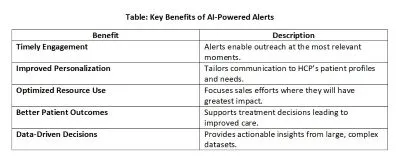
Progress in artificial intelligence (AI) and machine learning have changed this approach by offering future notifications driven by real-time data from different sources. These units support more targeted search, helps access to HCP when they are most likely to respond, improve the efficiency of engagement efforts and better patients contribute to care.
Real-Time Intelligence: A Major Advantage
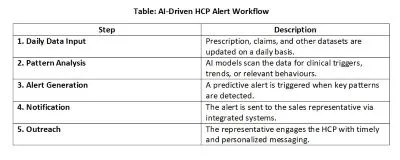
The set that sets modern HCP engagement has the ability to use and function on almost immediate data. Advanced systems now record hundreds of crores of prescription and medical requirements each day, converting clinical events into useful insights with minimal delays. This is a major improvement of old systems, where it takes two weeks or more time to produce a very long result in today's rapidly growing market, where treatment decisions are made in a few days.

The actual value comes from a combination of speed with accuracy. From clinical data to digital behavior, by examining patterns in thousands of variables, these systems enable searching that is timely and strongly concentrated.
Moving Beyond Traditional Alerts with AI
Traditional alert systems usually depend on previous data or basic rules-based triggers, offering limited insight and flexibility. AI-controlled notifications continue by predicting future events by using large versions of clinical and medical data prepared from many sources. This includes brochures and medical requirements, insurance rejections, HCP digital activity, electronic medical records, laboratory results and consumer data more accurate and timely obtaining predictions.
These AI-driven notifications are designed to fit evenly into current systems and workflows without disturbance. This sale allows the teams to provide more targeted and relevant messages based on full understanding of each HCP needs. Instead of changing the methods of traditional involvement, these are supporting the extensive sales method by improving conversation planning and enriching general HCP interactions.
Changes to Adoption and Effective Implementation
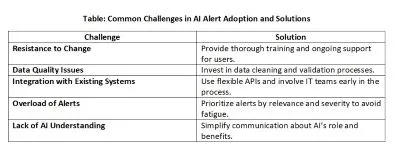
Over the past six years, the use of AI-controlled notice in drug sales has become more widely accepted. When a detailed explanation and justification was needed, it is quickly seen as a valuable and necessary tool. Nevertheless, successful use still depends on strong changes and proper training.
Sales representatives should feel safe by using AI-operated notice and understanding how to implement them effectively. This means that providing complete training before the rollout not only explains how notifications work, but also how they support the overall engagement strategy. Although users do not require deep technical knowledge of the AI model, they should understand that the patient's type is identified and where the patient is in treatment trips, to ensure more relevant HCP interaction.
Measuring Effectiveness and Business Impact
The success of the AI-powered alerts is evaluated using a series of performance measures. For field-based notifications, it includes conversion rates at both patient and HCP levels, such as a new diagnosis or introduction of prescriptions. Digital notifications are measured using standard engagement indicators such as open and click frequencies, while the response from sales team provides useful insight into how notifications work in settings in the real world.
The evaluation of the return on the investment is beyond these basic data by looking at additional sales generated through these initiatives. This well ensures a round approach that technology not only supports commercial development, but also strengthens the quality of the connection with HCP.
Looking Ahead: The Future of Pharma Sales Engagement
In the sale of the drug, AI grows rapidly at both speed and accuracy, which has the opportunity to analyze the increasing number of data sources. This progress is not just an advantage, required for companies aimed at being competitive in a rapidly composed landscape. Investment in AI tools and understanding will be important for maintaining speed.
The future of engagement lies in even more sophisticated targeting, such as using advanced techniques such as deep learning and nerve networks. Some systems already support heavily coordinated workflows, for example when a HCP treats a patient or runs online research, an email before conversation can be triggered the same day, after a person's visit was a little time after.
Such integrated, multi-channel outreach pharmacy forms the next phase of sales. AI-operated alerts will be more powerful, including the information from the clinical patient and indicators of HCP interest as access to rich datasets. Rapid processing and daily distribution will bring outreach close time, which is especially important in competing environments where timely engagement is important to influence treatment decisions.
The Preparation of what is next
In order to succeed in a rapidly changing environment, biopharmaceutical companies must adapt their strategies and systems to support real-time engagement. This means updating equipment such as customer and patient relationship management systems, enabling rapid data processing and ensuring that the engagement plan is designed to take full advantage of real-time insights. Ongoing training is also needed to help teams create most of these advanced technologies.
An important first step is to create awareness in the sales teams about the benefits of AI-operated equipment and how they can increase today's sales practices. Regular workshops can help field teams understand the value of these systems and address any challenge that they face.
AI-driven alerts rebuild how organizations connect to HCPs. As the technology is more advanced, people who use it and integrate them quickly will be in the best position to deliver relevant messages in time, leading to better results for both patients and businesses.
The Role of Personalization in AI-Driven Engagement
One of the most valuable aspects of the AI-powered alerts is his ability to support personal involvement on a scale. By analyzing both behavior and clinical data, AI can help in tailor-made messages from sales teams that are more relevant to each HCP's specific interests, treatment habits and patient profiles. This level of privatization is difficult to achieve with manual division alone.
In addition, individual outreach sales promote strong relationships between representatives and HCP, which improves the quality of conversations and design chairs over time. This ensures that the material is close in line with current HCP requirements, which makes each touch point more efficient.
Ethical Use of AI in HCP Engagement
For example, the use of AI in sales and marketing increases, it is important for companies to address moral ideas. Openness, privacy and responsible use of patient and HCP data should be the core of each AI strategy. Organizations should ensure that data are used properly and complied with regulatory frameworks, such as GDPR and HIPAA.
In addition, AI's recommendations should not support changed human decisions. Sales people still play an important role in determining the best of explaining notifications and joining HCP. Ethical AI not only uses the reputation for security measures, but also strengthens long-term beliefs with stakeholders.
Conclusion
AI-driven alerts are no longer a news that they become a majority of strategies for medication. In time, with the ability to provide relevant and individual insights, these tools help companies to remain competitive in overload and complex markets. Those who invest quickly and carefully will be well placed to give strong results to their brands, their teams and finally patients.