


The clinical research sector undergoes a significant change in 2025, which is high on technological progress, regulatory changes and patient focus. These changes are not just a trend, but a sign of a broad movement towards more effective, inclusive and intelligent clinical studies. As an industry infection in this new era, it becomes important for informed and adaptable to professionals, organisations and stakeholders. This article examines five main trends that are defined the future of clinical research.
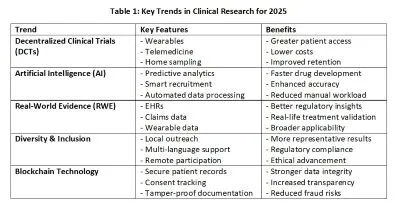
1. Decentralized Clinical Trials Gaining Ground:
Decentralized Clinical Trials (DCTs) has moved from a new concept to a central component of modern clinical research. DCT removes many obstacles associated with traditional site-based models so that participants can participate in studies from their homes or communities. Use of portable technologies, mobile applications and telemedicine platforms facilitates real-time data collection and remote monitoring.
Wearable equipment is now able to measure large health parameters such as heart rate, glucose level, and physical activity and sleep patterns. These continuous data alleys provide rich insight into the patient's health and treatment effects. Virtual counseling reduces the requirement for a visit to the site, making participation more practical and attractive. In addition, home-based sample collection reduces the burden for competent participants through trained personnel or self-collection sets.
From an operational point of view, decentralized trials reduce logistical costs, make participants a wider pool and increase the degree of storage. They are particularly beneficial for rare diseases or studies associated with geographically spread population. Since regulatory agencies continue to support distance models with updated guidance, the infrastructure and confidence in DCT are expected to strengthen.
2. Artificial Intelligence Supporting Trial Efficiency
Artificial intelligence (AI) revolution is how clinical studies are concept, design and controlled. The role extends from the discovery of the drug to monitoring after marketing, which provides future indication skills and automation that streamlines different research stages.
In the early stages, AI algorithms analyze biomedical data sets to identify potential drug candidates. The machine learning models can guess how a molecule will interact with biological goals, which accelerates the selection process and reduces the dependence on traditional laboratory testing. During the test phase, the AI tool is used to optimize the patient's recruitment by analyzing demographic, genetic and clinical data to match candidates with appropriate studies.
AI testing also increases monitoring and data quality. Natural Language Processing (NLP) can automate medical records, side effects and other unarmed data reviews. Automatic systems reduce data registration errors, support in real-time flag deviations and temporary data by analyzing adaptive test design.
Clinical research does not have AI integration without challenges, including privacy problems and transparent algorithms. However, benefits in terms of speed, accuracy and cost certificates are sufficient. In 2025, AI race tests are no longer extraordinary. They become ideal.
3. Real-World Evidence Informing Better Decisions
Real-World Evidence (RWE) refers to electronic health records (EHR), database, patient registers and insights from the real-world data (RWD) that requires portable health equipment. Unlike data collected under controlled test settings, RWE shows how therapy manages in everyday clinical practice.
The RWE regulator plays an important role in supervision of submission, market access strategies and post-approval monitoring. Regulatory bodies in the United States, the EU and the Asia Pacific regions are encouraged to use RWE to complement traditional clinical test data. Pharmaceutical companies use RWE to show long-term value, safety and efficiency of new means.
The value of RWE lies in its ability to provide insight into a wider population, usually includes patient’s clinical studies such as older adults, comorbidities persons and those from submerged ethnic backgrounds. For rare disease research, RWE can offer important data that is difficult to achieve due to small test sizes.
Data integration platforms and analysis tools improve the reliability and interpretation of advance RWE.
4. Increasing Diversity and Inclusion in Clinical Trials:
Clinical research has a lack of diversity among testing participants one of the long-term challenges. Historically, many tests have underestimated women, old adults and ethnic minorities, which can lead to treatment that may not be universally effective. By 2025, Push for Inclusive Research gained momentum, both morally mandatory and supported by regulatory incentives.
Sponsors and research organizations use strategies to improve registration diversity. These include social -increasing initiatives to raise awareness, collaboration with local health professionals and the use of digital platforms to reach out to the wider audience. Test materials are translated into several languages to accommodate non-English-speaking participants, and adapt to the consent processes for the level of different literacy.
Decentralized test models contribute to more inclusion by removing geographical and logical obstacles. Participants can now contact the research teams, practically, can use resources on home testing and evaluation plan at a flexible time.
Regulatory agencies must include diversity plans in rapid testing presentations, which reflect a comprehensive obligation to equity in the innovation of the health care system. If these changes embracing, the industry goes on towards more representative and general research results.
5. Exploring Blockchain for Data Integrity and Trust
Blockchain technology appears to be a promising tool to meet some of the continuous challenges in clinical testing of data management. With its decentralized, transparent and irreversible laser system, blockchain can increase the safety, traceability and reliability of test data.
Clinical research includes secure consent forms in blockchain applications, patient data tamper-proof and automatic smart contracts for payment of websites and compliance with protocol. By creating a fixed overview of all test-related activities, it promotes more and more confidence among blockchain participants, investigators and regulators.
Data fraud and manipulation in clinical studies are important concerns, especially when the results affect decisions on public health and approval of the authorities. The ability of blockchain to detect and prevent unauthorized changes helps to reduce these risks. It also supports audit tracks and simplifies data verification processes, which reduces administrative load.
While the integration of blockchain is still in its early stages, pilot programs and industry cooperation in 2025 show its practical value. Due to the mature technology, it is likely to use, especially in multi-tender and global tests where data security and differences are crucial.
Preparing for the Future: Key Takeaways for Clinical Research Professionals

Clinical research landscapes are developing rapidly, and professionals working in it should also develop. To remain competitive and make meaningful contributions, scientists must make:
• Develop decentralized test function and a strong understanding of related technologies.
• Few skills in AI and data analysis to support digital changes in clinical research.
• Stay up to date on regulatory development related to real evidence and diversity requirements.
• Explore the principles and applications of blockchain in clinical data management.
Openness to cross-functional collaboration, continuous learning and innovation will be important for navigating further changes. When these trends converge, they have the ability to make clinical tests more effective, inclusive and reliable, which eventually accelerates the distribution of secure and effective treatments to patients.
In summary, 2025 is a significant twist for the clinical field of research. Decentralized models, artificial intelligence, real-world evidence, integration of inclusive practice and blockchain techniques set a new standard for how clinical tests are designed and performed. Embracing these advances will ensure that the research community is well placed to meet future challenges and opportunities.