The adoption of the ballroom concept in pharmaceutical manufacturing has enabled a significant shift toward flexible production. By mobilising process equipment and mounting it on wheels, facilities can quickly adjust layouts and scale operations without major infrastructure changes.
However, the practicality of moving heavy process equipment by hand remains a challenge that is often overlooked in the modern cleanroom suite. Process Engineers shouldn’t be struggling to manoeuvre buffer totes or combining every sinew of strength to move chromatography columns.
The industry’s push for flexibility must be matched with safe, mechanised movement strategies.
The reality of moving equipment in cleanroom suites
Single-use systems and the ballroom concept have been key developments for many pharmaceutical manufacturers, making it easier to scale up and reconfigure cleanroom setups. As part of this, many manufacturers have rushed to add wheels to their process equipment, in theory allowing it to become more ‘mobile’. While mounting equipment on wheels adds flexibility, when that equipment weighs 1,000kg or more, expecting staff to push it by hand simply isn’t realistic.
The safety risks of manual handling
It might sound easy to ‘wheel in’ a reactor or a single-user mixer, but in practice, doing so manually is physically demanding and unsafe. Industry statistics paint a clear picture of the real-world impact of manual handling.
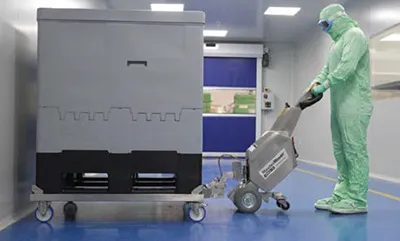
In cleanroom environments, manual handling risks extend well beyond lifting. Tasks like pushing and pulling loads are often overlooked, yet they’re a leading cause of strain injuries. According to the UK Health and Safety Executive (HSE), musculoskeletal disorders accounted for 7.8 million lost working days in 2024 – with each person taking an average of 14.3 days off work.
Across Europe, work-related musculoskeletal disorders remain the most common occupational health problem. According to the European Agency for Safety and Health at Work (EU-OSHA), three in five workers in the EU report MSD symptoms, particularly back pain and upper limb discomfort – exactly the kind of strain experienced when manoeuvring heavy process equipment manually.
Within pharmaceutical environments, manually pushing and positioning process equipment leads to:
• Musculoskeletal disorders and strains
• Hand, finger and foot trap injuries
• High levels of sickness-related absence
• Workplace compensation claims and litigation
• Employee fatigue
It’s not just a safety issue; manual handling is slowing down your suite
Alongside the obvious safety concerns of moving heavy-wheeled process equipment, relying on manual strength to manoeuvre loads also impacts suite efficiency and, ironically, flexibility.
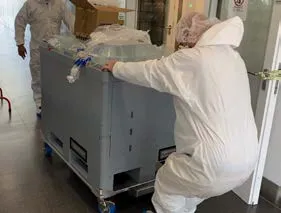
Manual handling-related injuries cost UK employers an estimated £21.6 billion a year. When staff are off work, or when production slows due to equipment movement challenges, cleanroom suite uptime takes a direct hit.
For example, moving a 10,000kg chromatography column could easily require five Process Engineers working in coordination, slowing down changeovers and tying up skilled staff who could be focused on value-adding production tasks.
Similarly, reconfiguring process trains and moving media totes often takes two people, pulling them away from their core responsibilities. When these tasks are repeated daily or weekly, they add up to hours of lost productivity and can quickly create bottlenecks during suite changeovers, undermining the flexibility that mobile equipment was meant to deliver in the first place.
Where do these issues stem from?
With the push toward more modular and efficient manufacturing setups, many facilities have rightly adopted wheeled process equipment in place of traditional fixed systems. But while wheels bring flexibility, they can also introduce risk if the full handling process isn’t thought through.
Often, these issues stem from a disconnect at the start of the procurement stage, where equipment is specified based on technical performance and process fit. Unfortunately, how that equipment will be moved once it’s delivered, especially in a cleanroom environment, is rarely part of the conversation. While Health & Safety teams are focused on safety and Production teams on usability, without a shared view at the specification stage with Procurement, equipment often arrives that’s difficult or dangerous to move manually.
But the equipment has handles?
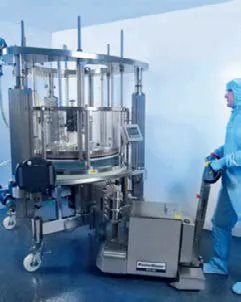
The Procurement team can be forgiven for assuming that loads are easy to move once they arrive on site, since a significant amount of process equipment (even weighing as much as 6,000kg) is fitted with handles – providing the illusion that it’s perfectly suitable for moving by hand.
The reality is wheels and handles are only part of the solution. Additional factors like wheel type, load weight, and floor surface all affect how much force is needed to get equipment moving and ultimately impact how easily equipment can be moved. Even the best castors can’t eliminate the risk when you're handling 1,000kg-plus loads by hand.
Adding a mechanised aid like an electric tug reduces that risk by doing the hard work for the operator, safely and consistently.
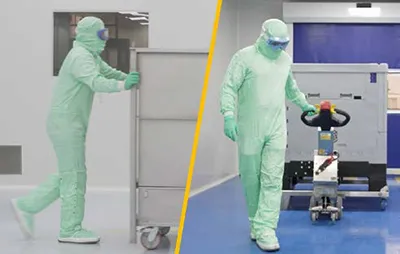
How to make the move from manual to mechanised.
To reap the benefits of ballroom systems, correct handling aids such as electric tugs can be used to mitigate the safety issues of manoeuvring wheeled process equipment.
Making the move from manual to mechanised isn’t as tricky as you’d think, and there are tried-and-tested solutions that work with most wheeled biopharmaceutical equipment, as well as quick wins that can make movements safer.
Not everything in your suite needs mechanical aids to help move it. For lighter loads, simply replacing existing worn castor wheels with high-quality equivalents can drastically reduce the friction when moving and make things much easier for operators.
Electric tugs support safer, smarter equipment movement
For heavy equipment, mechanical aids and solutions like electric tugs are a safer, more flexible solution for pharmaceutical manufacturers.
They offer a clean, compact way to move wheeled process equipment without manual strain. Designed for controlled environments, they’re a smart fit for cleanrooms, and they remove the need for multiple operators, allowing a single operator to carefully control even the heaviest equipment.
Why electric tugs are a great fit for pharmaceutical environments:
• Help reduce injury risks from strain and repetition
• Ideal for working in cleanrooms and GMP environments
• Speed up suite reconfigurations
• Require minimal training
• Can move large loads safely with a single operator
• Have a compact design, perfect for moving in tight spaces like airlocks
• High-grade 316 stainless steel construction
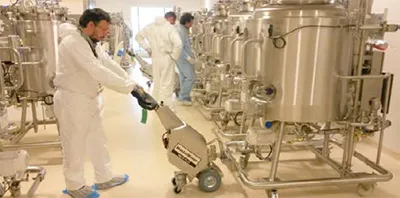
The pay-off: Safer, faster and more flexible operations
Pharmaceutical manufacturers and CDMOs who have introduced electric tugs into their cleanroom operations quickly see improvements, not just in safety, but across productivity and suite flexibility as well.
Stainless steel electric tugs help operators work more safely and facilities run more smoothly, delivering benefits including:
• Fewer injuries
Removing the need to push and pull heavy equipment helps cut down on MSDs and staff absence
• Quicker suite changeovers
Reconfigurations are faster when equipment can be moved easily
• Create flexibility
A single operator can reposition equipment that previously took two or more people
• Improved suite uptime
Less downtime and fewer disruptions to workflows, increasing suite uptime
Manual vs mechanised in practice
The shift to mobile process equipment has brought welcome flexibility, but it also introduces new day-to-day challenges for production teams. What impact can electric tugs have on these challenges? These examples illustrate where things can go wrong and how solutions like electric tugs act as the answer to these challenges.
1. Moving a 1,000L Bioreactor
Fitting castor wheel kits to a 1,000L bioreactor makes it easier to adapt the suite layout, but who’s moving it, and how?
In many facilities, the answer is two members of production staff, manually pushing and steering the load. It typically takes around 15 minutes to move and position each unit. Multiply that by daily movements, and it quickly eats into uptime, not to mention the physical toll. This kind of task puts staff at risk of musculoskeletal injuries, with back strain alone leading to absence periods of approximately 14.3 days on average (HSE, 2024). In this instance, a 1,200kg capacity SM100+ SS electric tug allows a single operator to move and position the same load safely, freeing up time and reducing risk without compromising on suite uptime.
2. Positioning a 14,500kg Chromatography Column
Chromatography columns weighing upwards of 10,000kg are often fitted with castors and wheel kits to enable scale-up or suite reconfiguration. But without the right equipment, moving that load means pulling four or five Process Engineers away from their core responsibilities. It’s inefficient, and it’s risky.
Manual movement at that scale increases the chance of accidental impact or misalignment, both of which can compromise the integrity of critical equipment. Using a heavy-duty tug such as the MT20/1500+ SS enables one operator to move the column with accuracy and control, reducing downtime and keeping valuable personnel focused on high-value production tasks.
3. Reconfiguring process trains and totes
A typical upstream biopharmaceutical process train might include a series of mobile 500L – 1,000L totes used for media and buffer preparation, storage, and transfer. These are often moved between cleanroom zones or positioned around bioreactors, with flexibility in layout being key to adapting to different batches or product types. Each tote can weigh over 1,000kg when full, and it’s not uncommon for reconfiguration to involve moving three to five totes per shift. If done manually, this can require two operators per tote, meaning a full train movement ties up four to ten people, increases physical strain, and adds significant time to changeover processes.
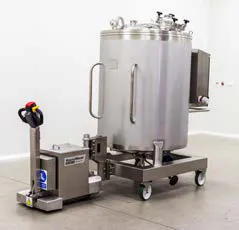
Electric tugs change this dynamic entirely. With a compact, cleanroom-compatible tug, a single operator can move and position totes quickly and safely, maintaining a constant supply of media and buffer with far less disruption to suite operations. Suites can be reconfigured faster and with fewer people, helping to avoid delays and ensuring critical supply feeds stay on schedule.
Tips for implementing mechanical aids
As the practical examples discussed outlined, mechanical aids like electric tugs can make a significant difference to suite safety and efficiency. However, there are some considerations to selecting when, what and how to mechanise the movement of process equipment.
What do you need to move?
Not all equipment requires mechanical aids. Lighter items around 100kg can be moved safely without aid, assuming a full risk assessment has been completed. For lighter loads that remain challenging to move by hand, consider investing in new, high-quality castors to improve ergonomics and reduce the force needed to move the load.
At this stage, it’s important to get feedback from Process Engineers and suite staff around which handling challenges could be made safer with mechanical aids. Starting with the heaviest equipment or the most frequently moved can help with justification, enabling staff to quickly see the benefits before fully rolling out new systems.
What should you look for in a mechanical solution or supplier?
When investing in new equipment, it’s important to ensure any solution is suitable for your environment, processes and application. Consider selecting suppliers and solutions that:
• Have a proven track record of working with leading manufacturers
• Have a design focused on the requirements of the pharmaceutical industry and cleanroom suitability
• Take a solutions-led approach to understanding your application, carefully reviewing your equipment to ensure suitability
• Can be customised to interface with your specific equipment
• Prioritise safety, control and the integrity of your process equipment
• Keep space to a minimum – compact solutions are best suited to the tight spaces associated with many pharmaceutical environments
• Have a wide product portfolio of solutions
How can I future-proof our equipment movement?
To future-proof your equipment movement, it’s important to set clear, standardised procedures (SOPs) and involve procurement early on.
SOPs should outline how each piece of equipment is to be moved, and what mechanical aid, like a powered tug, should be used. Including mobility requirements in procurement specifications ensures that new equipment is either compatible with existing handling aids or highlights the need for new ones, avoiding last-minute workarounds or unsafe manual handling.
Conclusion
The rise of mobile process equipment and systems in the pharmaceutical sector has introduced new challenges in material handling. While wheels and handles suggest mobility, they do not eliminate the risks associated with heavy, frequent movement within cleanrooms.
Mechanised solutions like electric tugs offer a practical, cleanroom-ready answer to these challenges. By reducing injuries, maximising suite uptime, and creating flexibility, they represent a strategic investment in the future of safe, flexible pharmaceutical production.
References
• Health and Safety Executive (HSE, 2024) - Work-related musculoskeletal disorders statistics (WRMSDs) in Great Britain, 2023/24. [online] Available at: https://www.hse.gov.uk/statistics/causdis/musculoskeletal.htm
• Health and Safety Executive (HSE, 2024) - Working days lost in Great Britain due to work-related illness and workplace injury, 2023/24. [online] Available at: https://www.hse.gov.uk/statistics/dayslost.htm
• Health and Safety Executive (HSE, 2024) - Costs to Britain of workplace injuries and new cases of work-related ill health, 2022/23. [online] Available at: https://www.hse.gov.uk/statistics/cost.htm
• European Agency for Safety and Health at Work (EU-OSHA, 2019) - Work-related musculoskeletal disorders: Facts and figures. [online] Available at: https://osha.europa.eu/en/publications/work-related-musculoskeletal-disorders-facts-and-figures