
The pharmaceutical landscape is rapidly evolving, driven by an influx of advanced treatments such as biologics, nucleic acid-based medicines, gene therapies, and nanoparticle-based delivery systems. These innovative therapies are transforming how diseases are treated, offering new options for conditions once considered untreatable. However, they present significant formulation and stability challenges.
These sensitive molecules are prone to degradation when exposed to environmental stressors like moisture, temperature fluctuations, and mechanical agitation. This fragility complicates manufacturing, storage, and distribution, particularly when considering the logistical strain on global supply chains. Cold-chain infrastructure has traditionally addressed this problem, but it is expensive, energy-intensive, and often impractical for remote or resource-limited regions. Beyond cost and accessibility, the environmental impact of maintaining extensive cold chains, with their significant energy consumption, is also a growing concern for the industry's sustainability goals.
To bridge this gap, lyophilisation presents a robust stabilising strategy. While lyophilisation has long been used for proteins and antibodies, it is now proving indispensable for a broader range of next-generation modalities. Whether applied to lipid nanoparticles (LNPs), viral vectors, enzymes, messenger RNA (mRNA), or other nucleic acid-based therapeutics, lyophilisation improves shelf life, protects molecular integrity, and enables more flexible global distribution without heavy reliance on ultra-cold storage. This shift allows for greater flexibility in storage and transportation, ultimately improving patient access globally.
Addressing the stability challenge with lyophilization
Water is one of the biggest contributors to the degradation of pharmaceutical compounds. Lyophilisation mitigates these risks by removing water through a sublimation process that transitions ice directly into vapour under vacuum conditions. The fundamental principle relies on the phase diagram of water, where a combination of low temperature (below freezing) and low pressure (vacuum) allows ice to bypass the liquid phase and directly sublimate. This gentle drying process minimises thermal and chemical degradation, which are common issues with conventional drying techniques.
Unlike heat-based drying methods, sublimation occurs at low temperatures, making it especially suitable for fragile biologics and nanoparticles. This process halts hydrolytic degradation and other chemical reactions that destabilise sensitive pharmaceutical compounds, thereby preserving structural integrity and efficacy.
The key benefits of lyophilisation offers complex therapeutics are:
• Improved long-term stability: By removing water, lyophilisation significantly reduces degradation reactions, enhancing the product's shelf life at various temperatures, including ambient conditions.
• Reduced need for cold chain storage: Lyophilised products often eliminate the requirement for ultra-cold storage and transportation, leading to substantial cost savings and improved accessibility, with added sustainability benefits.
• Enhanced shelf life: The removal of water inhibits microbial growth and enzymatic activity, contributing to a longer shelf life compared to liquid formulations.
• Increased convenience: Lyophilised products are easier to handle, store and transport. They can be reconstituted quickly and easily before administration.
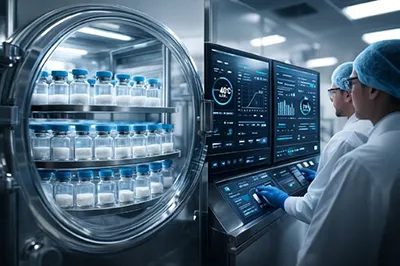
An example use case for lyophilisation is with mRNA products. Lyophilisation reduces the need for ultra-cold storage by stabilising both the fragile mRNA molecules and the LNP delivery systems that protect and transport them. Without lyophilisation, mRNA therapies typically require storage at temperatures as low as -70 degrees Celsius to prevent degradation.
Formulation and process optimization
Selecting the right excipients is a critical first step in successful lyophilisation. These supporting ingredients protect sensitive molecules from stresses encountered during freezing and drying. Cryoprotectants guard against damage during the freezing phase, while lyoprotectants stabilise active ingredients during the drying stage.
The interaction between the active and the chosen excipients must be thoroughly understood, as incompatibilities can lead to unforeseen degradation or reduced stability. This often requires extensive screening of various excipient combinations and concentrations. Selecting incorrect excipients or improper concentrations can lead to cake collapse, poor reconstitution, or loss of biological activity. Thus, excipient screening and optimisation are fundamental steps in ensuring a successful freeze-dried formulation.
Common excipients include sugars such as sucrose and trehalose, which act as stabilisers by forming a glassy matrix around molecules. Polyols like mannitol are often used to add structural integrity to the dried cake. Amino acids help prevent protein aggregation during both the freezing and drying phases, while surfactants are critical for stabilising nanoparticle-based formulations by preventing particle fusion or aggregation. The primary function of these excipients is to replace water’s hydrogen bonding network, thereby preserving the native structure of proteins, nucleic acids, and complex nanoparticles throughout the lyophilisation process.
Cycle development and product characterisation
Developing an effective lyophilisation cycle involves managing three key phases:
1. Freezing: Controlled nucleation techniques help ensure uniform ice crystal formation, which promotes consistent drying and minimises variability.
2. Primary drying: Ice sublimation occurs under vacuum, requiring careful control of shelf temperature and chamber pressure to avoid collapse or melt-back of the product matrix.
3. Secondary drying: This phase removes tightly bound residual moisture, critical for achieving long-term stability without compromising the molecular structure.
Achieving the right balance between drying efficiency and product stability is crucial. Optimising the cycle reduces processing time and energy consumption while protecting the integrity of the therapeutic product.
Equally important is comprehensive quality control to ensure the lyophilised product maintains safety, efficacy, and stability. Residual moisture measurement, i.e., Karl Fischer titration, is critical to gauge shelf life. For nanoparticle-based systems, like LNPs, it is especially important to test particle size distribution. Molecular integrity assessment using high-performance liquid chromatography (HPLC) and electrophoresis can check for degradation. Evaluation of reconstitution time is also key to ensuring rapid and clear dissolution upon mixing with diluent
For LNPs, dynamic light scattering (DLS) is commonly used to measure particle size and polydispersity, ensuring the particles remain within the desired range for optimal delivery. Electron microscopy (e.g., cryo-TEM) can provide visual confirmation of LNP integrity and morphology post-lyophilisation. Additionally, functional assays are essential to confirm that the biological activity of the therapeutic is retained after the lyophilisation and reconstitution process.
Scaling up from bench to commercial manufacturing
Successfully scaling lyophilisation from laboratory to commercial manufacturing requires not only technical adjustments but also strict adherence to global regulatory standards. Regulatory agencies, including the U.S. Food and Drug Administration (FDA) and the European Medicines Agency (EMA), require comprehensive validation data to demonstrate that the lyophilisation process consistently produces a stable, high-quality product.
Meeting these expectations involves rigorous stability testing under various storage conditions to establish product shelf life and to verify that the freeze-dried formulation maintains its intended quality attributes over time. This includes confirming consistent moisture content, potency, purity, and reconstitution performance across different batches.
Process validation must confirm that every stage of the lyophilisation cycle, from freezing to primary and secondary drying, is repeatable and tightly controlled. Manufacturers must also implement a robust product control strategy, including detailed documentation, risk management plans, and quality assurance systems.
Transitioning lyophilisation processes from small-scale development to commercial production introduces complex challenges. Uniformity remains a significant hurdle; large-scale lyophilisation involves maintaining consistent temperature and pressure across thousands of vials. Variations can lead to inconsistent moisture content and compromise stability.
Solutions for scale-up include implementing Process Analytical Technology (PAT) tools such as further product temperature measurement, comparative pressure measurement, and Manometric Temperature Measurement (MTM) to monitor water vapour concentration and product temperature in real time.
Extensive development protocols ensure that processes developed at the lab scale can be replicated reliably at the commercial scale. Advanced control systems are also being integrated into commercial freeze-dryers to enhance process robustness and efficiency.
Supply chain factors also play a critical role. Ensuring a reliable source of GMP-grade excipients, validating commercial-scale equipment, and maintaining redundancy in manufacturing sites are all essential steps to prevent production delays and maintain quality consistency. Robust supply chain management, including supplier qualification and contingency planning, is paramount for uninterrupted commercial supply.
Looking ahead
The demand for stable, accessible, and patient-friendly pharmaceutical products will continue to accelerate as more complex therapeutics enter the market. Several key technological advances are shaping the future of lyophilisation.
One of the most promising trends is the development of continuous lyophilisation technologies, which offer increased throughput, improved energy efficiency, and enhanced process control. Spray freeze-drying is gaining traction for applications where particle engineering and rapid reconstitution are critical. Microfluidic-based drying approaches are being explored to enable highly controlled processing for nanoformulations and delicate biologics.
Sustainability is also an increasing focus. Lyophilisation reduces reliance on ultra-cold storage, lowering energy consumption and the environmental footprint associated with cold-chain logistics. As pharmaceutical companies push toward net-zero goals, the ability of lyophilisation to contribute to carbon reduction will make it even more essential in future drug development.
For developers working on cutting-edge medicines, integrating lyophilisation strategies early in the development process is becoming a critical success factor. The future of medicine will depend not only on innovation in therapeutic molecules but also on innovation in how those molecules are stabilised, stored, and delivered to patients worldwide.