In a world where therapeutic timelines are shrinking and the demand for biologics is surging, the traditional paradigms of biopharmaceutical manufacturing are being challenged. The emergence of advanced biomanufacturing, particularly continuous processing, is not just a technological evolution it’s a revolution reshaping how we discover, develop, and deliver life-saving treatments.
This article navigates through the compelling transition from batch to continuous processing, evaluates the enablers of this transformation, and unravels the multifaceted benefits for stakeholders across the pharmaceutical value chain.
The Imperative for Change
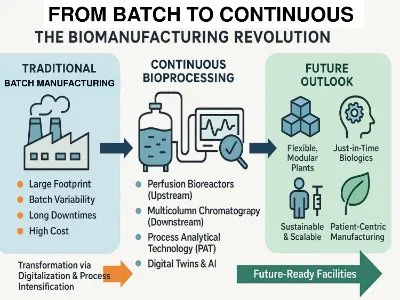
Biomanufacturing the cornerstone of therapeutic protein production—has historically relied on batch-based systems. While this model has served the industry well, it comes with intrinsic limitations: high capital costs, prolonged downtimes, batch-to-batch variability, and restricted scalability.
The explosion in demand for monoclonal antibodies (mAbs), cell and gene therapies, and personalized biologics mandates manufacturing platforms that are agile, robust, and economically sustainable. Advanced biomanufacturing, characterized by process intensification, automation, and continuous production, offers a transformative solution.
Decoding Continuous Bioprocessing
Continuous bioprocessing refers to the uninterrupted, real-time progression of production stages—upstream and downstream—without the need for intermediate storage or downtime. This model mirrors principles from the chemical industry, optimized for precision and efficiency.
i. Upstream Intensification:
Perfusion bioreactors are at the heart of continuous upstream processing. Unlike fed-batch systems, where cells are cultured and harvested in discrete runs, perfusion systems maintain cell viability and productivity over extended durations. Using cell retention devices like alternating tangential flow (ATF) filters or tangential flow filtration (TFF), high-density cultures can be maintained continuously, yielding higher product titers.
ii. Continuous Downstream Processing:
The downstream segment long considered the bottleneck is now catching up. Technologies such as multi-column chromatography (e.g., periodic counter-current chromatography, PCC), continuous virus filtration, and single-pass tangential flow filtration (SPTFF) are revolutionizing purification workflows. These modular, interconnected operations reduce cycle times and increase throughput without compromising product integrity.
Digital Integration: The Nervous System of Modern Biomanufacturing
Advanced biomanufacturing is inseparable from digitalization. Process analytical technologies (PAT), real-time release testing (RTRT), and model predictive control (MPC) are vital in ensuring tight process control and compliance.
Digital Twins virtual replicas of physical processes allow real-time monitoring, simulation, and optimization of manufacturing conditions. Coupled with machine learning, these tools empower predictive maintenance, anomaly detection, and adaptive control, minimizing process deviations and ensuring batch consistency.
Furthermore, Industry 4.0 principles are enabling smart factories where AI and robotics harmonize data, analytics, and physical operations ushering in an era of self-correcting, autonomous production platforms.
Regulatory Outlook: A Collaborative Evolution
The paradigm shift to continuous manufacturing has drawn considerable attention from regulatory authorities. The U.S. FDA, EMA, and PMDA have been proactive in encouraging innovation, as evidenced by initiatives like the FDA’s Emerging Technology Program (ETP) and ICH Q13 guideline on Continuous Manufacturing.
The key regulatory expectation is not whether continuous processing is superior, but whether it is well understood, controlled, and validated. Real-time analytics, comprehensive risk assessments, and robust control strategies are pivotal in gaining regulatory acceptance.
Early adopters such as Vertex Pharmaceuticals and Janssen Biotech have set successful precedents. Vertex’s continuous manufacturing facility for cystic fibrosis therapies was among the first to receive FDA approval, highlighting the viability of this model.
Economic and Environmental Sustainability
Transitioning to continuous processing is not merely a scientific milestone it’s an economic and environmental imperative. Key advantages include:
• Reduced Footprint: Continuous processes require significantly smaller facilities, leading to lower capital expenditures.
• Higher Yields: Process intensification boosts volumetric productivity, often by 2–5 fold.
• Minimized Waste: Integrated workflows reduce buffer consumption and effluent generation.
• Energy Efficiency: Optimized systems consume less power, enhancing environmental compliance.
According to a study by BioPhorum Operations Group (BPOG), switching to continuous bioprocessing can reduce the cost of goods by up to 50% for mAbs, a compelling metric for stakeholders navigating pricing pressures.
Case Studies: Pioneering the New Normal
1. Sanofi's Framingham Facility, USA
This digital biotech facility exemplifies end-to-end continuous processing. Equipped with single-use systems, real-time analytics, and automated feedback loops, it slashed batch release timelines from weeks to days. Sanofi reported up to 80% reduction in process cycle time—underscoring the power of operational agility.
2. WuXi Biologics
As a global CDMO, WuXi Biologics has adopted continuous bioprocessing platforms for multiple biologics, enhancing scalability and speed-to-market. Its "Biologics Factory of the Future" in Ireland demonstrates how modular facilities can support multi-product operations with exceptional flexibility.
3. Amgen’s Next-Gen Biomanufacturing Plant in Singapore
Amgen’s investment in flexible, modular facilities with continuous capabilities has significantly reduced operating costs. Their facility boasts a 75% smaller footprint and 70% lower water and energy usage compared to traditional plants.
Challenges on the Road Ahead
While the benefits are evident, the path to continuous bioprocessing is not devoid of hurdles:
• Technical Integration: Ensuring seamless coupling of upstream and downstream processes with consistent flow rates and process harmonization is technically demanding.
• Process Development Complexity: Designing and scaling continuous processes from lab to commercial scale necessitates advanced modeling and control systems.
• Cultural Resistance: Shifting from familiar batch systems to dynamic, data-intensive platforms requires organizational change and re-skilling of personnel.
Nonetheless, these challenges are being rapidly addressed through cross-sector collaboration, consortiums (e.g., NIIMBL, BioMAN), and academic-industry partnerships driving innovation in process intensification and control strategies.
The Future: Personalized Biomanufacturing
As personalized medicine becomes the new frontier—especially in CAR-T, autologous therapies, and RNA-based platforms—continuous processing offers the granularity and flexibility essential for bespoke production. The convergence of continuous manufacturing, modular automation, and digital informatics will enable “just-in-time” manufacturing models tailored to individual patient profiles.
Additive manufacturing (3D bioprinting), real-time gene editing tools, and AI-driven optimization engines are also poised to integrate with continuous workflows, offering unprecedented personalization and precision.
Conclusion
Advanced biomanufacturing and continuous processing are not merely upgrades they are the new operating system for biopharmaceutical production. These approaches promise to dismantle traditional silos, enabling faster, leaner, and greener production while ensuring product consistency and regulatory compliance.
The onus now lies with industry leaders, regulators, and academic pioneers to accelerate adoption, refine technologies, and reshape regulatory frameworks. As we transition from mass production to precision biomanufacturing, continuous processing will be at the heart of this paradigm shift ushering in an era of next-gen therapies that are not only more effective but also more accessible.
Reference
1. Aydin Kavara, David Sokolowski, Mike Collins, Mark Schofield. Chapter 4 - Recent advances in continuous downstream processing of antibodies and related products, Allan Matte (Ed), Approaches to the Purification, Analysis and Characterization of Antibody-Based Therapeutics, Elsevier, 2020: 81-103.
2. Lee SL, O'Connor TF, Yang X, et al. Modernizing pharmaceutical manufacturing: from batch to continuous production. J Pharm Innov. 2015;10(3):191–199.
3. Rathore AS, Agarwal H, Sharma AK, Pathak M, Muthukumar S. Continuous processing for production of biopharmaceuticals. Prep Biochem Biotechnol. 2015;45(8):836-49. doi: 10.1080/10826068.2014.985834.
4. Nasr MM, Krumme M, Matsuda Y, et al. Regulatory Perspectives on Continuous Pharmaceutical Manufacturing: Moving From Theory to Practice: September 26-27, 2016, International Symposium on the Continuous Manufacturing of Pharmaceuticals. J Pharm Sci. 2017 Nov;106(11):3199-3206. doi: 10.1016/j.xphs.2017.06.015.
5. Abu-Absi NR, Yang L, Thompson P, et al. Defining process design space for continuous monoclonal antibody purification. Biotechnol Bioeng. 2010;106:894–905.
6. Amanullah A, Sarangapani R, Marks D. Advanced process control in biopharmaceutical manufacturing: enabling real-time adaptive manufacturing. Trends Biotechnol. 2021;39(4):346–359.
7. BioPhorum Operations Group. Continuous bioprocessing control and connectivity. 2023. Available from: https://www.biophorum.com
8. Walsh G & Walsh E. Biopharmaceutical benchmarks 2022. Nat Biotechnol. 2022;40:1722–1760.