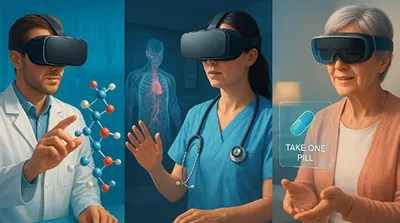
Augmented reality (AR) and Virtual Reality (VR) are two evolving digital tools with significant impact on the way communications, technology transfers, troubleshooting, and training activities are conducted. A third emerging tool involving AR and VR is Mixed Reality (MR), where we blend AR, VR, and the physical world to unlock the next generation of experiential learning, simulation, and collaboration.
The use of these tools requires proper alignment between the business needs and the intended use of the technology. AR and VR are not the same, each one has its unique benefits. Each tool has specific requirements and constraints that must be considered. We will discuss each tool and provide our guidance. Names of suppliers, available hardware, and applications will be provided as reference, but their mention does not represent an endorsement from the authors.
Augmented Reality (AR)
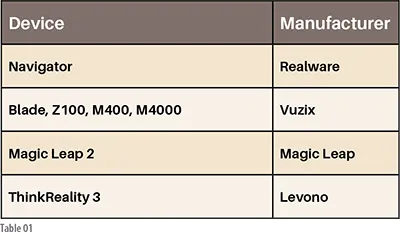
AR is focused on providing real-time access to information (e.g., documents, procedures, forms, videos) required to execute tasks using headsets containing both a monitor for the user to see the information and a camera for the system to capture the environment where the user is working. In addition, most applications include two-way communication involving either another headset or device (e.g., tablets, laptops, desktops, cell phones), allowing remote support by subject matter experts not available at the site/place where the user is located.
The following are examples of AR hardware available in the market. Names of suppliers, available hardware, and applications will be provided as reference but their mention does not represent an endorsement from the authors.
Virtual Reality (VR)
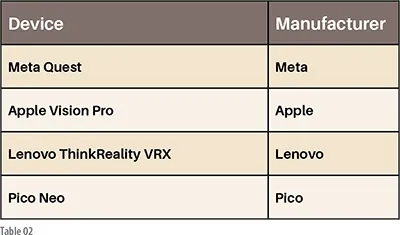
VR is mainly focused on providing a safe immersive digital environment where the user has a full interactive simulation of the work environment (e.g., GxP facility), training on real procedures, using virtualised versions of actual equipment and materials without consuming any resources or disrupting operations. This virtual space, presented to the users via headsets, provides the opportunity to master the required actions expected during the actual execution of procedures in real life. VR is also used to simulate and practice potential scenarios by the users without potential safety risks or wasting materials.
The following are examples of VR hardware available in the market. Names of suppliers, available hardware, and applications will be provided as reference, but their mention does not represent an endorsement from the authors.
Software and Applications for AR and VR
On the software front, we have evaluated both lightweight communication tools and fully validated, GMP-ready platforms like Apprentice.io for AR applications. Meanwhile, for VR, where the headset is only a portal, the real value lies in what happens inside it. We have worked with multiple development partners, including Gronstedt Group, Tipping Point Media, and Resolve, each bringing specialised expertise in regulated training environments. You will find additional development partners across the industry.
Critical considerations for software and applications include:
• Licensing and delivery models (per user/device or pre-loaded)
• Regulatory readiness (CSV, audit trail, documentation)
• Internal vs. full-service development (do you have SMEs available)
• Change management support for adoption
With the right ecosystem, hardware, software, and content, AR and VR can become a cornerstone of your digital training strategy.
GxP Environments – Expectations and Requirements
Procedures: The implementation of AR in GxP-regulated applications provides the option of augmenting procedures with videos and overlaying graphics to guide the user while executing a task. The videos will allow reviewing the proper execution of an activity prior to its actual execution, besides the written instructions. The use of overlaying graphics provides sequential instructions and highlights of specific details to ensure satisfactory completion of the tasks. Also, the AR application may facilitate the documentation of activities by means of pictures and voice commands.

This type of application requires approval and qualification of the augmented procedure versus the approved process description or method. Controlled access to the augmented procedure is a basic requirement to avoid unauthorised changes. Any change must follow the change control systems/procedures of the organisation.
The use of VR provides users with the experience of executing a task or procedure in a simulated environment. This allows either to develop experience or refresh the skills on such procedure ahead of the actual real-life execution of the tasks.
Training: AR makes possible the training of personnel via remote real-time presentations. The subject matter expert (SME) can do a show & tell of a procedure while the trainees observe at their work stations located at different rooms, facilities, and sites. The two-way communication capability of AR hardware allows the trainees to ask questions and receive feedback from the SME as the training is progressing. Also, a trainee will have real time feedback while using augmented procedures when the overlayed images detect a potential issue or error while executing a training task.
VR-designed training modules are intended to reinforce muscle memory, as the learner/trainee will practice the tasks as many times as needed until mastering the execution. It is critical to design VR modules considering instructional design factors to take full advantage of VR: (a) Clear training goal and skill development (e.g., why and how tasks are executed); (b) Understanding of consequences of failing to execute the tasks as designed (e.g., impact of product quality); (c) Recognition of successful execution of the tasks (e.g., Pass/Fail). The use of VR results in a reduced variability between trainers and offers consistent, audit-ready experiences across global teams.
VR adapts to each learner. A senior technician could fast-forward through basics, while a new graduate could safely explore concepts in depth. That’s the power of immersive, patient, and repeatable learning in biopharma.
Deviations and Problem Solving: AR and VR tools can be used for the resolution of deviations and facilitate problem-solving activities. AR headsets (e.g., used as two-way communication devices) are used to “bring” SMEs to witness activities on the shopfloor. The presence of remote SME reduces the need for travelling and expedites troubleshooting activities. Meanwhile, VR applications can be used to simulate errors and assess the potential result of such mistakes.
In any case, AR or VR, the outcome of the activities must be properly documented once the witnessing or simulation is completed.
AR and VR Implementation in GxP Environments
Data integrity and privacy: The use of digital tools requires data collection (e.g., process parameters, pictures, video, time, date, etc.) AR and VR are no exceptions to this fact. The implementation of AR and VR must satisfy the regulatory expectations of data integrity (e.g., ALCOA+) as well as privacy laws (e.g., personal data).
Information Technology Requirements and Challenges: AR and VR implementation in pharma must prioritise fit-for-purpose design. During the selection process, you should evaluate the headsets under consideration for the following factors:
• Durability in caustic GMP environments (AR) or training lab handling and use (VR)
• Form factor, does it obscure vision or integrate seamlessly with the work environment in the case of AR
• Connectivity (WiFi, USB, Bluetooth) – Both AR and VR
• OS compatibility (Android, Windows, iOS)
• Total cost of ownership (inclusive of price of software, hardware, and potential ongoing subscription fees)
• Device management to ensure version control, remote troubleshooting, and application governance, all essential for compliance. Scaling beyond a USB cord means investing in enterprise-grade platforms (e.g., Meta Horizon, Microsoft Intune, and ArborXR.) These allow for secure remote updates, usage monitoring, and compliance across sites and geographies.
• Hardware Evaluation to assess equipment strengths, from image clarity and passthrough to durability and battery life. The right choice depends on your use case: manufacturing floor vs. training lab, clarity vs. cleanability.
Implementation Strategies: Augmented Reality and Virtual Reality in a GMP environment must be backed by the organisation. An example of the strategy to implement AR and VR using a three-tiered model focused on impact and adoption follows:
• Tier 1: Communication
Clear communication of the benefits of the technology. In the case of AR headsets, they are used for real-time collaboration, enabling GEMBA walks, audits, tech transfers, training sessions, and virtual tours. These low-risks, high-reward use cases help ease teams into the technology with immediate benefits.
• Tier 2: Immersive Training
The design of interactive training modules is directly linked to SOPs, replacing paper screenshots with contextual, audiovisual guidance and augmented documentation. The results are faster learning, better retention, and greater confidence on the floor. In the case of VR, the advantage of developing muscle memory ahead of final qualification of the trainees in critical activities (e.g., Aseptic manipulations, use of welders and sealers, aseptic gowning) is a training accelerator.
• Tier 3: Smart Integration
The potential use of AR in MES platforms (e.g., SAP, ORACLE), enabling just in time, and hands-free support during live batch execution. This approach transformed SOPs from static documents to dynamic, real-time performance tools.
Lesson Learned
Implementing new technology is a journey, it requires both a clear starting point and a well-defined problem statement. Waiting for a “perfect” solution will leave you stuck in a potential paralysis by analysis while your competitors move forward. Instead, define the challenge you are trying to solve and use that to establish your baseline requirements for hardware and software. Know what “good enough” looks like to get started.
In large organisations, visibility and alignment are critical. You will need to secure endorsement, raise capital, and build internal momentum. That means early and proactive engagement with key stakeholders — IT, Finance, Legal, Compliance, and beyond. Leaving these teams out until implementation is a guaranteed roadblock.
Equally important: validation. Especially in regulated environments like biopharma, AR/VR tools need to be treated like any other system, tested, documented, and risk-assessed. Build trust by starting small, demonstrating value, and scaling based on real outcomes.
Finally, do not underestimate change management. The tech is only as good as the people using it. Train thoughtfully, gather feedback, and design for adoption, not just deployment.
Final Remarks
AR and VR are no longer future-facing luxuries, they are current-state tools that improve compliance, consistency, and efficiency in biopharmaceutical operations.
These technologies help accelerate onboarding, improve right-first-time execution, and ultimately, get therapies to patients faster and more reliably.