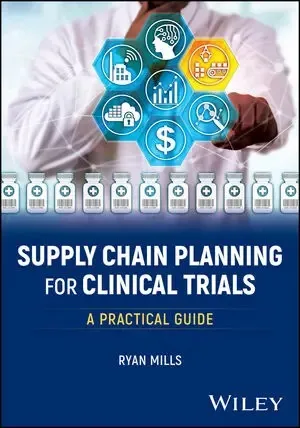
1. What motivated you to write Supply Chain Planning for Clinical Trials: A Practical Guide, and what unique perspective do you bring from your 15 years of experience in the field?
The primary motivating factor for writing this book was to provide a reference guide for people without a formal supply chain background and / or real-world experience with clinical trials. It’s challenging to learn supply chain principles, clinical trial basics, and planning technologies all at once. As a result, navigating multiple learning curves leads to avoidable mistakes that waste precious resources or cause supply unavailability for patients. In terms of my perspective, I bring a blend of classic supply chain training and best practices from time spent both inside and outside of the pharmaceutical industry that led me to want to do this.
2. How did your role at Denali Therapeutics influence the practical insights you share in the book about clinical trial supply chains?
Back in 2019, I started at Denali as the first dedicated supply chain hire and was tasked with building the function from the ground up. In those early days, I built a robust planning tool and began to develop the business processes we use today. From 2020 to today, we’ve hired an outstanding team of supply chain professionals who are responsible for all aspects of supply chain planning and execution. Onboarding, coaching, and developing those people was a primary source of inspiration for the book.
3. What are the key differences in managing supply chains for clinical trials compared to traditional pharmaceutical production?
The first key difference from commercial pharmaceutical products is that the demand profile for clinical trial material is fixed by the study design. There are a pre-determined number of subjects taking a pre-determined quantity of drug. On the surface this simplifies the forecasting process, but planners don’t know where or when those subjects will enroll in the study. Consequently, there is a bias towards over-production which leads to excessive waste. This is exacerbated by the fact that clinical products often have reduced expiry profiles from their commercial counterparts.
4. Can you explain the biggest challenges pharmaceutical companies face when planning the supply of pre-production drugs for clinical trials?
Prior to gaining experience with manufacturing clinical Drug Substance (e.g. the Active Pharmaceutical Ingredient), yields and lead times are often unpredictable. This is especially true for biologics. As clinical development progresses, the manufacturing process often undergoes significant changes to optimize performance and scale the process up for eventual commercial launch. These changes also have the potential to impact yields which influences how many batches to produce and when those batches should begin manufacture to ensure timely supply of clinical material. Further, Quality-related issues often impact clinical material availability because of this lack of experience.
5. How do you approach balancing the need for timely drug supply with the unpredictable nature of clinical trial demand?
The best approach to achieve this balance is to create demand and supply plans that are end-to-end. Here end-to-end means the plan covers all aspects of demand including demand from clinical trials and from manufacturing process development. And the plan should cover all aspects of supply from the Finished Product that supplies the clinic back through Primary Packaging, Drug Product, Drug Substance, and critical Raw Materials. This end-to-end plan creates visibility to the supply chain and enables the Clinical Planner to maintain balance between demand and supply as conditions on the ground change.
6. What are some of the most effective tools or strategies you recommend in the book to minimize risk and cost in clinical trial supply chain management?
Clinical Planners should spend as much time as possible analyzing their plan and developing succinct communications to share the outputs of their analyses with the appropriate stakeholders. Many strategies are shared within the book about how to analyze demand and supply plans, how to effectively perform scenario analyses, and how to share actionable information. Even the best plans are laid to waste if internal and external partners don’t act on the plan’s recommendation.
7. How do regulatory and quality considerations impact the supply chain planning process for clinical trials, particularly in global studies?
Both quality and regulatory play critical roles in supply chain planning processes for clinical trials. So much so that an entire chapter is devoted to each topic! On the quality side, the largest impact is felt in managing production lead times which are often lengthened by the batch record review process. On the regulatory side, it’s imperative that imported product align with the content of the approved Clinical Trial Application (CTA) for a given protocol. Non-compliance can significantly delay a trial. In the European Union and the United Kingdom, there is a dedicated role, the Qualified Person (QP), who both performs a quality check of an imported batch and ensures its attributes match the CTA. However, in most other countries this role doesn’t exist and it’s left to the sponsor to maintain compliance.
8. Could you share an example where inadequate supply chain planning led to significant delays in a clinical trial, and how the situation was handled?
The most impactful delays happen due to insufficient supply of Drug Substance and / or Drug Product. This typically happens when there is a significant change in demand such as a new study getting added to the plan or a significant change in planned supply such as having a batch fail in production without back-up inventory on hand. Both cases represent a planning failure. On the demand side, the Clinical Planner should maintain a close relationship with stakeholders at the trial level and at the program level to anticipate such large changes in demand. On the supply side, the inventory strategy should account for high-risk products to ensure available inventory is available in the event of a batch failure.
9. Your book includes spreadsheet-based models to help readers plan clinical trial supplies. How can these models be adapted for different trial scenarios?
All the models presented in the book reflect foundational planning concepts that are applicable across product modality (e.g. small molecules, biologics) and study design (e.g. open label vs. blinded, single country vs. global). Demand forecasting, Finished Product supply planning, expiry planning, distribution planning, and upstream (e.g. Drug Substance and Drug Product) planning are relevant to every clinical trial supply chain. The hope is that when readers understand these concepts they’ll be able to successfully apply them to their specific product’s supply chain and its planning needs.
10. What business processes do you believe are critical for ensuring efficient supply chain management during clinical trials?
While the book outlines six relevant business processes, there are four essential processes to clinical trial supply chain management. Those are demand and supply plan creation, the demand and supply planning process itself, clinical demand and operations planning (CD&OP), and supply plan handover. Creating the plan requires accurately defining the parameters of the supply chain and the relevant trials. Maintaining an accurate plan requires refreshing the inputs and outputs via a well-organized planning process. CD&OP facilitates the sharing of information with demand-side and supply-side stakeholders. And supply plan handover ensures the plan is communicated and acted upon in a timely fashion.
11. How do you see the evolution of clinical trial supply chains in the face of emerging technologies like AI, blockchain, or personalized medicine?
Artificial intelligence in particular has the potential to profoundly change clinical trial supply chain management. Within the next decade, there is potential for integrated planning tools that provide real-time demand sensing combined with accurate inventory levels. Bolting artificial intelligence onto this type of platform could enable a Clinical Planner to rapidly optimize production plans or to run scenarios under a variety of conditions to generate an options analysis for senior management’s consideration.
12. What role does supply chain optimization play in accelerating the drug development process and reducing costs?
Supply chain optimization plays a crucial role on both fronts. Ensuring uninterrupted supply means a trial will not be slowed due to lack of product. Optimizing production plans reduces waste which allows precious resources to be reinvested elsewhere in the development process. There is a third benefit to supply chain optimization though which is that the organization can remain focused on the drug development process without expending energy on solving supply chain-related issues.
13. What advice would you give to professionals looking to specialize in clinical trial supply chain management? Are there any key skills or qualifications they should focus on?
This is incredibly rewarding work where you have a direct impact on the lives of patients who are desperately in need of lifesaving, life-extending therapeutics, and life-improving. This is also incredibly challenging work that requires strategic agility, analytical reasoning, and strong communication skills. The ideal person in this role likes crunching numbers and enjoys dealing with people, not just one or the other. Obtaining a formal education or professional certification in supply chain management is a nice pre-requisite but nothing beats practical experience in clinical trial management and/or planning expertise in another industry.
14. Do you foresee writing future publications on related topics within the pharmaceutical or biotechnology supply chain field, and if so, what areas would you like to explore further?
While I have no plans to publish another book soon, I’m looking forward to the impact technological advances will have on our industry and in this particular space. Pharmaceutical supply chain thought leadership is another topic that’s been bouncing around my head, too. It’s often said that our industry is decades behind the most forward-thinking, innovative consumer supply chains, but I’m not sure I entirely buy that given the regulatory constraints we operate under. Clearly there are further opportunities for optimization and harmonization between clinical and commercial supply chains though, and that’s an exciting space to potentially approach down the road.