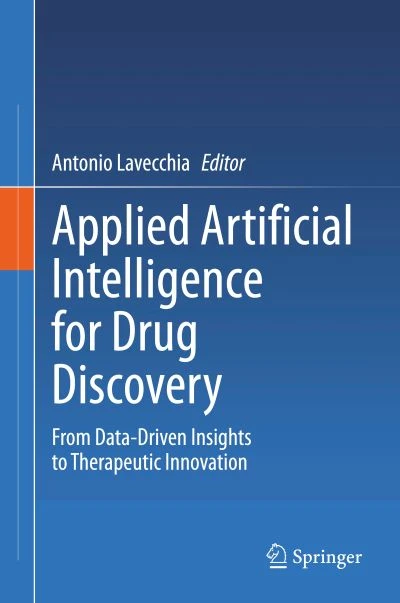
1. What inspired you to compile Applied Artificial Intelligence for Drug Discovery, and what gap in the current literature were you aiming to address?
Applied Artificial Intelligence for Drug Discovery was inspired by the rapid integration of AI across the entire pharmaceutical pipeline, from target identification to clinical translation. I aimed to address a gap between highly specialised AI methods and their practical application in drug discovery. The book brings together interdisciplinary expertise, real-world case studies, and emerging technologies to provide a structured framework for translating data-driven insights into therapeutic innovation across areas such as molecular design, ADMET, repurposing, and clinical development.
2. How does this book differentiate itself from other publications on AI in drug discovery, particularly in terms of practical application and industry relevance?
What differentiates this book is its strong focus on real-world application and end-to-end integration across the drug discovery pipeline. Rather than presenting isolated AI methods or proof-of-concept studies, it links generative models, explainable AI, large language models, federated learning, and reproducible workflows to concrete use cases in medicinal chemistry and translational research. By combining academic and industry perspectives, the book provides actionable insights that support adoption in pharmaceutical R&D.
3. The book spans the entire drug discovery pipeline—from target identification to clinical translation. Why was it important to adopt such an end-to-end perspective?
Adopting an end-to-end perspective is essential because drug discovery is a highly interconnected process, in which decisions made at early stages strongly influence downstream success. Many AI approaches perform well in isolated benchmark tasks but struggle to demonstrate impact in real-world drug development. By covering the full pipeline, from target identification and molecular design to clinical trials and precision medicine, the book emphasises integration, data continuity, and translational relevance across the entire development process.
4. Among the 27 expert-authored chapters, were there any surprising insights or emerging trends that stood out to you during the editorial process?
One striking insight was how rapidly the field is moving toward the integration and convergence of technologies into more unified, data-centric platforms. Across the chapters, there is a clear shift from single-task models to multimodal approaches and foundation models combining structural biology, omics data, and clinical information. The growing role of large language models, federated learning, explainable AI, reproducible modeling, and low-data strategies such as active learning stood out as key trends shaping more scalable and clinically relevant AI systems.
5. How do you see AI reshaping early-stage drug discovery, particularly in target identification and validation?
AI is transforming early-stage drug discovery by making target identification more data-driven, systematic, and less reliant on single-source evidence. Advanced models can integrate genomics, transcriptomics, pathway-level information, and clinical data to uncover novel disease-target relationships that are difficult to detect experimentally. In target validation, AI helps prioritise biologically relevant candidates, assess pathway involvement, and even support indication expansion for existing compounds before costly experimental validation.
6. De novo drug design is gaining traction with AI. What key advancements highlighted in the book do you believe will have the most immediate impact?
One of the most impactful advancements is the rise of generative AI models capable of designing novel molecules with desired properties. Approaches such as deep generative models, reinforcement learning, diffusion models, and foundation models for molecular design are enabling more efficient exploration of chemical space. Their integration with ADMET prediction, retrosynthesis, and feasibility assessment is especially important because the biggest near-term impact will come from molecules that are not only novel but also synthesizable and experimentally testable.
7. ADMET prediction remains a critical challenge in drug development. How does AI improve predictability and reduce late-stage failures, based on the book’s findings?
AI improves ADMET prediction by integrating large-scale chemical, biological, and pharmacokinetic data into more accurate, generalizable, and increasingly predictive models across different chemical spaces. Deep learning approaches can capture complex, non-linear relationships that traditional methods often miss. The book highlights the role of graph neural networks, transfer learning, explainability tools, and multimodal modeling in identifying toxicity and poor pharmacokinetic profiles earlier, helping reduce attrition from preclinical selection through later-stage development.
8. What role do you see machine learning and deep learning playing in bridging the gap between preclinical research and clinical translation?
Machine learning and deep learning are key to bridging the gap between preclinical research and clinical translation by integrating heterogeneous data across biological scales, from molecular to patient-level information. They enable more predictive models that link molecular mechanisms to patient outcomes, improving the selection of clinically relevant targets and compounds. This is especially relevant for AI-assisted clinical trial design, patient stratification, and precision medicine, where integrating preclinical, clinical, and real-world data can improve translational success.
9. From an industry perspective, what are the biggest barriers to adopting AI-driven drug discovery approaches at scale?
The main barriers include data quality and standardization, limited data sharing, and integration into existing R&D workflows. Many models perform well in controlled settings but often lack robustness, reproducibility, and external validation in real-world applications. Regulatory uncertainty, evolving compliance requirements, and the need for interpretability also slow adoption. Many organisations also lack the infrastructure and cross-functional culture needed to connect AI outputs with medicinal chemistry, biology, and clinical decision-making.
10. The book brings together contributions from multiple experts. How did you ensure consistency and coherence across such a diverse set of perspectives?
Ensuring consistency across diverse contributions required a clear editorial framework, strong thematic alignment, and a shared translational focus. I defined a common structure focused on the drug discovery pipeline, encouraging authors to link methods with practical applications and translational impact. Continuous interaction with contributors helped maintain coherence in terminology, scope, and level of detail across very different areas, from molecular modelling and retrosynthesis to federated learning, clinical trials, and precision therapeutics.
11. How can pharmaceutical companies balance the integration of AI technologies with regulatory expectations and data integrity requirements?
Pharmaceutical companies can balance AI integration with regulatory expectations by prioritising data quality, transparency, validation, and reproducibility. Implementing standardised data practices, such as FAIR principles and robust data governance frameworks, as well as maintaining detailed model documentation, is essential. Close collaboration with regulators, robust validation strategies, and explainable AI are also critical,“so that AI becomes not a black-box add-on”, but a documented and auditable part of the development pipeline.
12. What skills and capabilities should the next generation of drug discovery professionals develop to stay relevant in an AI-driven landscape?
The next generation of drug discovery professionals should develop a hybrid, interdisciplinary, and increasingly translational skill set combining domain expertise in chemistry and biology with data science and AI literacy. Familiarity with data curation, validation, reproducibility, and human-AI collaboration will be just as important as knowing how to use models. The future belongs to “augmented scientists” who can bridge experimental and computational approaches in increasingly data-driven research environments.
13. Looking ahead, what are the most promising innovations in AI for therapeutic development that readers should keep an eye on over the next 5–10 years?
Over the next 5–10 years, the most promising innovations include multimodal and foundation AI models, low-data learning strategies, and privacy-preserving collaborative frameworks that better connect chemical, biological, and clinical information. I would also highlight AI for peptide discovery, nanomedicine, digital patient models, and more adaptive clinical development. Large language models, federated learning, and more explainable and trustworthy AI systems will also be central to real-world impact.
14. Finally, what key takeaway would you like readers—particularly industry stakeholders—to gain from this book?
The key takeaway is that AI is not just a technological upgrade but a fundamental paradigm shift in how drugs are discovered and developed. Its true value lies in connecting data, models, experiments, and clinical decisions across the entire pipeline in a more coherent and actionable way. For industry stakeholders, meaningful impact will depend not only on adopting AI tools but on combining innovation with validation, usability, and translational discipline.
Read the full article — it's free
Register with Pharma Focus Europe to unlock expert insights, research articles and in-depth industry analysis.