
In order to ensure progress in medicine, clinical trials are necessary, and sponsors and researchers must not stop their work once the data is gathered. A good number of participants particularly in life-threatening or chronic disease trials undergo a concrete clinical benefit in the course of the trial. Sudden termination of the opportunity to receive the investigational treatment may lead to damage, distress, or even relapse.
Post-trial access (PTA) is access to an investigational intervention or alternative care after the trial intervention is provided, or not provided, after a clinical trial ends. It is an expression of respect, beneficence, and justice; these are three major ethical considerations in biomedical research.
Why Post-Trial Access Matters
The question here is: Once the trial has been completed, do researchers and sponsors have any obligation to the participants? To most of these people, the response is in the affirmative.
Patients enter the trials usually due to necessity when it comes to conditions like HIV, cancer, multiple sclerosis, or rare genetic diseases. They are not necessarily able to provide themselves with care beyond the trial. Patients are put at risk when after realizing that a certain therapy is helpful, it is recalled after the experiment has been done.
When trials are carried out in low and middle-income countries (LMICs) the problem is further complicated by the fact that healthcare facilities are lowly accessible and the trial may be the only way to get access to the latest treatment.
In addition to a moral requirement, PTA can also be used to increase recruitment and retention, as well as instill trust in research, among the population. It has a very clear message that subjects are not mere test subjects, but collaborators of scientific developments.
Ethical and Legal Foundations of PTA
The international ethical practices are becoming more recognized of the necessity of PTA:
| Framework | Key Provisions Related to PTA |
| Declaration of Helsinki (2013) | Researchers should expect to cover post-trial assistance; this should be told to the participants at the consent. |
| CIOMS Guidelines (2016) | The trial mechanisms must incorporate PTA plans; sponsors are encouraged to specify duration and extent. |
| ICH-GCP E6 (R2) | It advises openness and safeguarding of the participants but PTA is not obligatory. |
| UNESCO Universal Declaration on Bioethics (2005) | Focuses on social responsibility such as the provision of follow up care. |
In spite of these endorsements, there is no binding legal obligation in most countries hence, there are some differences between regions.
Key Challenges to Implementation

Implementation can be hindered by practical challenges even when PTA has been ethically agreed upon:
1. Ambiguous Responsibility
What happens to the expense of the after treatment, is it sponsored, local government, insurance or the investigator? In its absence, implementation fails to go through most of the time.
2. National Legislation Absence
Whereas in certain countries PTA is mandatory (e.g. Brazil), in most LMICs there are no enforceable policies and, upon termination of a trial, the participants lack protection.
3. Financial Burden
It can be costly to continue providing the high priced treatment interventions, which is particularly biologics, or cell and gene therapies, when they are outside trial. Long term costs may not be readily covered, or unable to be absorbed by the Sponsors.
4. Regulatory Misalignment
Ethical advice is present, yet in most cases, it clashes with national drug laws, which can be an obstacle to making investigational products accessible after the end of the trial.
5. Logistical Hurdles
Continuity of access may be deterred by such issues as importation of unapproved drugs after trial stage, cold-chain logistics, or clinician training in the country.
Around the World Case Studies:
Brazil
Among the very few countries where the PTA policy is legally required. The government expects the sponsors to support the treatment until it is publicly availed or when the physician advises them to stop the treatment.
India
The New Drugs and Clinical Trials Rules (2019) recently updated, forced a post-trial access obligation in the situations when the patient benefited substantially. Nevertheless, it is still unclear in terms of their timelines and implementation.
South Africa
Research Ethics Committees (RECs) are in an active role of seeing to it that PTA plans are integrated into trial authorization. Follow-up access is closely observed in HIV research in particular.
Europe
PTA is supported by the European Medicines Agency (EMA) to be used in compassionate use, but the rules vary in individual states of the EU. There is post-trial access that may depend by the country and the party that sponsors the trial.
United States
The States do not mandate PTA. Nevertheless, it is possible to enjoy a continued access in special cases through Expanded Access or Compassionate Use programs, which are, for the most part, case-by-case arrangements.
Designing PTA into Clinical Trial Protocols
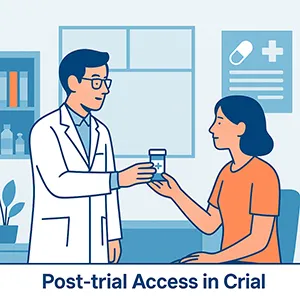
The PTA planning should start at trial design stage. In this proactive approach, it is possible to have:
• Post-trial care budget
• Negotiations with the local health systems to give the eventual handover
• Full text of informed consent language
• Ethics boards alignment between authorities, sponsors and ethics boards
Considerations when Planning PTA
| Element | Recommendations |
| Duration of Access | Clearly define time period fixed (e.g., 1 year) or until commercial availability |
| Type of Treatment | Equal access to investigational product or equivalent evidence based alternatives |
| Eligible Participants | Whether the PTA is given to everyone participating in trials or those who only benefited should be decided on as well. |
| Monitoring & Follow-up | Make sure that safety checks and adverse event monitoring do not stop |
| Local Partnerships | Delivery coordination with hospitals or public health systems |
Ethics Committees and PTA
Research Ethics Committees (RECs) can take influential steps in terms of accountability. They can:
• Turn down the protocols without PTA plans
• Ask a question during trial review
• Demand PTA milestones that can be measured
• Post-study follow-up to make sure of compliance
The main determinant is the reinforcement of RECs through training and support, particularly in LMICs where control might not be substantial.
The Role of Sponsors and CROs
The key role is played by sponsors, and it is pharmaceutical companies. Some of the ways in which they can be responsible to their duties are:
1. Incorporate PTA into the contracts of the site
2. Get involved with health authorities as early as possible
3. Look to local Contract Research Organizations (CROs) to help with post-trial distribution of treatment
4. Standardize the global PTA policy guidelines that are used in every trial
5. Give good exit strategies to transfer participants to sanctioned treatments or national programmes
Improving Transparency and Trust
The participants are entitled to know whether there will be post-trial treatment on the onset. Transparency optimizes informed consent and facilitates the making of better decisions by participants. Among some of the practices are:
• Clear explanation during recruitment
• Open disclosure of limitations
• Avoiding false promises
• Providing contact points for post-trial support
Opportunities for Policy and Innovation
1. United Global PTA Framework: An adopted WHO policy would standardize the expectations and eradicate disparities.
2. Connection with the National Programmes: National programmes (as current treatment programmes) could be aligned with the trials so that transitions would be easier.
3. Public-Private Partnership: There might be a division of duty between the NGOs and the pharmaceutical companies especially in the areas of diseases of poverty.
4. Technology-Based Follow-Ups: Telehealth systems may be used to check on the patients that have been completed within a trial in remote locations.
Conclusion: Sustaining the Promise of Research
The clinical trials are not isolated incidences. They come under a bigger system that needs to safeguard the people within it. Post-trial access could never be just about extending medication rather it is about respecting the faith that participants put in science and it is not leaving participants with a cliff-edge of treatment once they have participated in medical progress.
Ethical investigation needs vision, fair-play and responsibility. The process of embedding PTA into clinical trial design and policy would enable the pharmaceutical industry to make a significant step towards the patient-centred innovation.