
Blockchain for Securing Clinical Trial Data: Safeguarding Integrity in Medical Research
Clinical trials are the foundation of medical progress. They determine the safety and effectiveness of new treatments, from life-saving vaccines to advanced cancer therapies. However, the integrity of trial data has long faced challenges, including unauthorised access, selective reporting, and even deliberate manipulation.
Blockchain technology, once associated primarily with cryptocurrency, is now being explored as a secure and transparent way to record and manage clinical trial data. Its unique combination of immutability, decentralisation, and cryptographic protection offers a framework that could transform the way research data is stored, shared, and verified.
This article examines how blockchain can enhance data security in clinical trials, the practical advantages it offers, the challenges it faces, and what the future may hold for its use in medical research.
The Need for Stronger Clinical Trial Data Security
Clinical trial data is both highly sensitive and extremely valuable. Breaches or inaccuracies can harm patients, undermine trust, and lead to regulatory penalties.
Key reasons data protection is critical:
• Patient confidentiality: People who take part in trials give out private, often genetic information that needs to be kept safe by laws like the General Data Protection Regulation (GDPR) in the EU and the Health Insurance Portability and Accountability Act (HIPAA) in the US.
• Scientific credibility: Altered or incomplete data undermines research outcomes and public confidence.
• Regulatory compliance: Drug approvals depend on verifiable, complete evidence submitted to authorities such as the European Medicines Agency (EMA) and the US Food and Drug Administration (FDA).
• Commercial stakes: Pharmaceutical companies invest heavily in research, and the value of their products can hinge on trial outcomes.
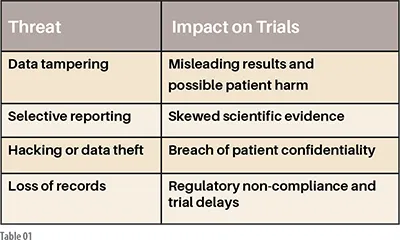
SIDEBAR: Common Data Integrity Threats
How Blockchain Works in Clinical Trials
Blockchain is a distributed ledger, a database duplicated across multiple computers (“nodes”) in a network. Data is stored in blocks, each containing a time-stamped record linked to the previous block via cryptographic methods.
Key attributes relevant to clinical trials:
• Immutability: Once recorded, data cannot be altered without leaving a trace.
• Transparency: People who are allowed to can see a record of all the comments.
• Decentralisation: No single party can control the system unilaterally.
• Security: Cryptographic techniques protect against unauthorised access.
Clinical trial blockchains are often permissioned, meaning only approved parties—such as researchers, sponsors, and regulators, can access or add data.

Ways Blockchain Improves Trial Data Security
Immutable Audit Trails
Once trial data is added to a blockchain, any changes are evident, deterring manipulation. This creates a permanent, verifiable record that can be audited at any stage.
Accurate Time-Stamping
Every entry, such as patient enrolment, consent, or reporting of side effects, is precisely time-stamped. This prevents backdating and ensures events are recorded in the correct sequence.
Secure Consent Management
Informed consent is fundamental in research ethics. Blockchain can store encrypted, time-stamped consent records linked to anonymised patient identifiers, ensuring a verifiable consent history.
Safe, Decentralised Data Sharing
Multi-site and multinational trials require secure data exchange. Blockchain allows encrypted sharing without a single central repository that could be vulnerable to attacks.
Mitigation of Selective Reporting
Trial protocols, results, and amendments can be recorded from the outset, making it evident if unfavourable outcomes are omitted.
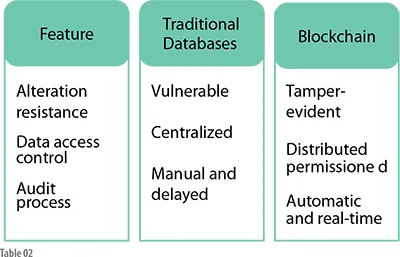
SIDEBAR: Blockchain vs. Traditional Trial Databases
Examples of Blockchain Use in Clinical Research
• TrialChain (University of British Columbia): Uses Hyperledger Fabric to record trial events and data submissions for verifiable audit trails.
• IBM–FDA Pilot Project: Tested blockchain for secure exchange of clinical and real-world evidence data, improving efficiency and trustworthiness.
• Ethereum Protocol Storage: Some researchers use public blockchains to store cryptographic “hashes” of trial data, proving authenticity without exposing raw data.
Current Challenges
Scalability
Clinical trials generate large datasets, including imaging and genetic information. Storing all of this directly on blockchain can be slow and costly. Hybrid approaches, storing large files off-chain but recording their hashes on-chain, are often preferred.
Privacy Regulations
Blockchain’s immutability conflicts with GDPR’s “right to erasure”, requiring innovative solutions that preserve security while meeting legal obligations.
Technical Complexity
Integrating blockchain with existing trial data systems requires specialist expertise and may increase operational costs.
Regulatory Uncertainty
Guidance on blockchain use in clinical trials is still evolving, and global trials face differing jurisdictional requirements.
BOX: Hybrid Storage Model
On-chain: Hashes, time-stamps, consent records, and protocol metadata
Off-chain: Raw clinical data stored securely in cloud or institutional servers, linked to blockchain entries
The Road Ahead
Emerging trends suggest blockchain’s role in clinical trials will expand:
• Integration with Wearables: Continuous patient monitoring devices could feed secure, authenticated data into trial blockchains.
• Smart Contracts: Self-executing code could automatically enforce trial rules, trigger alerts for deviations, and release milestone-based payments.
• Global Registries: A universal blockchain registry of all trials could improve transparency and reduce duplication.
• Patient-Controlled Data Access: Patients could grant and revoke access to their data via blockchain systems, empowering them in the research process.
Conclusion
Blockchain offers an innovative approach to securing clinical trial data, addressing long-standing concerns around integrity, transparency, and data protection. While challenges in scalability, privacy compliance, and regulation remain, early initiatives demonstrate significant potential.
As the life sciences sector seeks more reliable, transparent, and patient-focused research systems, blockchain is poised to become a valuable component of future clinical trial infrastructure—helping to ensure that medical advances are built on a foundation of trust.