
In today's rapidly growing, industries, companies under constant pressure are to meet strict compliance standards. For companies working in areas such as medicines, medical equipment and biotechnology, regulatory conditions plays an important role. The management of regulatory conditions is a complex and time-consuming task, which often includes manual processes, extensive documentation and strict inspections. Fortunately, progress in technology, especially in automation of regulatory conditions and in artificial intelligence (AI), there is a revolution in companies to comply with companies.
What Is Regulatory Affairs?
Regulatory Affairs are a professional area in regulated industries such as medicines, biotechnology, medical equipment and food science. This makes sure that companies follow all rules and promises related to the development and marketing of products.
The Scope of Regulatory Affairs:
Regulatory professionals ensure that their companies meet all national and international regulatory requirements for product growth and then monitoring.
It is important to maintain correct and updated documents. This includes clinical test data, production practices and safety standards.
Presenting regulatory documents to governing bodies is an important aspect of regulatory matters. These submissions should be accurate, wider and in time.
Challenges in Regulatory Affairs:

Manually controlling regulatory affairs presents several challenges:
- Time-consuming Procedures: Preparing, reviewing, and presenting regulatory documents is labor intensive.
- High Risk of Human Error: Manual procedures increase the possibility of errors, potentially delay approval, or result in the resulting non-transport penalty.
- Increasing Complexity: Regulatory landscapes are constantly evolving, with constant updates of rules, guidelines, and compliance standards in areas.
Given these challenges, transformation solutions in automation and artificial intelligence of regulatory conditions have emerged as promoting as streamlining operations and reducing errors.
Future of Regulator Automation: Implementation of AI in Regulatory Operations:
New artificial intelligence tools (AI) are close to mainstream. Despite the first reluctance, the regulation teams are now immersed in AI-assisted solutions with a view to increasing compliance. However, development teams are required to prioritize real-time data evaluation to a machine-first approach. AI and machine learning tools are prescribed to produce better results for patients, payments, and stakeholders.
Although the adoption has slowed, large pharmaceutical companies have already invested in AI-implemented automation for regulatory document analysis. These devices are from basic automation to fully AI-assisted review system, procedures to streamline and improve accuracy.
Regulatory Operations Include Large Applications of AI:
Automatic study protocol: AI can automatically populate the study protocol using text from Explorer's brochure and protocol concept documents.
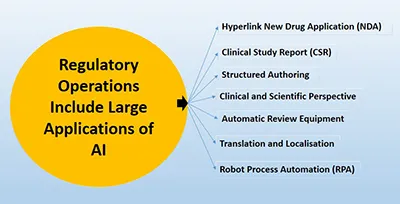
- Hyperlink New Drug Application (NDA): Automation enables hyperlinks within NDA, improving navigation and access.
- Clinical Study Report (CSR): Early simplifies the creation of automation security stories, especially for large datasets, with the Medical Writing Safety Authority that ensures accuracy.
- Structured Authoring: The document standardizes the organization so that authors can focus on materials by following predetermined rules.
- Clinical and Scientific Perspective: AI-borne material requires specialist assessment to ensure scientific accuracy and appropriate decisions.
- Automatic Review Equipment: Initiation of sequential review procedures simultaneously documents reviews, comments, and tracking facilities.
- Translation and Localization: For the summary, agencies such as AI/ML AIDS are required, especially EMA in multilingual document construction.
- Robot Process Automation (RPA): Data helps with works such as extraction, server upload, filing, document imports, concentrations, bookmarks, and data organization.
AI-operated automation reduces manual workload and improves efficiency, accuracy, and compliance, redeveloping regulatory conditions. As adoption increases, organizations should balance technological progress with specialist inspection to ensure regulatory integrity.
Key Considerations for Implementing Regulatory Automation:
Careful plans for risk evaluation and mitigation are necessary to implement regulatory automation. Organizations should evaluate potential challenges, ensure a clear return on investment (ROI), and have realistic expectations. Tying teams, securing senior leader sponsors, and working with experienced partners can increase the success of the implementation.
The most important factors that include
- Data Management: A strong data management system is required to maintain accuracy and safety. This includes data confirmation, quality control, and security measures.
- Technology Requirements: Organizations will assess the needs of hardware, software, and network infrastructure, as well as evaluate the seller's solution to choose the most appropriate technique.
- Resources and Skills: Special expertise in data management, programming, and project management is important for implementation and ongoing system maintenance.
- Change Management: Automation introduces important processes and technical changes. A well-defined change management plan, including communication, training, and clear guidelines, ensures a steady transition and reduces disruptions.
Regulatory automation is a complex but transformative effort. Organizations should attack the right balance, neither being very ambitious nor limited to achieving meaningful effects.
Future of Regulatory Automation: Navigation of AI and Regulatory Operations:
Despite the existing challenges, the regulatory landscape is first class for automation, much adopted with AI and software tools. A machine-first approach, combined with real-time data evaluation, paves the way for a dynamic regulatory system from the start, which reduces more effective results for patients, payers, and stakeholders.
AI in Regulatory Operations: Current Landscape
Regulatory automation is run by advanced technologies such as AI-driven match management systems, which benefit from algorithms and machine learning to identify potential match risk.
Further automation tools include:
- Document Storage Solution: safe and structured storage for regulatory documents.
- Submission Publishing Platform: Preparation and presentation of submission of regulations.
- Workflow Management Equipment: Increase process efficiency and collaboration.
In addition to improving efficiency, regulatory automation makes pharmaceutical companies deal with large workload by maintaining compliance and quality standards. For example, performing stability tables is a repetition, accuracy material function. Automation software eliminates manual data introduction, so that regulation teams can focus on high-value activities by reducing errors.
The Benefits of Regulatory Automation in the Life Sciences Industry:
The regulatory streamlines automation operations, reduces human errors, and ensures compliance with developed rules. Large benefits include:
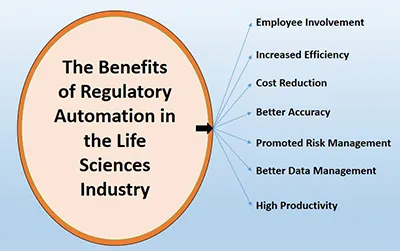
- Employee Involvement: Automation eliminates duration tasks so that employees can focus on high-value work and top modern technologies.
- Increased Efficiency: Automatic equipment streamlines operations and reduces the time and resources required for match management.
- Cost Reduction: Automation reduces the matching costs by eliminating manual data collection and analysis.
- Better Accuracy: Automatic systems reduce human errors, increase data quality and regulatory reporting.
- Promoted Risk Management: AI-operated equipment detection and addresses on compliance, which reduces the risk of non-transport and known damage.
- Better Data Management: The automatic system ensures that the regulatory data is accurate, updated, and easily accessible, improving the reporting standards.
- High Productivity: Automation allows clinical research organizations (CROs) and regulatory teams to focus on strategic initiatives to increase competition.
For organizations working with clinical research partners, it is necessary to choose a partner with a strategy focused on quality, efficiency, and cost-effectiveness. Proper adjustment ensures that regulatory automation equipment effectively benefits from meeting goals for business and compliance.
Getting Started with Regulatory Affairs Automation and AI:
For companies automating regulatory cases and companies that use AI, the first step is to evaluate current processes to identify areas where automation can provide the highest value.
Implementation step
- Consider the Current Processes: Identify time-consuming regulatory functions.
- Research Automatisation Equipment: Explore solutions that provide AI-driven automation and match insight.
- Pilot a Solution: Test the system on a small scale before a full rollout.
- Train Your Team: Make sure professional regulatory cases are equipped to use new equipment effectively.
Conclusion:
The automation of regulatory conditions and AI is no longer just industry buzzwords; they are required to remain competitive in heavily regulated industries. By streamlining compliance, by reducing errors, and by providing data-driven insights, these technologies increase the efficiency of a rapidly complex regulatory landscape. As adoption increases, the future of regulatory conditions will be smart, faster, and more efficient.