The biopharmaceutical industry is undergoing a profound transformation, marked by the convergence of biotechnology, computational sciences, and engineering. This dynamic evolution is being accelerated by innovations across multiple scientific disciplines, including genomics, artificial intelligence (AI), systems biology, precision engineering, and synthetic biology. Together, they are redefining how drugs are discovered, developed, manufactured, and delivered. One of the most significant shifts in this landscape is the diversification of the therapeutic pipeline. Traditional small molecules and monoclonal antibodies are now being augmented—and in some cases, replaced—by next-generation biologics such as bispecific antibodies, antibody-drug conjugates (ADCs), fusion proteins, and nucleic acid-based therapeutics. This paradigm shift allows for therapies that are not only more potent but also highly targeted, minimising off-target toxicity and improving patient outcomes, especially in complex disease states such as oncology, autoimmunity, and rare genetic disorders.
Next-Generation Biologics and Their Role in Precision Therapeutics
Among the emerging biologic modalities, bispecific antibodies and ADCs represent the forefront of precision oncology. Bispecifics are engineered to bind two different epitopes or antigens simultaneously, enhancing their ability to recruit immune effector cells or block multiple signaling pathways. ADCs, on the other hand, are hybrid molecules that combine the targeting capabilities of antibodies with the cell-killing potency of cytotoxic drugs. This dual action increases therapeutic efficacy while reducing systemic exposure, which is particularly valuable in the treatment of hematological malignancies and solid tumors. Fusion proteins are another novel class gaining momentum. By linking therapeutic proteins with domains that extend half-life or modulate immune responses, fusion proteins provide enhanced pharmacokinetics and safety profiles. Recent FDA approvals for fusion-based drugs treating hemophilia and autoimmune diseases underscore their growing clinical relevance.
mRNA Therapeutics and Programmable Gene Modulation
The COVID-19 pandemic served as a catalyst for mRNA vaccine technology, but its potential extends far beyond infectious diseases. Current research is optimizing mRNA platforms for a wide array of applications including protein replacement therapies for genetic deficiencies, immuno-oncology, and in vivo gene editing. Self-amplifying mRNA (saRNA) and circular RNA (circRNA) technologies are emerging as next-generation platforms, offering prolonged expression and lower dosing requirements. Particularly exciting is the integration of programmable RNA-guided systems like CRISPR-Cas13, which target and edit RNA rather than DNA. This enables transient, reversible gene modulation with fewer off-target effects compared to DNA editing systems. Such tools are under preclinical evaluation for conditions ranging from spinal muscular atrophy to chronic viral infections.
AI/ML Integration in Biologic Design and Drug Development
Artificial intelligence and machine learning are revolutionizing drug discovery pipelines. Advanced algorithms now facilitate de novo drug design, codon optimization, immunogenicity prediction, and virtual screening of biologics. AI models can also predict three-dimensional protein structures using tools like AlphaFold2, drastically reducing the time and cost associated with crystallography or NMR-based methods. AI-driven optimization of codon usage is particularly critical in mRNA therapeutics, where nucleotide sequence affects protein translation efficiency, stability, and innate immune activation. Furthermore, AI/ML approaches are being embedded in pharmacokinetic/pharmacodynamic (PK/PD) modeling and clinical trial simulations to forecast therapeutic windows and patient responses with high precision.
Synthetic Biology and Computational Biophysics: Enabling Rational Design
Synthetic biology provides the framework for constructing novel biological circuits, while computational biophysics offers mechanistic insights into molecular interactions. Together, they enable rational protein engineering and metabolic pathway redesign. One example is the development of logic-gated CAR-T cells that selectively kill cancer cells expressing two or more tumor markers, thereby reducing on-target/off-tumor toxicity. In microbial systems, synthetic biology allows for the engineering of chassis organisms—such as E. coli, Saccharomyces cerevisiae, or Pichia pastoris—to express high-value therapeutic proteins with optimized yields. Moreover, de novo biosynthesis of complex molecules like opioids or taxanes using engineered pathways is proving cost-effective and scalable. Table 1 outlines critical enabling technologies revolutionizing biopharma pipelines and infrastructure
Table 1: Emerging Technologies Shaping Biopharma
| Technology | Application Area | Current Status |
| Self-amplifying mRNA vaccines | Infectious disease, oncology | Preclinical to Phase I trials |
| AI-driven drug discovery | Target identification, de novo design | Industry-wide integration |
| CRISPR-Cas13 gene editing | RNA-based modulation of gene expression | Preclinical |
| IIoT-enabled smart manufacturing | Real-time process control, automation | Implemented in cGMP facilities |
| Digital twin in bioprocessing | Simulation of cell culture and purification | Early-stage adoption |
| Modular, single-use bioreactors | Biomanufacturing scalability and sterility | Industry standard |
| Real-world evidence (RWE) platforms | Post-market surveillance, adaptive trials | FDA-recognized |
Revolutionizing Manufacturing: From Batch to Smart Continuous Bioproduction
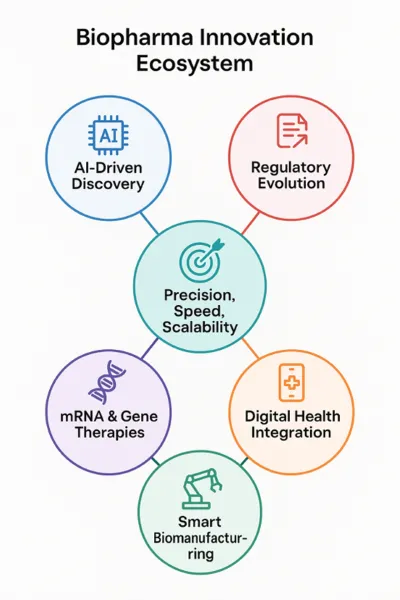
The manufacturing arm of biopharma is evolving with equal intensity. Traditional batch production is giving way to continuous biomanufacturing, enabling higher yields, lower costs, and better consistency. This transition is powered by innovations such as single-use modular bioreactors and integration of Process Analytical Technology (PAT) for real-time monitoring of critical quality attributes (CQAs). Digital twins—virtual replicas of the physical manufacturing process—are becoming indispensable tools. These models simulate bioreactor behavior and purification steps under varying conditions, helping optimize operations without halting actual production lines. They are particularly valuable during scale-up or tech transfer processes between contract development and manufacturing organizations (CDMOs). Smart manufacturing, enabled by the Industrial Internet of Things (IIoT), involves interconnected sensors, cloud-based analytics, and AI-driven process control. In Good Manufacturing Practice (cGMP) environments, IIoT facilitates predictive maintenance, energy efficiency, environmental control, and quality assurance. Figure 1 demonstrates the interconnected ecosystem that underpins next-generation biopharmaceutical innovation and delivery.
Digitization and Decentralization in Clinical Development
Biopharma is also witnessing transformation in how clinical trials are designed and conducted. Adaptive trial designs—where dosing regimens, sample sizes, or endpoints may evolve mid-trial based on interim data—are gaining regulatory acceptance. Similarly, decentralized clinical trials (DCTs), which rely on telemedicine, wearable devices, and home delivery of drugs, are improving patient recruitment and retention while reducing trial costs. Real-world evidence (RWE) is another game-changer. By analyzing patient data from electronic health records (EHRs), insurance claims, and digital health devices, researchers can validate drug efficacy and safety post-approval, thereby enhancing pharmacovigilance and life-cycle management. Regulatory bodies like the FDA and EMA are now including RWE in their decision-making frameworks.
Personalized Medicine and Ecosystem Integration
The convergence of diagnostics, therapeutics, and digital tools is making personalized medicine a clinical reality. Companion diagnostics now accompany many biologics, helping clinicians tailor treatments based on patient genotypes, immune profiles, or biomarker expression. Pharmacogenomics is being embedded into electronic health systems, guiding decisions on drug selection and dosage. Moreover, digital therapeutics—software-based interventions approved for specific clinical indications—are being integrated with traditional treatments to improve adherence and patient engagement. These include AI-powered mobile applications that track symptoms, deliver cognitive behavioral therapy, or monitor biometric data in real time.
The Road Ahead: Regulatory Flexibility and Global Collaboration
Regulatory frameworks are evolving to support this innovation. Agencies are adopting faster approval pathways such as Breakthrough Therapy Designation (BTD), Accelerated Approval, and Conditional Marketing Authorizations. Collaborative review models across jurisdictions (e.g., FDA-EMA pilot programs) are also expediting international approvals. Public-private partnerships (PPPs), particularly during the COVID-19 era, have illustrated the potential of collaborative ecosystems. Initiatives like Operation Warp Speed and the Coalition for Epidemic Preparedness Innovations (CEPI) have demonstrated that with sufficient funding, coordination, and regulatory agility, life-saving therapies can be delivered in record time.
Sustainability and Ethical Innovation in Biopharma
As the biopharmaceutical industry scales innovation, it is also under increasing pressure to align its operations with principles of environmental sustainability, equitable access, and ethical research conduct. The environmental footprint of biologics manufacturing—characterized by high energy consumption, single-use plastics, and complex cold-chain logistics—is prompting a shift toward greener bioproduction models. Sustainable biopharma is no longer aspirational; it is becoming operationally and strategically critical. To address these challenges, companies are investing in green chemistry, biodegradable materials, and energy-efficient manufacturing systems. Closed-loop systems, where bioreactors and downstream units are integrated to minimize waste and solvent use, are gaining traction. Some facilities now harness renewable energy sources and employ carbon offsetting mechanisms to reduce greenhouse gas emissions. In parallel, eco-friendly packaging and ambient-stable biologics are being explored to reduce the reliance on cold-chain infrastructure, especially important for expanding access in low-resource settings.
On the ethical front, the use of AI and real-world data in research must be balanced with robust governance frameworks to safeguard patient privacy, informed consent, and data integrity. Regulatory bodies are beginning to mandate explainability and auditability in AI models used for clinical decision-making or drug discovery. Equity in access to advanced therapeutics—particularly gene therapies and immunotherapies—remains a global challenge. Addressing this requires differential pricing strategies, open science collaborations, and regional manufacturing hubs that can localize production while maintaining global quality standards. Ethical innovation now extends beyond molecules to include how those molecules are discovered, who benefits from them, and at what cost.
Conclusion
The biopharmaceutical industry stands at the cusp of a new era—one defined by convergence, intelligence, and patient centricity. Innovations in genomics, synthetic biology, and mRNA therapeutics are being complemented by AI-driven design tools, IIoT-based manufacturing, and digitized clinical workflows. These integrated platforms are accelerating discovery, enhancing safety, and driving down costs. At the same time, they are enabling the creation of highly personalized, adaptive, and scalable therapeutic solutions. As biopharma shifts from a drug-centric to an ecosystem-centric paradigm, its impact on global health will become not just transformative but truly foundational.