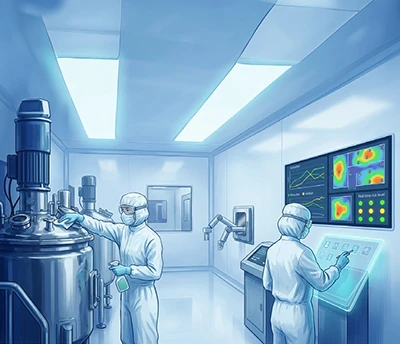
Biopharmaceutical manufacturing has always carried an inherent risk of contamination, but the nature of that risk is changing. Today’s facilities are more interconnected and biologically complex than ever. Cell and gene therapies (CGTs), multiproduct operations and accelerated development timelines have all raised the stakes for contamination control.
In this environment, cleaning and disinfection are more than routine hygiene activities operating quietly in the background: they are foundational elements of process protection. When living systems and complex biomolecules are involved, even minor lapses can result in batch failure, supply disruption or regulatory scrutiny. As regulatory expectations continue to evolve, most notably through the updated EU GMP Annex 1, manufacturers are being challenged to demonstrate that cleaning and disinfection are scientifically justified and fully integrated into a broader contamination control strategy (CCS).
The new reality of biopharma contamination risk
On paper, many biopharmaceutical operations take place in Grade C and D cleanrooms, similar to those used in small molecule manufacturing. In practice, the comparison is misleading.
Biopharmaceutical processes depend on cell cultures, growth media and proteins that are highly susceptible to contamination. A microbial ingress that might be manageable in a chemical process can rapidly proliferate in a biological system, often rendering an entire batch unusable. Several factors amplify this challenge:
• Early-stage vulnerability, where contamination introduced upstream can propagate throughout the process
• Multiproduct facilities, increasing the potential for cross-contamination
• Integrated manufacturing models, combining upstream, downstream and sometimes fill-finish activities, or transferring intermediates between sites.
As a result, many biopharmaceutical manufacturers adopt more conservative cleaning and disinfection practices than room classification alone would suggest. Increasingly, regulators expect this conservatism to be articulated explicitly within a structured CCS, rather than embedded implicitly in legacy practices.
From procedures to systems, from complexity to control
The updated Annex 1 has reinforced what many biopharmaceutical manufacturers already recognise: contamination control cannot be managed through isolated procedures [1]. Instead, it must be addressed through an integrated CCS.
In the context of cleaning and disinfection, this requires moving beyond a narrow focus on individual products or methods to a broader evaluation of how and why specific approaches are selected, how they are applied in practice and how effectiveness and residue control are demonstrated over time. The challenges outlined below highlight the key considerations that must be addressed to ensure cleaning and disinfection strategies are truly holistic, risk-based and aligned with the demands of modern biopharmaceutical manufacturing.
Challenge 1: Cleaning complex product contact equipment without direct visibility
Product-contact equipment presents some of the most demanding cleaning challenges in biopharmaceutical manufacturing. Unlike many small-molecule processes, residues are rarely uniform or chemically simple. Instead, cleaning programs must address complex and variable combinations of:
• Proteins and product-related impurities
• Cell debris and nucleic acids
• Media components, buffers and excipients
These challenges are often amplified downstream. Operations such as centrifugation and separation generate dense, heterogeneous residues that are difficult to remove and even more difficult to assess visually. Equipment design further compounds the problem: extensive closed pipework, complex skids and large vessels significantly limit access and preclude direct inspection.
Addressing these challenges depends on carefully designed and validated clean-in-place (CIP) programs in which cleaning effectiveness is demonstrated through repeatability rather than one-off outcomes. This requires selecting chemistries appropriate for biological soils, defining robust process parameters such as temperature, time, flow and mechanical action, and using validation strategies that consistently demonstrate effective soil removal across the full range of operating conditions.
Challenge 2: When cleaning agents become the next contamination risk
In biopharmaceutical operations, residues do not originate solely from the manufacturing process itself. Cleaning and disinfection agents can also introduce risk if they are not adequately removed or if the selected chemistries are poorly matched to the materials of construction. Over time, heavy reliance on water and clean steam, particularly when complementary acidic cleaning steps are limited or absent, can lead to surface discoloration, mineral deposits or rouging in stainless steel systems. Aggressive disinfectants or poorly controlled residues may further accelerate corrosion, staining or surface degradation.
These effects complicate visual inspection, but the more significant concern is their impact on the long-term integrity and reliability of critical equipment. Given the substantial capital investment in biopharmaceutical facilities, particularly in stainless steel vessels, skids and support systems, residue control is both a contamination-control challenge and an asset-protection issue. Increasingly, regulators view visible residue as an indicator of underlying control, but the operational risk extends well beyond inspection readiness.
Addressing this challenge requires a lifecycle approach rather than periodic corrective action. Effective residue management depends on selecting chemistries with proven rinsability and low-residue profiles, defining rinse criteria that reflect process and material risks, and verifying performance through routine checks rather than relying on visual assessment alone. As equipment designs, utilities and operating conditions evolve, these controls must be reassessed periodically and clearly embedded in the CCS. In biopharmaceutical manufacturing, protecting compliance and protecting assets are closely linked objectives, and both rely on deliberate, science-based residue management.
Challenge 3: Manual environmental cleaning
While equipment cleaning is often highly engineered, environmental cleaning and disinfection remain largely manual, and therefore inherently variable.
Biopharmaceutical cleanrooms typically require disinfectants supported by robust efficacy datasets. Beyond bactericidal, fungicidal and sporicidal performance, additional data, such as virucidal or endotoxin-related information, can give added assurance, as well as support potential investigations and risk assessments should they arise. However, efficacy on paper does not guarantee efficacy in practice. Manual application introduces variability at multiple points:
• Differences in technique and surface coverage
• Inconsistent contact times
• Variability in training and interpretation of standard operating procedures (SOPs)
• Lower perceived criticality in Grade C and D environments.
Reducing variability depends on structured controls, including clear, detailed SOPs and consistent operator training and supervision. When selecting disinfection agents, one active agent available across multiple formats (wipes, sprays, bulk solutions) should be considered. Standardising chemistry across upstream and downstream areas simplifies validation and rotation strategies.
Challenge 4: Large cleanrooms and limited time
Biopharmaceutical cleanrooms are much larger than those found in small-molecule facilities, creating practical challenges for routine cleaning and disinfection. Applying disinfectants across expansive floor areas and around complex equipment layouts using traditional mops and buckets is often time-consuming and ergonomically demanding. These constraints have driven growing interest in alternative application approaches that can improve coverage and efficiency, while reducing reliance on operator technique.
In this context, optimised application tools, automated or semi-automated systems, and bio-decontamination technologies such as vaporised hydrogen peroxide are being considered, particularly for large or hard-to-access spaces. While automation is not appropriate for every scenario, it can deliver a level of uniformity and repeatability that manual methods alone cannot, especially in challenging areas.
Challenge 5: Reduced cleaning does not mean reduced risk
Single-use systems have reduced the need for traditional cleaning validation and enabled rapid changeover in biopharmaceutical manufacturing, but they do not eliminate the risk of contamination. Instead, they introduce a different set of challenges that must be actively managed. Polymeric materials used in single-use assemblies can be sensitive to certain disinfectants, and over-application or incompatible chemistries may compromise material integrity. For this reason, careful adherence to supplier guidance is essential, particularly when handling high-value components.
Transfer disinfection represents one of the most critical interfaces in single-use operations. Effective control depends on clearly defined procedures and approved material lists, close collaboration with suppliers to support double- or triple-bagged packaging where possible and, in some cases, the use of automated transfer disinfection systems to reduce operator variability. As a result, the primary risk shifts from cleaning validation to the consistent control of interfaces between uncontrolled and controlled environments.
Challenge 6: Managing closed systems at the point of highest risk
As processes progress toward fill-finish, isolators and closed systems become central to contamination control. These systems rely heavily on validated bio-decontamination cycles to achieve consistent, repeatable control across large internal surface areas.
Cycle development and validation are therefore critical, requiring a detailed understanding of:
• Load configuration
• Material compatibility
• Worst-case conditions
When properly implemented, bio-decontamination provides a powerful complement to manual cleaning programs, offering a level of consistency that is difficult to achieve through operator-dependent methods alone.
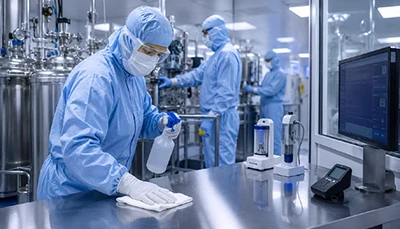
What inspectors are really looking for now
Regulatory scrutiny of cleaning and disinfection practices continues to intensify. Annex 1 explicitly highlights residue control, reflecting concerns around visible buildup, chemical interactions and surface degradation.
Inspectors are increasingly focused on:
• Justification of disinfectant selection and rotation
• Evidence of residue control within the CCS
• Use of sporicidal agents
• Alignment between documented procedures and actual practice
• Environmental isolate trending and robust root cause analysis (RCA) when required
• Robust corrective and preventative action (CAPA) and effectiveness checks
Facilities that can demonstrate a coherent, data-led approach are better positioned to respond to this scrutiny.
The direction of travel: Automation, data and smarter control
Future advances in cleaning and disinfection will likely focus on reducing variability and increasing predictability. Automation, whether through robotic application systems or integrated bio-decontamination, can reduce reliance on operator technique, particularly in large or complex environments.
Digital tools add another layer of control, enabling trend analysis, early risk identification and improved data integrity. By shifting from reactive response to predictive insight, manufacturers can strengthen contamination control while supporting regulatory compliance. At the same time, there is growing interest in more sustainable, low-residue chemistries that balance environmental considerations with performance and material compatibility.
A different industry demands a new mindset
Biopharmaceutical manufacturing is not simply an extension of traditional pharmaceutical production, as the biology involved and the complexity of modern facilities require a different mindset for contamination control.
Cleaning and disinfection now sit at the intersection of process protection, operational execution and regulatory compliance. In environments built around cell cultures, complex proteins and closed systems, these activities can no longer be treated as background hygiene tasks or managed in isolation. Their effectiveness depends on how well they are designed and integrated into the broader manufacturing system.
Regulatory expectations, reinforced by Annex 1, reflect this shift. As facilities become more flexible and processes more interconnected, the margin for error continues to narrow. Addressing that risk requires a scientific, data-led approach that treats cleaning and disinfection as critical control measures. When embedded within a robust, risk-based CCS, they become essential to protecting product quality, safeguarding supply continuity and sustaining regulatory confidence in an increasingly complex biopharmaceutical landscape.
Reference
1. https://health.ec.europa.eu/document/download/6eaee230-0dde-4bd2-b4b8-4f248be26d13_en
Read the full article — it's free
Register with Pharma Focus Europe to unlock expert insights, research articles and in-depth industry analysis.