
Drug formulation has never been more demanding. Pharmaceutical developers are increasingly working with challenging molecules poorly soluble, chemically sensitive, or unpleasantly bitter and a range of patient demographics, conditions, and preferences. Addressing these successfully requires more than a well-chosen active pharmaceutical ingredient (API). It demands advanced formulation expertise that considers the full patient experience.
Excipients historically regarded as inert carriers or fillers are central to that effort. The science underpinning their selection and use has evolved considerably, revealing how functional excipients can now help formulators address problems that, until recently, had no good solution.
From inactive to indispensable: a new perspective on excipients
In modern drug development, excipients are chosen for a multitude of reasons, from lipids that enhance solubility to polymers that enable controlled release to surfactants, disintegrants, and stabilisers that optimise drug delivery and dosage form performance. The choice of excipient can meaningfully influence how a drug behaves in the body, how reliably it reaches its site of action, and how long it remains stable on the shelf. As such, excipients are no longer selected simply to carry an API, but for their ability to actively shape drug performance.
Vitamins are an excellent example of this shift. Ascorbic acid (vitamin C) and alpha-tocopherol (vitamin E) are increasingly incorporated into formulations not for their nutritional properties but for their antioxidant activity. In formulations containing chemically sensitive APIs, these compounds can protect against oxidative degradation, extending shelf life and preserving therapeutic efficacy. What’s more, they can also be used as nitrite scavengers to mitigate nitrosamine formation a safety concern that has been under intense regulatory scrutiny since potentially cancer-causing carcinogens were first identified in common medicines in 2018.
Vitamins and their derivatives are also playing a vital role in the growing biologics space, where they support the development of advanced therapy medicinal products. Specifically, vitamin excipients may be used to prevent protein aggregation, reducing viscosity in monoclonal antibody solutions, as well as acting as adjuvants in vaccines, and providing nutrients in cell culture for biopharma processing. Together, these evolving applications illustrate how excipients have moved beyond passive formulation components to become multifunctional enablers of stability, safety, and therapeutic performance across an increasingly complex drug development landscape.
The bitter truth: why taste is a persistent formulation challenge
Beyond stability and biological performance, excipients can also shape the way a medicine is experienced by the patient, from its texture to its taste. This is especially critical given that unpleasant taste remains one of the most common reasons patients do not take their medications. In fact, 91% of U.S. paediatricians reported unpleasant medication taste as a key barrier to patient compliance, and 64% of 14-year-olds say that “disliking taste” is a main reason they find some medicines difficult to take. Similarly, 40% of consumers agree that taste influences their choice when purchasing over-the-counter products.
The impact of unpleasant tasting medicine is felt across all patient populations, but children and the elderly are often the most affected. Children are particularly sensitive to bitterness and are more likely to refuse medication or spit it out, while elderly patients may experience altered taste perception, making them more susceptible to off-notes such as metallic or lingering bitter sensations. Regulatory bodies, including the European Medicines Agency (EMA) and the U.S. Food and Drug Administration (FDA), have recognised this, emphasising the importance of palatability in drug product development. For formulators, prioritising palatability in oral dosage formulation is therefore not a nice-to-have it’s essential to patient adherence and treatment success.
More than 60% of APIs are inherently bitter, making taste one of the most common formulation challenges in oral drug development.
The science of bitterness
Humans are evolutionarily adapted to detect and reject bitter-tasting compounds, which in nature often signal toxicity. The detection mechanism relies on a family of taste receptors known as bitter taste-sensing type 2 receptors (TAS2Rs, or T2Rs), which belong to the G protein-coupled receptor (GPCR) superfamily. There are 25 known TAS2Rs in humans, each capable of detecting structurally diverse bitter compounds. Some TAS2Rs are broadly tuned, responding to many different bitter molecules, whereas others are highly selective, recognising only a handful of specific molecules.
When a bitter API activates these receptors, it triggers an involuntary aversive response that can lead to immediate rejection of the medication, particularly in more sensitive patient groups, like children and senior adults. This ‘rejection’ is heightened when bitterness lingers or worsens as the medication dissolves in the mouth, causing a long-lasting negative experience. Even minimal levels of bitterness can significantly reduce patient compliance.
The complexity of the problem lies in its variability. Bitterness perception differs between individuals genetic variations in TAS2R genes mean that what tastes intensely bitter to one patient may be only mildly unpleasant to another. Therefore, understanding the molecular mechanisms of bitterness perception and how different APIs interact with TAS2Rs is key to developing effective taste modulation strategies.
The taste modulation toolkit
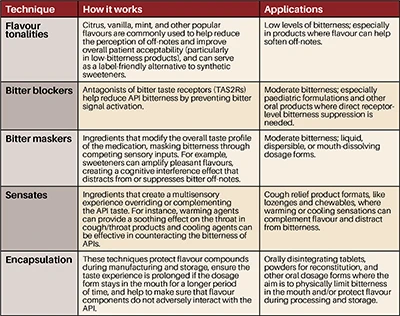
Multiple strategies are available to address bitterness in pharmaceutical formulations, and they are not mutually exclusive. In practice, effective taste masking often requires a combination of approaches, selected and optimised for the specific sensory profile of the API and the needs of the target patient population. The following table summarises the key tools in the taste modulation toolkit and how they work in practice.
While flavour tonalities remain among the most widely used tools in the taste enhancement toolbox, the right approach depends on the level of bitterness involved. Low levels of bitterness can often be addressed using tonalities alone, while moderate bitterness typically requires the addition of blocking and masking strategies. For very high bitterness, formulators may need to combine all available tools, including innovative taste modulation technologies and encapsulation techniques, to reduce bitterness as much as possible. By integrating one or a combination of these approaches, it is possible to produce therapies that are not only effective but also more palatable, ensuring better patient adherence to treatment regimens.
Case study: Targeting bitterness at the source
Using proprietary receptor-based discovery methods and sensory validation, bitterness masking technologies have been developed that target bitter taste receptors directly rather than relying solely on flavour masking. This reflects an emerging approach to addressing poor palatability through the combination of blockers, maskers, and cognitive interference molecules adapted for different APIs and oral dosage forms.
These technologies are typically developed through multi-step workflows supported by technical documentation, regulatory data, and sensory evaluation studies to support formulation development and palatability assessment.
The earlier the better: regulatory considerations
A common and possibly costly mistake in drug development is to treat taste as an afterthought. Flavour selection that is deferred until late-stage formulation development often leads to reformulation exercises, delayed timelines, and missed market opportunities. The regulatory implications alone can be significant.
In Europe, flavouring substances are governed by Regulation (EC) No 1334/2008 and must appear on the EU's approved list for food use; safety criteria are set by the European Food Safety Authority (EFSA). In the US, the FDA classifies flavours into distinct categories—natural, natural with other natural flavours, artificial, and blended—with implications for labelling and marketing. Any flavouring used in a medicine must be evaluated to confirm it does not adversely affect the quality, safety, and efficacy of the API, a requirement that demands careful documentation and often specialist support.
Practically speaking, taste decisions are best introduced around Phase II of clinical development, once safety assessments are complete and the core formulation is sufficiently established. At this stage, a structured approach should consider the following:
• Patient demographics: many children find bitter tastes particularly unpleasant and are more comfortable with sweeter flavours, while elderly patients may also struggle with bitterness or metallic notes. Geographical and cultural flavour preferences also vary.
• Regulatory requirements: regional standards differ in their approach to natural versus artificial options. Halal, kosher, and allergen-free certifications may also be relevant depending on the target market.
• Technology selection: the choice of masker, blocker, sensate, or encapsulation strategy must be aligned with the dosage form, manufacturing process, and stability requirements.
• API interactions: flavour components must not reduce the efficacy or stability of the active ingredient. Where chemical interaction is a risk, encapsulation or careful composition design can provide a solution.

The sweet spot of functional excipients
Functional excipients, from vitamins acting as nitrite scavengers and antioxidants to flavour modulators that target taste at the receptor level now make it possible to address formulation challenges that once required compromise. The key is to use them strategically. This requires an understanding of the underlying biology and chemistry, specialist formulation expertise, an awareness of regulatory requirements, and an appreciation of the patient experience that begins the moment a medicine enters the mouth.
As the pharmaceutical industry continues to evolve and formulations become more complex, the role of excipient science in enabling safe, effective, and patient-friendly medicines is essential. Formulators who harness these capabilities early in development—and work with partners that combine innovation, quality, and regulatory insight—will be best placed to bring the next generation of patient-centric oral drug products to those who need them.
References:
1 Nanda KK, et al. Inhibition of N-Nitrosamine Formation in Drug Products: A Model Study. J Pharm Sci. 110(12):3773-3775 (2021).
2 Homšak M, et al. Assessment of a Diverse Array of Nitrite Scavengers in Solution and Solid State: A Study of Inhibitory Effect on the Formation of Alkyl-Aryl and Dialkyl N-Nitrosamine Derivatives. Processes. 10(11):2428 (2022).
3 AAP Division of Health Policy Research. Many patients don’t comply with prescription regimens: survey. Vol. 18, pg. 213, 2001.
4 Nordenmalm et al. Children’s views on taking medicines and participating in clinical trials. Arch Dis Child., vol. 1 6 04, pg. 900-905, 2019.
5 dsm-firmenich. Firmenich Taste Lounge Online Consumer Community, Total Sample n-200, September 2021. Published online 2021.
6 European Medicines Agency. (2013). Pharmaceutical development of medicines for paediatric use – scientific guideline. Available at: https://www.ema.europa.eu/en/pharmaceutical-development-medicines-paediatric-use-scientific-guideline
7 U.S. Food and Drug Administration. (2023). Pediatric Drug Development Under the Pediatric Research Equity Act and the Best Pharmaceuticals for Children Act: Scientific Considerations. Available at: https://www.fda.gov/regulatory-information/search-fda-guidance-documents/pediatric-drug-development-under-pediatric-research-equity-act-and-best-pharmaceuticals-children-act
8 Dagan-Wiener A, Nissim I, Ben Abu N, Borgonovo G, Bassoli A, Niv MY. Bitter or not? BitterPredict, a tool for predicting taste from chemical structure. Sci Rep. 2017 Sep 21;7(1):12074. doi:10.1038/s41598-017-12359-7
9 Huang W, Shen Q, Su X, Ji M, Liu X, Chen Y, Lu S, Zhuang H, Zhang J. BitterX: a tool for understanding bitter taste in humans. Sci Rep. 2016 Apr 4;6:23450. doi: 10.1038/srep23450
10 Margulis E, Slavutsky Y, Lang T, Behrens M, Benjamini Y, Niv MY. BitterMatch: recommendation systems for matching molecules with bitter taste receptors. J Cheminform. 2022 Jul 7;14(1):45. doi: 10.1186/s13321-022-00612-9
11 Roudnitzky, Natacha, et al. "Receptor polymorphism and genomic structure interact to shape bitter taste perception." PLoS genetics 11.9 (2015): e1005530.
12 Andrews D, Salunke S, Cram A, Bennett J, Ives RS, Basit AW, Tuleu C. Bitter-blockers as a taste masking strategy: A systematic review towards their utility in pharmaceuticals. Eur J Pharm Biopharm. 2021 Jan;158:35-51. doi: 10.1016/j.ejpb.2020.10.017
13 Sohi H, Sultana Y, Khar RK. Taste masking technologies in oral pharmaceuticals: recent developments and approaches. Drug Dev Ind Pharm. 2004 May;30(5):429-48. doi: 10.1081/ddc-120037477
Read the full article — it's free
Register with Pharma Focus Europe to unlock expert insights, research articles and in-depth industry analysis.