Trustworthy AI in Drug Discovery: From Innovation to Regulatory Readiness
Antonio Lavecchia, Full Professor of Medicinal Chemistry and Head of the Drug Discovery Laboratory, Department of Pharmacy, University of Naples Federico II
This article examines how AI-driven drug discovery is moving from experimental innovation toward trustworthy, regulatory-ready implementation. It discusses validation, interpretability, data integrity, reproducibility, and human oversight as essential requirements for translating AI outputs into reliable pharmaceutical decisions, with attention to the evolving regulatory context and its global implications for industry.
Opening: AI is entering a new phase
Artificial intelligence is entering a new phase in drug discovery. After years of enthusiasm for predictive models, generative chemistry, and automated screening, attention is shifting from what AI can generate to whether its outputs can be trusted to influence pharmaceutical decisions. A model may predict a promising target, rank candidate molecules, or flag a potential toxicity risk, but these outputs become valuable only if they are reliable, reproducible, interpretable, and relevant to the decision being made. In drug discovery, the question is no longer whether AI can generate predictions, but whether those predictions can support decisions that are scientifically justified, traceable, and defensible. This shift marks the transition from AI as an experimental innovation to AI as a regulated, decision-support capability. It is also the central challenge for companies seeking to move AI from isolated pilot projects into real pharmaceutical pipelines.1
From predictive performance to decision readiness
Many AI models perform well under benchmark conditions, yet pharmaceutical R&D requires more than strong retrospective performance. Benchmarks are useful for comparing methods, but they rarely capture the full complexity of real discovery programmes, where data are incomplete, biological systems are heterogeneous, and decisions must be made under uncertainty. A high-performing model is not automatically a decision-ready model.
Decision readiness requires several additional qualities. First, technical accuracy must be tested beyond the training environment, including on external and prospectively collected data. Second, robustness is essential: the model should remain reliable when applied to new chemical series, different biological contexts, or evolving datasets. Third, predictions must have biological and chemical relevance, not merely statistical plausibility. Fourth, the output must be connected to a concrete decision, such as selecting a target, prioritising a compound, deprioritising a molecule with potential toxicity, or informing the design of a clinical study. Finally, the entire process should be traceable, so that experts can understand which data, model version, assumptions, and validation steps supported the recommendation.
In this sense, trustworthy AI is not defined by prediction alone, but by the ability to turn prediction into accountable pharmaceutical action.
The five pillars of trustworthy AI in drug discovery
In drug discovery, trustworthiness can be understood through five practical pillars: Data integrity, validation, interpretability, reproducibility, and human oversight.
The first pillar is data integrity: AI models are only as reliable as the data on which they are trained and evaluated. In pharmaceutical research, this means using curated, representative, and traceable datasets, with clear information on data provenance, assay conditions, experimental variability, inclusion criteria, and known limitations. Data should also follow the principles of being findable, accessible, interoperable and reusable, so that results can be reviewed, reused, and compared across projects.
The second pillar is validation: Internal validation is not sufficient when AI outputs may influence research decisions. Models should be tested on independent datasets, external benchmarks, realistic prospective scenarios, and, where possible, experimental confirmation. Validation should also be aligned with the intended use of the model. A tool used for exploratory hypothesis generation does not require the same evidence standard as a system used to prioritise candidates for expensive preclinical studies.
The third pillar is interpretability: Explainable artificial intelligence can help scientists understand which molecular, biological, or clinical features are driving a model output. This is essential because a prediction may be statistically strong but scientifically misleading if it relies on artefacts, biased patterns, or non-causal correlations. Interpretability allows experts to ask whether an AI recommendation is chemically plausible, biologically meaningful, and consistent with existing knowledge, a point increasingly central to explainable AI approaches in drug discovery.2
The fourth pillar is reproducibility: A reliable AI-supported result should be capable of being reconstructed. This requires documentation of model versions, training data, code, parameters, preprocessing steps, validation procedures, and workflow changes. Without reproducibility, an AI output cannot become part of a reliable evidence record.
The fifth pillar is human oversight: Human experts should not simply approve AI outputs at the end of the process. They must be able to question the result, examine the supporting evidence, understand its limitations, and reject or escalate the recommendation when necessary. In this sense, trustworthy AI is not only a technical property, but a governance function connecting data, models, experts, decisions, and accountability.3 Together, these five pillars define the pathway through which AI outputs can move from computational predictions to evidence that is reviewable, traceable, and suitable for pharmaceutical decision-making (Figure 1).
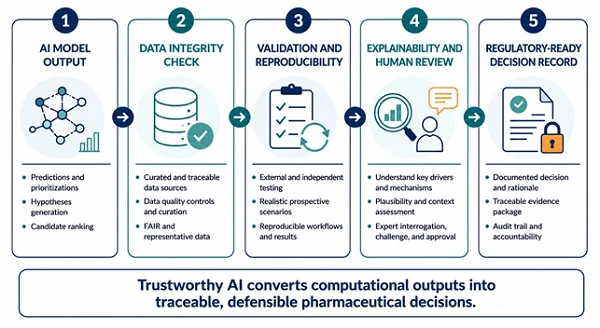
Figure 1. From AI prediction to regulatory-ready evidence. The figure shows how data integrity, validation, reproducibility, explainability, human review, and documented decision records convert AI outputs into traceable pharmaceutical evidence.
Europe’s regulatory moment
Europe is now entering a decisive regulatory moment for artificial intelligence. The issue is not simply that AI is becoming more regulated. The deeper change is that AI systems used in sensitive scientific and healthcare contexts are increasingly expected to be well documented, controllable, verifiable, and accountable. For pharmaceutical companies, this means that AI cannot remain an experimental technology operating outside established quality and governance systems.
The European AI Act introduces a risk-based framework that requires organisations to consider not only what an AI system can do, but also the level of risk associated with its intended use.4 Recent European Commission guidance on high-risk AI systems further reinforces the need to classify AI applications according to their context, purpose, and potential impact before deployment. In drug discovery, this is particularly relevant because AI outputs may influence target selection, compound prioritisation, toxicity assessment, clinical trial design, or evidence generation. Even when a model is not directly used for a regulatory submission, its influence on downstream decisions should be understood and documented.
At the same time, regulatory agencies are converging on similar expectations. EMA and FDA have jointly identified good AI practice principles for drug development, emphasising the responsible use of AI across the medicine lifecycle.5 The FDA has also clarified considerations for AI models that generate information or data intended to support regulatory decision-making for drugs and biological products.6
Regulatory readiness should not be treated as a final administrative step, but as a design principle built into AI workflows from the beginning. For industry, this means that trustworthy AI requires early attention to intended use, data provenance, validation, reproducibility, human oversight, and documentation.
What this means for the industry
For pharmaceutical companies, the practical implication is clear: AI must move from isolated pilot projects to industrially reliable workflows. Many organisations have already tested AI tools for target identification, compound screening, molecular generation, toxicity prediction, or clinical trial optimisation. However, the real challenge is no longer to demonstrate that AI can produce interesting outputs. It is to make AI-supported recommendations usable, reviewable, and accountable within established R&D processes.
This requires a shift in how AI projects are designed and managed. Companies should begin by defining the intended use and context of use of each model: what decision it supports, who will use it, under what conditions it will be applied, and what level of evidence is required. Data governance should be established early, including documentation of data sources, quality controls, curation procedures, and known limitations. Model versions, training datasets, validation datasets, parameters, and workflow changes should be recorded so that results can be reconstructed later.
Benchmarking should also become more realistic. AI systems should be tested not only on convenient retrospective datasets, but on scenarios that resemble actual discovery decisions. Once deployed, models require monitoring because data distributions, scientific priorities, and operational contexts can change over time.
Most importantly, trustworthy AI cannot be owned by data science teams alone. It requires collaboration among medicinal chemists, biologists, clinicians, data scientists, quality specialists, regulatory experts, and IT teams. The companies that will benefit most from AI will not simply be those with the most advanced algorithms, but those able to connect algorithms with evidence, accountability, and decision-making.
Conclusion:
Trustworthy AI as a competitive advantage
Trustworthy AI should not be seen as a regulatory burden or a constraint on innovation. In pharmaceutical R&D, it is becoming a prerequisite for scaling innovation responsibly. Models that cannot be validated, interpreted, reproduced, or connected to accountable decisions may remain useful for exploration, but they will struggle to influence high-value development choices. By contrast, AI systems built around data integrity, validation, transparency, human oversight, and documentation can become strategic assets for companies seeking to accelerate discovery while maintaining scientific credibility.
For European pharmaceutical organisations, this is also an opportunity. A culture of trustworthy AI can strengthen collaboration among science, technology, quality, and regulatory functions, while increasing confidence in AI-supported decisions. Trustworthy AI is not the opposite of innovation. It is the condition that allows innovation to move from promising experiments to reliable pharmaceutical impact.
References
- Lavecchia A, ed. Applied Artificial Intelligence for Drug Discovery: From Data-Driven Insights to Therapeutic Innovation. Springer Nature Switzerland; 2026.
- Lavecchia A. Explainable Artificial Intelligence in Drug Discovery: Bridging Predictive Power and Mechanistic Insight. WIREs Computational Molecular Science. 2025;15(5):e70049.
- Gangwal A, Lavecchia A. IMPACT Framework: Establishing Global Standards for Artificial Intelligence Implementation, Methodology, and Translation in Drug Discovery. Wiley Interdisciplinary Reviews: Computational Molecular Science. 2026;16(2):e70072.
- European Commission. Guidelines for providers and deployers of AI high-risk systems under the AI Act. 2026.
- European Medicines Agency and U.S. Food and Drug Administration. Guiding Principles of Good AI Practice in Drug Development. 2026.
- U.S. Food and Drug Administration. Considerations for the Use of Artificial Intelligence to Support Regulatory Decision-Making for Drug and Biological Products. Draft Guidance. 2025.

Antonio Lavecchia is a Full Professor of Medicinal Chemistry at the University of Naples Federico II, where he leads the Drug Discovery Laboratory. His work spans AI-driven drug discovery, molecular modeling, medicinal chemistry, and pharmaceutical innovation. He has published over 200 papers, edited Applied Artificial Intelligence for Drug Discovery, and serves as an expert evaluator for industrial R&D projects.