
Trapicolast Emerges as a First-In-Class Response to Drug Resistance: The Weakest
Dr Vikram Venkateswaran, Founder, Healthcare India
As malaria control stalls under rising drug resistance, Trapicolast, an AI-designed, first-in-class antimalarial, signals a strategic shift. By targeting dual essential parasite pathways and engineering resistance avoidance from inception, it redefines drug discovery for neglected diseases and strengthens the weakest link in the malaria eradication playbook.
Why Eradicating Malaria is Tricky?
Malaria remains one of the world’s most persistent infectious diseases. Each year, it infects hundreds of millions and causes more than half a million deaths, with sub-Saharan Africa bearing the overwhelming burden. Children under five account for most fatalities, highlighting malaria’s deep inequity.
From 2000 to the mid-2010s, the global malaria response was defined by scale. Insecticide-treated bed nets, rapid diagnostic tests, and artemisinin-based combination therapies (ACTs) drove historic reductions in morbidity and mortality. Yet in recent years, progress has plateaued. In some regions, malaria cases are rising again.
While climate change, conflict, and health-system fragility play a role, the most critical constraint today is biological: antimalarial drug resistance.
ACTs have underpinned malaria treatment for nearly two decades. Increasing resistance in Plasmodium falciparum now threatens its long-term viability. The parallels with chloroquine are difficult to ignore. Once highly effective, chloroquine lost its utility within a generation due to unchecked resistance.
Role of Vaccines
Vaccines have rightly generated optimism. RTS, S, the first vaccine developed for Malaria by GSK and the more recent R21 developed by The Jenner Institute and produced by Serum Institute in India, significantly reduce severe disease and child mortality. However, vaccines do not eliminate infection or clear transmission reservoirs. Drugs remain the only intervention capable of rapidly clearing parasites from infected individuals. Without durable drugs, malaria control remains fragile.
Despite this reality, the antimalarial drug pipeline has struggled to deliver truly novel mechanisms. Most candidates represent incremental chemistry—modifications of known scaffolds that parasites can adapt to quickly. The consequence is a cycle of innovation followed by resistance.
Breaking this cycle requires a fundamentally different approach.
New Molecule for Anti-Malarial Resistance
Trapicolast, developed by Adnexus Biotechnologies, exemplifies such a shift. It is one of the first antimalarial drugs designed entirely through an AI-native platform, Sutra™ AI, which generated both the molecular scaffolds and their mechanistic logic.
Trapicolast’s defining feature is its dual-mechanism action. First, it inhibits apicoplast DNA polymerase, disrupting replication of an organelle essential for fatty-acid synthesis and parasite survival. Second, it interferes with vesicular trafficking, preventing the parasite from transporting proteins required for its blood-stage lifecycle. This simultaneous targeting of two essential pathways creates a significantly higher evolutionary barrier to resistance.
Crucially, resistance avoidance was designed in from the outset. The AI platform modelled mutation-escape likelihoods, conserved regions, and pathway redundancy. The resulting compounds, ADX1 and ADX2, represent novel chemical classes with no overlap with existing antimalarial drugs.
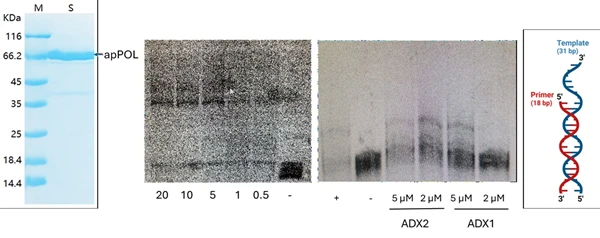
Biochemical validation of Trapicolast candidates targeting apicoplast DNA polymerase (apPOL). SDS-PAGE confirms enzyme expression, while primer–template extension assays demonstrate inhibition of polymerase activity by ADX1 and ADX2 at micromolar concentrations, supporting disruption of parasite DNA replication as a therapeutic mechanism.
This positions Trapicolast as more than a promising molecule. It has the potential to serve as a future anchor drug in next-generation combination therapies, extending both clinical durability and public-health value.
From Molecules to Platforms
An equally important question sits behind Trapicolast: not just what the molecule does, but how it came into existence.
For decades, antimalarial drug discovery has largely followed a familiar path. Scientists identify a promising compound, refine its chemistry, and optimise it until it becomes clinically viable. This approach has delivered some of the most important malaria therapies of the past generation, including artemisinin-based combinations. Yet it also has a structural limitation, most new drugs remain variations of what already exists. Over time, parasites learn to adapt.
The challenge is not simply to produce new molecules, but to explore entirely new biological and chemical territory.
This is where AI-driven discovery begins to change the equation. Instead of searching for incremental improvements to known scaffolds, computational systems can evaluate vast areas of chemical space while simultaneously considering protein structure, evolutionary conservation, and pathway dependencies. In practical terms, this allows researchers to ask a different kind of question: What mechanisms have we not yet explored?
That shift matters greatly for diseases such as malaria. Unlike oncology or cardiovascular medicine, malaria has historically attracted limited commercial investment. Much of the progress in the field has relied on global health partnerships, philanthropic capital, and academic collaboration. While these efforts have been enormously valuable, they rarely sustain the continuous discovery cycles that large pharmaceutical pipelines depend on.
Technologies that shorten discovery timelines and reduce early-stage costs could therefore have a disproportionate impact on global health. If platforms like Sutra™ AI consistently generate first-in-class candidates, they may lower the barrier to exploring new therapeutic mechanisms for diseases that have long struggled to attract sustained R&D attention.
Seen through this lens, Trapicolast may represent more than a single drug candidate. It could mark an early example of how algorithm-guided discovery reshapes the way medicines for neglected diseases are found.
Future Implications of this development
The broader implication is equally important. Neglected diseases like Malaria have historically suffered from weak commercial incentives and high R&D risk. AI-native platforms change this equation by compressing discovery timelines, lowering early-stage costs, and enabling systematic exploration of mechanistic space.
In effect, artificial intelligence makes first-in-class innovation feasible in areas where traditional pharma models have struggled.
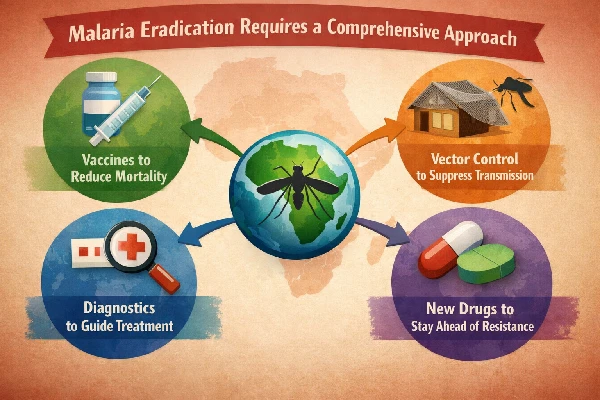
Malaria eradication will not be achieved through a single intervention. It will require vaccines to reduce mortality, vector control to suppress transmission, diagnostics to guide treatment, and new drugs capable of staying ahead of resistance.
Today, drug innovation is the weakest link in this chain. Trapicolast directly addresses this vulnerability while offering a blueprint for how future global-health drugs can be discovered.
In the long fight against malaria, success will depend not on incremental fixes, but on intelligently designed breakthroughs. Trapicolast and the AI platform behind it point firmly in that direction.

Dr. Vikram Venkateswaran is a healthcare strategist, clinician, and Founder of Healthcare India. A former healthcare leader at Deloitte, he advises startups, investors, and health systems on innovation, AI, and growth strategy. He frequently writes and speaks on the future of healthcare, technology, and global health.



