The Rise of In Vivo Gene Editing: New Opportunities in Therapeutic Innovation
Lakshmi, Editorial Team, Pharma Focus Europe
In vivo gene editing moves the correction of a disease-causing sequence out of the manufacturing suite and into the patient's own body. For pharmaceutical leaders, that shift converts a bespoke procedure into a scalable product, reopening questions of delivery, durability, evidence generation and pricing. This feature examines where the science now stands, what the operating model demands, and how executives should govern an irreversible therapeutic class.
Introduction:
When the Factory Moves Inside the Patient
For most of the past decade, genetic medicine has been defined by a logistical paradox. The science was astonishing; the operations were artisanal. Cells were drawn from a patient, flown to a specialist facility, edited, tested, released and flown back for infusion after conditioning chemotherapy. The results in several inherited blood disorders and aggressive cancers were among the most striking modern medicine has produced. The delivery model, however, looked nothing like a pharmaceutical product — it looked like a series of one-off surgical events wrapped in a supply chain.
In vivo gene editing dissolves that paradox. Rather than removing cells to edit them, the editing machinery is packaged into a carrier, infused, and directed to the tissue where the correction is needed. The patient becomes the reactor, and what arrives at the hospital is a vial rather than a personalised batch. That single architectural change alters almost every commercial, regulatory and manufacturing assumption in genetic medicine — and it is why boards that once treated gene editing as a scientific curiosity now treat it as a portfolio decision.
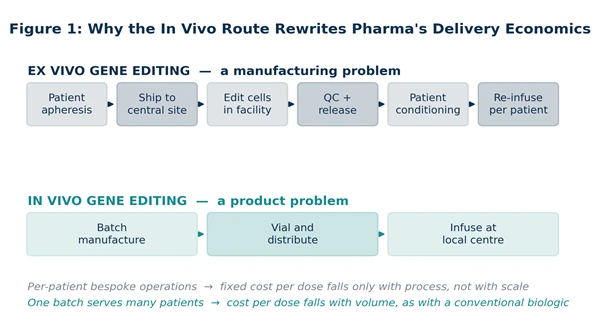
Figure 1: The in vivo route collapses a per-patient manufacturing chain into a conventional product chain.
From Bespoke Procedure to Pharmaceutical Product: The Economics Behind the Shift
The commercial case for in vivo gene editing is not primarily a story about better biology. It is a story about cost structure. In an ex vivo model, almost every unit of cost is incurred per patient: apheresis, cryopreservation, controlled transport, a dedicated clean-room slot, full release testing, conditioning and inpatient recovery all scale linearly with the number of people treated. No amount of demand growth changes that arithmetic.
An in vivo product behaves like a biologic. The editing components are manufactured in batches, filled into vials, released against a single specification and distributed through existing cold chains, so the marginal cost of the thousandth dose is far below the first. Just as importantly, the treating site no longer needs cell-processing or transplant-grade capability, which widens the addressable population well beyond the few academic centres qualified to deliver bespoke cell products.
For chief executives, this is the crux. Ex vivo editing produced remarkable medicines that struggled to reach patients at scale because the care pathway itself was the bottleneck. In vivo editing offers a genetic medicine that can be launched, supplied and reimbursed using operating muscles the pharmaceutical industry already possesses.
Beyond Rare Disease: The Widening Therapeutic Aperture
The earliest in vivo programmes concentrated on the liver for a practical reason: intravenously administered lipid nanoparticles accumulate there naturally. That produced early clinical validation in inherited amyloid conditions and in metabolic disorders driven by a single liver-expressed protein.
The more consequential development is the movement outward from that comfort zone. Approaches aimed at lowering lifelong cholesterol exposure, correcting haemoglobin disorders without cell collection, and restoring inherited sensory function have shifted the conversation toward chronic diseases affecting millions. If one administration can durably remove a cardiovascular risk factor that now requires decades of daily adherence, the commercial frame is no longer orphan pricing but prevention at population scale.
That widening aperture is precisely why the risk calculus tightens. A one-time irreversible intervention in a person with a fatal untreated disease carries a very different benefit-risk threshold from the same intervention in an otherwise healthy adult managing a modifiable risk factor — and the safety strategy must be built for the second standard from the outset.
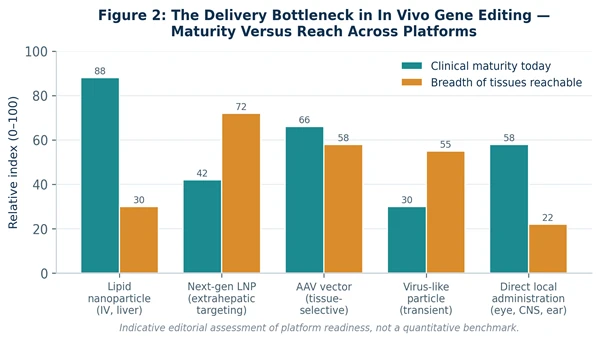
Figure 2: Delivery remains the rate-limiting step — the most mature carriers reach the fewest tissues.
The Real Bottleneck in In Vivo Gene Editing Is Delivery, Not Editing
The nucleases, base editors and template-guided systems now available are, in a laboratory sense, extraordinarily capable. The scarce resource is the ability to put them where they are needed, in enough cells, without provoking an unacceptable response. Three constraints define the field.
The first is tissue tropism. Liver delivery is largely solved; bone marrow, cardiac and skeletal muscle, kidney and the central nervous system are not. Engineered lipids, targeted capsids and non-integrating particle systems are all competing to extend reach, and the winner may differ by indication — a platform bet made on liver performance may not transfer.
The second is immune interaction. Viral carriers can meet pre-existing antibodies that exclude some patients and generally preclude repeat dosing; non-viral carriers avoid much of that, but the editing proteins themselves can still be recognised. Transient systems, which deliver machinery that degrades within days, shorten the window in which the immune system can react.
The third is specificity in a living organism. Off-target activity measured in cultured cells poorly predicts what happens across billions of cells in heterogeneous tissue. Regulators increasingly expect orthogonal methods, genome-wide assessment and evidence on larger chromosomal rearrangements. That package is expensive and slow, and not one to compress in pursuit of a filing date.
The decisive question in an in vivo programme is rarely “can we make this edit?” It is “can we reach enough of the right cells, once, safely, and prove that we did nothing else?”
Case Study: How a Mid-Sized Pharmaceutical Developer Rebuilt a Failing Programme Around Delivery
The following composite case reflects a pattern seen repeatedly across European genetic medicine programmes; identifying details have been generalised.
The situation
A mid-sized pharmaceutical developer had spent three years advancing an in vivo editing candidate for an inherited muscle-wasting condition. In cellular models, correction efficiency exceeded ninety per cent. In two successive animal studies, functional benefit was marginal: editing was high in liver tissue and in single digits in the target muscle, far below the team's own threshold for benefit. Internal debate centred on improving the editor, and the committee was preparing to terminate.
The reframing
A newly appointed head of translational science reframed the problem: the editor was not underperforming, it was never arriving. The team had optimised against a cellular assay that bypassed the only step that mattered in a living animal — biodistribution. The programme was paused for nine months and restructured around three decisions: delivery became the primary development objective with its own budget and leadership; the screening cascade was rebuilt so no candidate advanced on cellular potency alone; and two carrier architectures were run in parallel, accepting duplicated cost for optionality.
The outcome
The reworked cascade eliminated the original lead within four months — it could not reach muscle at a tolerable dose. The back-up architecture achieved target-tissue editing an order of magnitude higher, with lower hepatic accumulation and a cleaner liver enzyme profile. Functional benefit followed. The programme reached regulatory interactions a year later than planned, but with a package that survived scrutiny on the biodistribution and off-target questions that had sunk peer programmes.
What executives should take from it
Three lessons generalise. A gene editing programme's structure tends to mirror where its founders came from, and most came from editing chemistry rather than delivery; that imbalance shapes resource allocation for years. Assay design encodes strategy — a cascade that cannot fail a candidate for the right reason will promote the wrong one. And redundancy in delivery is not inefficiency; where the carrier determines the indication, it is the cheapest insurance available.
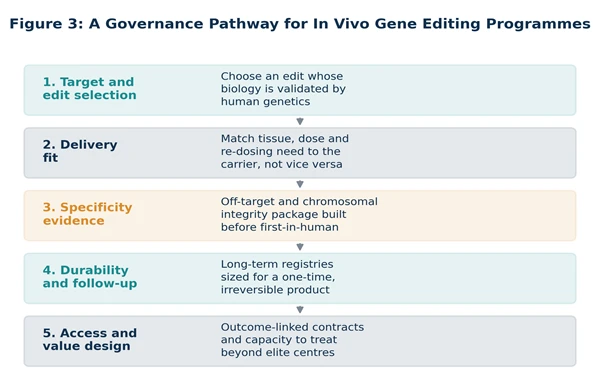
Figure 3: A staged governance model for pharmaceutical in vivo gene editing portfolios.
Regulatory Expectations and the Problem of a Medicine You Cannot Withdraw
European and international regulators have converged on broadly consistent expectations, even where formal guidance is still evolving: justify the editing approach against alternatives, characterise unintended editing using more than one method, hold the delivery component to the same purity standard as the editing sequence, and commit to follow-up measured in years.
The follow-up obligation is a permanent operating commitment, not a study. A therapy intended to last a lifetime generates a registry population that must be tracked and assessed long after the launch team has moved on. Organisations that treat this as a regulatory nuisance under-resource it, then discover at the first safety signal that they cannot locate much of the treated population.
There is also a communications dimension boards underestimate. The distinction between editing a patient's body cells and editing inherited germline material is scientifically fundamental yet poorly understood outside the field. The therapies discussed here alter tissue in a consenting individual and are not passed to that person's children. An organisation that has not rehearsed how it explains that difference to patients, payers and parliamentarians is one adverse headline away from a debate it cannot win.
Pricing, Access and the Value Puzzle for One-Time Pharmaceutical Therapies
A durable single administration collides with health systems built to pay for chronic consumption. Value accrues over decades; cost lands in one budget year, often with a payer who will not capture the downstream savings. European assessment bodies have grown comfortable with outcome-linked and staged payment arrangements, but each demands infrastructure most organisations lack: the ability to track individual outcomes over years and reconcile payments against them.
A second tension emerges as the field moves toward larger populations: orphan-scale pricing cannot survive contact with a prevention indication. A therapy priced for a few hundred patients is unaffordable for a few hundred thousand, and health systems will say so. The credible path is a genuinely lower cost of goods — which batch manufacturing makes plausible — matched to a price that reflects population-level budget reality.
Frequently Asked Questions on In Vivo Gene Editing
How does in vivo gene editing differ from ex vivo gene editing?
In ex vivo editing, cells are removed, modified in a facility and returned. In vivo editing delivers the machinery directly into the body, so the modification happens inside the patient's own tissue. The difference is operational as much as scientific: one is a bespoke procedure, the other a batch-manufactured product.
Are these therapies heritable?
No. The therapies in clinical development act on somatic tissue — the body cells of a consenting patient — and the changes are not passed to that person's children. Heritable editing of embryos or reproductive cells is a separate matter, prohibited in clinical use across European jurisdictions and not part of the pipeline discussed here.
Can an in vivo edit be reversed if something goes wrong?
In general, no. A change made to a cell's genome persists in that cell and its descendants, so management relies on preventing error rather than correcting it: rigorous specificity testing before dosing, careful dose escalation, and transient delivery systems that limit how long the editing machinery stays active.
Why is delivery considered harder than the editing itself?
Editing tools are highly capable in a test tube. Reaching a specific organ in a living body, entering enough cells and avoiding an immune response is a separate engineering problem. Liver delivery is comparatively well solved; muscle, bone marrow, kidney and the central nervous system remain far harder, and the available carrier often determines which diseases a platform can address.
What does this mean for pharmaceutical manufacturing strategy?
In vivo products can largely use nucleic acid and nanoparticle capability rather than dedicated cell-processing suites. Organisations that invested heavily in patient-specific cell facilities should assess how much of that footprint transfers, and how much future capacity is better served by conventional biologic fill-finish infrastructure.
How long before in vivo gene editing reaches routine clinical use?
Liver-directed indications are furthest advanced, and the earliest approvals are realistically a few years away rather than a decade. Extrahepatic and chronic-disease applications sit further out, gated less by editing chemistry than by delivery performance and by the size of the safety database a preventive indication will require.
Conclusion:
A Class of Medicine That Rewards Patience and Punishes Shortcuts
In vivo gene editing is entering the pharmaceutical mainstream not because the editing tools suddenly improved, but because the delivery systems around them became good enough to make a scalable product conceivable — turning genetic medicine into something an established organisation knows how to manufacture, distribute and support.
The opportunity is genuine and the aperture is widening from ultra-rare conditions toward chronic disease. But the class carries an unusual asymmetry: the upside is a single administration that changes a patient's biology for life, and the downside is an error that cannot be withdrawn. Every governance choice is an expression of how seriously an organisation takes that asymmetry.
The developers who lead this field over the next decade will not be those who reach first-in-human fastest. They will be the ones who built the delivery science, the evidence package and the follow-up capability before they needed them — and who understood that in a medicine you cannot take back, rigour is not a constraint on speed. It is the only durable form of it.

Lakshmi is a science writer with a foundation in the laboratory. She earned her master's in biotechnology and trained through research internships at ICGEB (JNU) and DIPAS, DRDO, with her work appearing in the Egyptian Journal of Veterinary Sciences. Now APCRM-certified and part of the editorial team at Pharma Focus America and Pharma Focus Europe, she reports on pharmaceutical technology, research, and innovation — giving complex science a clear and confident voice for industry leaders.