The Rise of Continuous Clinical Trials: Redefining Drug Development
Lakshmi, Editorial Team, Pharma Focus Europe
Clinical development is shifting from discrete, asset-anchored studies towards continuous platforms in which therapies enter and leave a standing trial under a single master protocol. Shared controls and shared infrastructure can cut sample sizes and development time substantially. This article examines the economics, the European regulatory position, the evidence from practice, and the control that sponsors must surrender to participate.
Introduction: The End of the One-Trial, One-Drug Era
The conventional clinical trial is a disposable asset. A sponsor writes a protocol for a single compound, activates a network of sites, recruits a control group, reads out, and then dismantles everything it has built. When the next candidate arrives — often in the same disease, often at the same hospitals — the entire apparatus is rebuilt from nothing. Every ethics submission, every site contract, every control patient is paid for twice.
A different model is now moving from methodological literature into routine practice across Europe and beyond. In a continuous trial, the study is anchored to the disease rather than to the molecule. A single master protocol establishes the population, the endpoint, the control and the decision rules; individual therapies then enter and leave that standing structure as evidence accumulates. The trial has no scheduled end date. For boards accustomed to appraising development as a sequence of discrete, budgeted studies, this is not an operational refinement. It is a change in the unit of investment.
What “Continuous” Actually Means
The vocabulary is unhelpfully crowded, and precision matters at board level because the designs carry different obligations. A master protocol is the overarching framework. Within it, a basket trial tests one therapy across several diseases or subtypes; an umbrella trial tests several therapies within one disease, usually allocated by biomarker; and a platform trial evaluates multiple therapies against a common control in a perpetual manner, with no defined completion date. Seamless designs, meanwhile, compress the transition between development phases inside a single protocol rather than across separate ones.
The continuous trial is the platform variant taken to its logical conclusion: a standing scientific utility rather than a project. Treatments are added as they become available and dropped once they have been formally tested, with entry and exit governed by pre-specified decision algorithms rather than by negotiation after the fact.
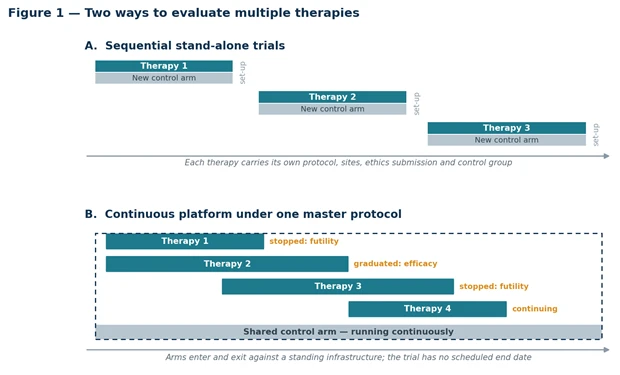
Figure 1: The same scientific question, two entirely different cost structures.
The Arithmetic That Changes the Boardroom Conversation
The efficiency case rests on two mechanisms, and executives should be able to separate them because they behave differently under scrutiny.
The first is the shared control arm. When several therapies are randomised contemporaneously against one control group, the platform attains the same statistical power for each individual comparison while enrolling far fewer control participants than separate two-arm trials would require. Fewer participants are exposed to a comparator, recruitment is faster because a smaller proportion of volunteers receives placebo or standard care, and total sample size falls. Simulation work in a five-experimental-arm setting has reported reductions of roughly 40 per cent in mean total sample size and roughly 40 per cent in average development time relative to running the equivalent stand-alone trials.
The second mechanism is amortised infrastructure. Site contracts, monitoring arrangements, data systems, endpoint adjudication and the ethics and regulatory dossier are established once and reused. The marginal cost of adding the fifth therapy to a running platform bears no resemblance to the cost of the first, which is precisely why continuous designs have taken hold fastest in indications where candidate volume is high and patient populations are scarce.
There is a further and less-discussed benefit: platforms also improve the precision of comparisons between active therapies, because interventions randomised against a shared control are statistically linked in a way that separate trials never are. For a portfolio holder deciding which of two internal assets to progress, that is a strategically useful property.
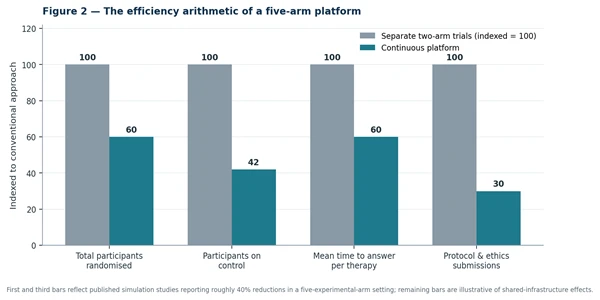
Figure 2: Where the savings come from, and which of them are evidenced.
Case Study: One Hundred Days, Three Answers
The most instructive demonstration remains a national platform trial launched in the United Kingdom in March 2020 to test treatments for hospitalised COVID-19 patients. The trial is publicly documented and academically led; it is described here without naming the programme or its institutions.
Its design decisions were deliberately austere. A single primary endpoint — mortality at 28 days — replaced the composite outcome sets typical of industry protocols. Eligibility was drawn as broadly as clinical safety allowed. Data collection relied on information already captured in routine care, so that participation added almost nothing to the workload of clinicians under extraordinary pressure. Randomisation was embedded directly into the hospital care pathway rather than bolted onto it.
The operational consequences were extraordinary. Recruitment opened nine days after the protocol was first submitted. More than 1,000 participants had joined within fifteen days, and over 10,000 within the first two months. By day 81 the trial had randomised 11,303 participants across 175 hospitals. Within 100 days of the protocol first being drafted it had produced definitive answers on three separate treatments — including the identification of a widely available corticosteroid that reduced 28-day mortality, a result incorporated into national treatment guidance within hours of announcement and subsequently estimated to have saved on the order of a million lives worldwide in its first nine months. Over its full life the platform has evaluated sixteen treatments, five of which were shown to reduce mortality.
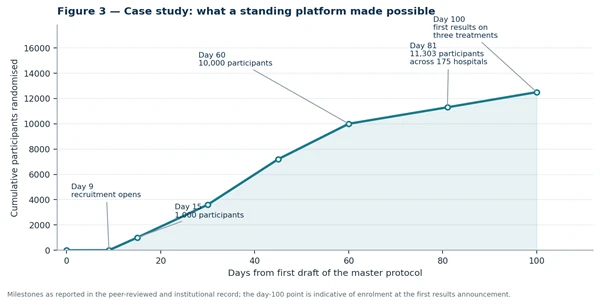
Figure 3: Recruitment against a standing platform, by day
Two qualifications keep this honest. The conditions were exceptional: a public health emergency, a mortality endpoint requiring no adjudication, and national infrastructure mobilised behind a single question. And the trial's own analysts have noted that it recruited only around 10 to 15 per cent of eligible patients, with site-level rates ranging from 3 per cent to 80 per cent; one published estimate suggested that recruiting half of eligible patients could have saved more than 2,000 additional lives in the United Kingdom alone. Even the exemplar left most of its potential unrealised, and the constraint was site engagement rather than design.
What transfers to commercial development is not the pandemic urgency but the four design choices: a simple endpoint, broad eligibility, integration into routine care, and decision rules agreed before the first patient rather than argued after the first signal.
Europe's Structural Advantage — and Its Structural Drag
Europe should be the natural home of continuous trials. Universal healthcare systems, national disease registries, mature academic trial networks and comparatively stable patient populations are exactly the substrate that care-embedded platforms require. The Clinical Trials Regulation has supplied the legal architecture: a single application through a common portal, collaborative assessment across member states, and, since 31 January 2025, a single framework governing every trial in the Union including those authorised under the previous directive.
The drag is behavioural and structural rather than legal. Historically, a substantial share of European trials have been non-commercial and largely mono-national, averaging little more than one member state per trial — the opposite of the multi-country scale a platform needs to be viable. The regulatory network has been explicit about this. The initiative running alongside the Regulation has published a revised workplan covering 2026 and 2027, with priority areas spanning the operation of the Regulation, maximising the impact of clinical trials, and preparedness for public health emergencies; monthly progress dashboards published since February 2026 point to faster authorisations and stronger multi-country collaboration, while also flagging a persistent tail of slower approvals and regulatory queries concentrated among complex trials.
For sponsors, that last point is the actionable one. Complex designs still attract disproportionate assessment friction. The remedy is not to avoid them but to engage far earlier and to specify decision rules more explicitly than a conventional protocol would require.
The Regulatory Ground Is Firming
Executives who last examined this question five years ago will find the position materially changed. Draft international harmonised guidance on adaptive designs for clinical trials was released for consultation in September 2025, aiming to establish common principles for the design, conduct, analysis and interpretation of adaptive trials across regions, together with common expectations for the documentation regulators will want to see. Its stated rationale is that the absence of such principles has limited the ability of sponsors and regulators to build efficient multi-regional development plans around innovative designs.
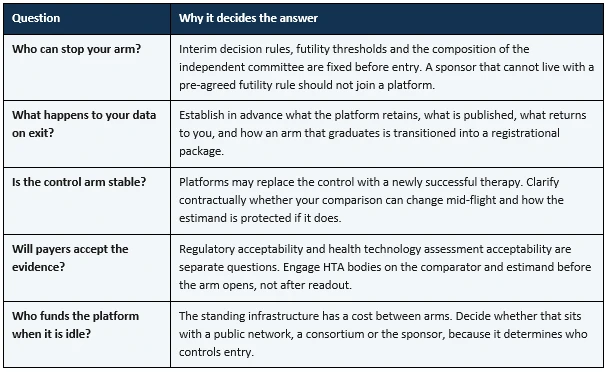
Genuine methodological questions remain open, and boards should know what they are rather than delegate them entirely. Controlling error rates across arms that enter at different times is not trivial. Borrowing information from non-concurrent controls improves efficiency but requires explicit modelling of drift over time, because standard of care and patient case-mix both move. And platforms that replace their control arm when a therapy succeeds create a moving comparator that must be handled in the estimand rather than discovered at analysis. These are tractable problems with an established statistical literature — but they are decisions to be made prospectively, in writing, before an arm opens.
What Sponsors Must Be Willing to Give Up
The strategic cost of continuous trials is control, and it is routinely understated in the enthusiasm for the efficiency numbers. A sponsor entering a platform accepts that an independent committee, applying pre-agreed rules, may terminate its arm for futility on a timetable the sponsor does not set. It accepts governance shared with a steering structure that may include competitors. It accepts that the comparator may change. It accepts that the timing and framing of its own readout are constrained by a protocol it does not solely own.
There is also an evidence-acceptance gap that sits squarely with the chief medical and market access functions. Regulatory acceptability and health technology assessment acceptability are not the same question. A platform comparison against a shared control may satisfy a regulator while leaving a national HTA body without the specific comparative evidence it requires for reimbursement. In European markets, where access is decided country by country, that gap is commercially material and needs to be closed at the design stage.
Five questions determine whether participation is a sound decision. None of them is a statistical question.
Conclusion: From Asset Portfolios to Disease Infrastructure
The continuous trial reframes what a development organisation actually owns. In the conventional model, the sponsor owns a sequence of studies and rebuilds the machinery each time. In the emerging model, a standing platform is the durable asset and individual molecules are transient occupants of it. That reframing explains why the design has advanced fastest where it was co-funded by public systems, academic networks and industry together: no single sponsor has enough candidates in one indication to justify permanent infrastructure alone.
Europe has the healthcare systems, the registries and now the regulatory architecture to make this the default rather than the exception. What has been missing is the willingness of commercial sponsors to trade unilateral control for collective speed, and a settled answer on how platform-generated evidence will be treated by payers as well as regulators.
The organisations that move first will not be those with the most sophisticated statistics. They will be those whose leadership has decided, deliberately, that a faster answer arrived at jointly is worth more than a slower answer owned outright. That is a boardroom judgement, not a biostatistical one — and in most companies it has not yet been made.

Lakshmi is a science writer with a foundation in the laboratory. She earned her master's in biotechnology and trained through research internships at ICGEB (JNU) and DIPAS, DRDO, with her work appearing in the Egyptian Journal of Veterinary Sciences. Now APCRM-certified and part of the editorial team at Pharma Focus America and Pharma Focus Europe, she reports on pharmaceutical technology, research, and innovation — giving complex science a clear and confident voice for industry leaders.