

The Rise of Antibody-Drug Conjugates in European Cancer Treatment
Lakshmi, Editorial Team, Pharma Focus Europe
Antibody-drug conjugates (ADCs) are moving from niche, late-line options to front-line pillars of European oncology. By pairing the precision of monoclonal antibodies with highly potent cytotoxic payloads, ADCs are resetting survival benchmarks in breast and urothelial cancers. This article examines the science, the clinical evidence, the access and manufacturing pressures, and the strategic choices that will determine which pharmaceutical organisations lead the next phase of ADC-driven cancer care in Europe.
For decades, European oncologists faced an uncomfortable trade-off. Chemotherapy was powerful but indiscriminate, damaging healthy tissue alongside tumour cells. Targeted antibodies were precise but often lacked the firepower to eradicate aggressive disease on their own. Antibody-drug conjugates resolve that tension by fusing both ideas into a single molecule: an antibody that seeks out a cancer-associated antigen, a chemical linker that keeps the drug stable in the bloodstream, and a cytotoxic payload released where it does the most damage to the tumour.
The timing of this shift matters. According to European Commission estimates, the EU recorded around 2.74 million new cancer cases and close to 1.3 million cancer deaths in 2022, with both figures rising compared with 2020. Breast cancer alone accounted for roughly 380,000 new diagnoses. Against this growing burden, ADCs have emerged as one of the most commercially and clinically consequential modalities in the pharmaceutical pipeline. For European C-suite leaders, the question is no longer whether ADCs will reshape oncology, but how quickly their organisations can build the science, manufacturing capacity and market-access strategies to compete.
From Magic Bullet to Market Force: The ADC Moment in European Oncology
The concept of a “magic bullet” that selectively kills diseased cells is more than a century old, yet early ADCs struggled to deliver on the promise. First-generation molecules suffered from unstable linkers that released toxic payloads prematurely, inconsistent drug loading and narrow therapeutic windows. Several were restricted to small haematological indications or withdrawn altogether.
The picture today is fundamentally different. More than a dozen ADCs now hold marketing authorisation in the European Union, spanning lymphomas, leukaemias, multiple myeloma and an expanding list of solid tumours including breast, urothelial, cervical, ovarian and lung cancers. Equally significant is where these medicines are being used. ADCs are steadily migrating from third-line and salvage settings into earlier lines of therapy, where patient populations are larger, treatment durations are longer and the commercial stakes are considerably higher.
This migration changes the economics of oncology portfolios. A medicine used in earlier lines must demonstrate durable benefit against stronger comparators, tolerability over many months of exposure and compatibility with other standard therapies. It also faces closer scrutiny from payers, because the number of eligible patients, and therefore the total budget impact, grows substantially. ADC developers can no longer rely on the low bar of a refractory population with few alternatives; they must prove superiority in settings where existing treatments already work.
Antibody, Linker, Payload: The Engineering Triad Behind Every ADC
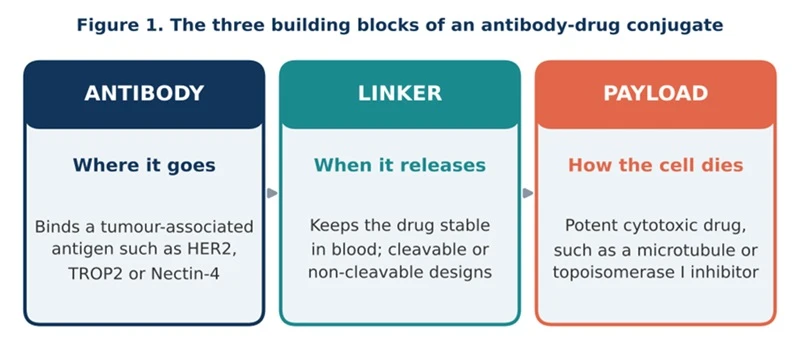
Every ADC is a carefully negotiated compromise among three components, and each one represents a strategic lever for differentiation. The antibody determines where the drug goes. Targets such as HER2, TROP2 and Nectin-4 are expressed abundantly on certain tumour cells, allowing the conjugate to concentrate its effect. The linker determines when the drug is released. Cleavable linkers are designed to break inside the tumour cell or its microenvironment, while non-cleavable designs release the payload only after the antibody is fully degraded.
The payload determines how the cancer cell dies. Microtubule inhibitors and topoisomerase I inhibitors dominate current portfolios, and the drug-to-antibody ratio, meaning how many payload molecules each antibody carries, has become a critical design variable. Newer ADCs can also exert a “bystander effect”, in which membrane-permeable payloads diffuse into neighbouring tumour cells that express little or no target antigen. This single property has done more than any other to expand the addressable patient population for ADC therapy.
Case Study: Two ADC Trials That Rewrote European Treatment Standards
Breast cancer: turning “HER2-low” into a treatable category
For years, breast tumours were classified in binary terms as HER2-positive or HER2-negative. Patients with low levels of HER2 expression, roughly half of all breast cancers, were treated as HER2-negative because conventional HER2-targeted antibodies offered them little benefit. The phase III DESTINY-Breast04 trial challenged that assumption. It enrolled 557 patients across Asia, Europe and North America with HER2-low metastatic breast cancer and compared the ADC trastuzumab deruxtecan with physician’s choice of chemotherapy.
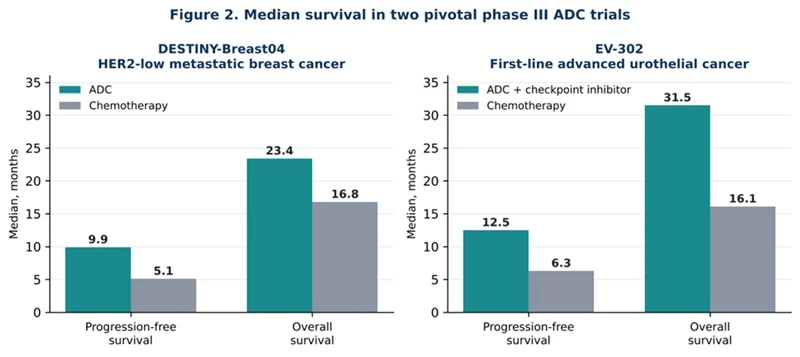
The results were striking. Median progression-free survival was 9.9 months with the ADC versus 5.1 months with chemotherapy, a 50% reduction in the risk of progression or death. Median overall survival reached 23.4 months against 16.8 months. The trial also underlined the safety vigilance ADCs demand: drug-related interstitial lung disease or pneumonitis occurred in 12.1% of ADC-treated patients compared with 0.6% on chemotherapy. The lasting impact was diagnostic as much as therapeutic, because pathology laboratories across Europe now have to distinguish HER2-low from HER2-zero tumours with precision.
Bladder cancer: ending a generation of chemotherapy dominance
In advanced urothelial carcinoma, platinum-based chemotherapy had remained the first-line standard for decades. The phase III EV-302 trial randomised 886 previously untreated patients to the Nectin-4-directed ADC enfortumab vedotin combined with the immune checkpoint inhibitor pembrolizumab, or to platinum-based chemotherapy. Median overall survival was 31.5 months with the combination versus 16.1 months with chemotherapy, a 53% reduction in the risk of death. Median progression-free survival doubled from 6.3 to 12.5 months, and the objective response rate rose from 44.4% to 67.7%, with complete responses in 29.1% of patients versus 12.5%.
The strategic lesson from both trials is clear. ADCs deliver their greatest value when paired with precise biomarker testing or rational combination partners, and when they move into earlier, larger treatment settings.
Europe’s ADC Access Equation: Value, Health Technology Assessment and the Biomarker Bottleneck
Clinical success does not automatically translate into patient access across Europe. ADCs are complex, high-cost biologics, and national payers apply differing value frameworks, which produces uneven launch timelines between member states. The EU Health Technology Assessment Regulation adds a new dimension. Since January 2025, new oncology medicines have been subject to joint clinical assessments at EU level, meaning ADC developers must now design evidence packages that satisfy a common European clinical review while still negotiating price and reimbursement nationally.
A second constraint is diagnostic readiness. As the HER2-low example shows, an ADC is only as valuable as the test that identifies its patients. Variability in biomarker scoring and unequal access to companion diagnostics can delay treatment for eligible patients. Pharmaceutical leaders who invest early in pathology education, assay standardisation and diagnostic partnerships will shorten the path from approval to real-world uptake.
The ADC Manufacturing Frontier: Building Capacity for High-Potency Precision
ADC production is among the most demanding processes in the pharmaceutical industry. It combines large-molecule biologics manufacturing with the synthesis of highly potent small-molecule payloads, followed by a conjugation step that must deliver a consistent drug-to-antibody ratio batch after batch. Payload handling requires specialised containment to protect operators, and the supply chain spans antibody production, payload synthesis, linker chemistry, conjugation, fill-finish and analytical release.
For European organisations, this complexity creates both risk and opportunity. Capacity for high-potency conjugation remains a bottleneck, and decisions to build in-house capability or secure long-term external partnerships now carry multi-year consequences. Executives who treat ADC manufacturing as a strategic asset rather than a procurement exercise will be better placed to protect launch timelines and supply resilience.
Next-Generation ADCs: Bispecific Targets, Novel Payloads and Smarter Combinations
The innovation curve in ADC science is accelerating. Developers are exploring bispecific antibodies that bind two tumour antigens to improve selectivity and counter resistance, dual-payload constructs that attack cancer cells through two mechanisms at once, and new payload classes designed to stimulate the immune system rather than simply kill cells. Site-specific conjugation technologies aim to produce more uniform molecules with wider therapeutic windows.
Combination strategy is the other major frontier. The EV-302 results demonstrated that pairing an ADC with an immune checkpoint inhibitor can achieve outcomes neither class reached alone. Expect European clinical programmes to test ADCs increasingly in the neoadjuvant and adjuvant settings, where curative intent raises both the clinical value and the evidentiary bar.
The ADC Boardroom Agenda: Where European Pharma Leaders Must Place Their Bets
For senior executives, the ADC opportunity demands integrated decision-making rather than isolated pipeline bets. Target selection must account not only for biological rationale but also for diagnostic feasibility and competitive crowding, as multiple programmes now converge on the same well-validated antigens. Clinical strategy should anticipate the evidence requirements of European joint clinical assessments from the earliest phases. Safety management, particularly for class-specific toxicities such as lung, ocular and neurological effects, must be built into launch planning so that oncologists feel confident prescribing new agents.
Above all, success will depend on alignment across research, manufacturing, medical affairs and market access. The organisations that move fastest will be those that view ADCs as a platform capability, combining linker and payload know-how, conjugation capacity and diagnostic partnerships into a repeatable engine for multiple products. Partnering models will matter too, as licensing deals and co-development alliances increasingly bring promising ADC assets into European portfolios at an earlier stage of development.
Conclusion
Antibody-drug conjugates have earned their place at the centre of European cancer treatment. Trials in breast and urothelial cancer have shown that well-engineered ADCs can extend survival meaningfully beyond long-standing chemotherapy standards, while also redefining how tumours are classified and treated. Yet the path forward is not purely scientific. Harmonised health technology assessment, diagnostic readiness, high-potency manufacturing capacity and safety stewardship will determine how quickly these advances reach patients across all member states. For Europe’s pharmaceutical leaders, the ADC era rewards those who invest decisively and coherently today, turning a powerful modality into sustained clinical and commercial leadership in oncology.

Lakshmi is a science writer with a foundation in the laboratory. She earned her master's in biotechnology and trained through research internships at ICGEB (JNU) and DIPAS, DRDO, with her work appearing in the Egyptian Journal of Veterinary Sciences. Now APCRM-certified and part of the editorial team at Pharma Focus America and Pharma Focus Europe, she reports on pharmaceutical technology, research, and innovation — giving complex science a clear and confident voice for industry leaders.