The Next Growth Strategy: Scaling GLP-1 Manufacturing and Global Market Expansion
Lakshmi, Editorial Team, Pharma Focus Europe
Incretin medicines have moved from a supply crisis into a scale contest. For European pharmaceutical and biotech leaders, growth in this class now rests on industrial decisions: synthesis route, purification and sterile fill-finish capacity, device supply, and where to compete once exclusivity lapses. This article examines how GLP-1 manufacturing economics are shifting, why oral formats reset capacity planning, and how disciplined global expansion converts manufacturing strength into durable pharmaceutical market share.
Introduction:
The Growth Question Has Moved to the Plant Floor
For most of the past four years, the strategic conversation around GLP-1 receptor agonists was a demand story. Prescriptions outran forecasts, waiting lists formed, pharmacy shelves emptied, and the commercial debate centred on reimbursement, prescriber behaviour and how far the obesity indication could stretch. That conversation has changed. Demand for incretin therapies is now the most predictable variable in the metabolic pharmaceutical market. What remains uncertain is who can make the molecules at the required scale, at an acceptable cost per gram, and in the right places to serve markets that are diverging faster than any therapeutic class in recent memory.
For European pharmaceutical and biotech leadership teams, this is a governance shift as much as an operational one. Decisions about synthesis route, purification throughput, sterile capacity and device supply, once delegated well below the executive committee, now determine revenue trajectory, gross margin and geographic reach. During 2026, patent protection on the leading GLP-1 molecule lapsed across several of the world's largest populations while remaining intact in Europe and the United States, splitting the class into two distinct commercial games played on the same industrial base. The next growth strategy for this category is, in practice, a manufacturing strategy.
The Tonne Problem: How GLP-1 Demand Broke Peptide Manufacturing Norms
GLP-1 receptor agonists are peptides of roughly 29 to 39 amino acids, assembled predominantly by solid-phase peptide synthesis: a stepwise cycle of coupling and deprotection on a resin support, followed by cleavage, preparative chromatographic purification and drying. The chemistry is mature and has been run by specialist peptide houses for decades. What is entirely new is the tonnage. Historically, a successful therapeutic peptide required tens of kilograms of active ingredient per year. Commercial incretin franchises consume hundreds of kilograms per product, and in aggregate the class is pushing peptide manufacturing toward metric-tonne annual output for the first time in the industry's history.
Published modelling circulated during 2026 places global peptide active ingredient demand for the GLP-1 class at approximately 99,000 kilograms a year by 2030. That single figure reframes the category from a marketing contest into an industrial one. It also explains an apparent paradox in the market data: the peptide synthesis services market is forecast to grow from around USD 4.4 billion in 2026 to roughly USD 7 billion by 2035, a compound annual rate of about 5.2 percent, far slower than the underlying volume curve. Volume is compounding at double digits while price per gram falls. Executives who plan capacity against revenue growth rather than kilogram growth will systematically under-build.
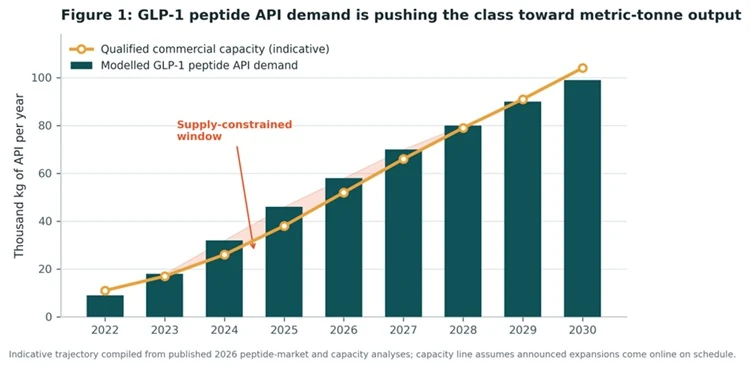
Demand for GLP-1 active ingredient has outpaced qualified capacity through the middle of the decade; announced expansions close the gap only if they are delivered on schedule.
Where GLP-1 Scale-Up Actually Breaks: Look Past the Synthesis Reactor
The instinctive response to a peptide supply constraint is to add synthesis capacity, and the industry has done so aggressively. Announced peptide contract manufacturing investment passed USD 2.4 billion within the first eight months of 2026 alone, with cumulative commitments across the leading North American producers approaching USD 4.2 billion against 2024 to 2026 project timelines. Yet capacity announcements and capacity availability are separated by years. Lead times for large-scale solid-phase synthesis assets remain in the range of 18 to 36 months, and booking windows at established peptide manufacturers have stretched to 18 to 24 months.
More importantly, synthesis is rarely the binding constraint once it has been addressed. Preparative chromatography sets the practical throughput ceiling and drives enormous solvent consumption. Lyophilisation and isolation capacity is scarce and capital-intensive. Sterile fill-finish, governed in Europe by an exacting annexe on sterile manufacture, is the slowest asset class in the chain to qualify. Device assembly for pens, cartridges and autoinjectors introduces a supply dependency that sits outside pharmaceutical manufacturing altogether. Behind all of it stands the constraint that capital cannot resolve quickly: skilled process chemists, lyophilisation engineers and quality professionals, whose scarcity is now widely identified as the limiting factor on how fast new plants can actually be operationalised.
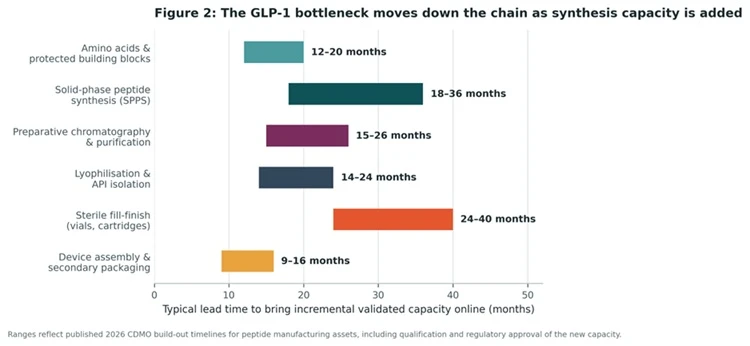
Adding synthesis capacity simply relocates the constraint; sterile fill-finish and purification carry the longest qualification timelines in the GLP-1 chain.
Rewriting the GLP-1 Cost Curve: Hybrid Routes, Biocatalysis and Green Chemistry
With volume assured and pricing under pressure, cost per gram has replaced availability as the competitive variable in GLP-1 manufacturing. Conventional solid-phase synthesis is materially efficient in chemistry but profligate in materials: process mass intensity for therapeutic peptides can reach thousands of kilograms of input, overwhelmingly solvent, per kilogram of active ingredient. At tonne scale, that is no longer a sustainability footnote but a determinant of plant footprint, waste-handling permits, energy contracts and unit economics.
The manufacturers positioning for the second half of the decade are therefore re-engineering the route rather than replicating it. Hybrid approaches that assemble fragments on resin and condense them in solution reduce resin loading and solvent turnover. Recombinant expression of the peptide backbone, followed by chemical modification of the side chain, shifts part of the burden from organic synthesis to fermentation, where capacity economics behave very differently. Enzymatic ligation and biocatalytic steps are moving from proof of concept toward commercial deployment. Solvent recovery, greener coupling reagents and continuous processing are compounding the effect. A producer that halves its cost per gram acquires pricing latitude in markets where competitors are structurally unable to follow.
The Oral Shift: Why GLP-1 Tablets Rewrite the Capacity Arithmetic
The arrival of oral incretin therapy is usually discussed as a convenience and adherence story. Its manufacturing implications are far more consequential, and they run in two opposite directions. An oral peptide formulation must overcome very low intestinal bioavailability, which means the tablet carries a daily dose an order of magnitude above the weekly injectable equivalent. On a per-patient, per-year basis, an oral peptide presentation can consume roughly seventy times more active ingredient than the injection it replaces. Far from relieving pressure on peptide capacity, the tablet is the single largest new claim on it. Europe granted marketing authorisation to the first oral GLP-1 receptor agonist for weight management in July 2026, following a positive committee opinion in May, and the volume consequences of that decision are only beginning to be modelled.
The second oral route is entirely different. Non-peptide, small-molecule GLP-1 agonists are conventional organic molecules of low molecular weight, made by crystallisation, distillation and continuous reaction chemistry in standard active ingredient plants. They approve, scale and cost like traditional pharmaceuticals, and the first such product secured a European national authorisation in August 2026 after clearing the United States earlier in the year. For a board allocating capital, these are not variations on a theme. One pathway demands peptide assets with three-year lead times; the other can be served by existing small-molecule infrastructure. The portfolio decision and the capacity decision are now the same decision.
The 2026 Exclusivity Map: Where GLP-1 Global Expansion Actually Happens
Global market expansion in this class is no longer a single strategy. Exclusivity on the leading GLP-1 molecule lapsed in Canada in early January 2026, making it the first Group of Seven market to open, followed by India, China and Brazil in March and by other markets including Türkiye. The response was immediate. In India, more than five domestic manufacturers launched within days, at prices reported between 70 and 90 percent below the originator, and the count of competing brands passed forty within roughly six weeks. Canada and Brazil together account for close to USD 2 billion in annual branded sales now exposed to follow-on entry.
The regulatory picture is anything but uniform, and that fragmentation is the strategic opportunity for well-prepared manufacturers. Some jurisdictions treat a chemically synthesised version as a complex generic requiring bioequivalence data alone. Others classify the same molecule as a biologic or similar biologic, demanding impurity, aggregate and immunogenicity characterisation, and in at least one major market a locally conducted clinical programme. Elsewhere, classification turns on whether the product was made by synthesis or recombinant expression. A single global dossier does not exist here. Companies that mapped these divergent pathways years in advance are launching now; those that assumed harmonisation are still filing.
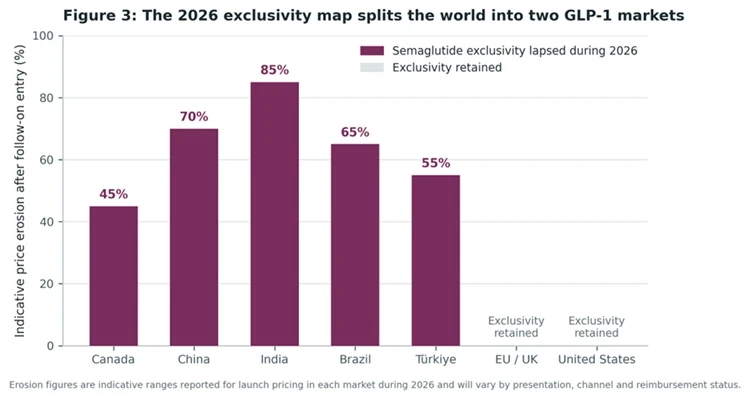
Two GLP-1 markets now coexist: high-volume, price-eroded territories opened during 2026, and protected Western markets where premium pricing and next-generation assets still govern strategy.
Europe's Play: Turning Regulatory Rigour into GLP-1 Supply Advantage
Europe occupies an unusual position in this landscape. It remains a protected commercial market for the originator products while simultaneously hosting a substantial share of the world's peptide manufacturing revival. European producers have committed heavily to expansion on the conviction that incretin demand is durable rather than cyclical, and they are marketing themselves less on cost than on qualification speed, data integrity and supply security. That positioning is credible precisely because European quality expectations are demanding. In a category where a single sterile manufacturing deviation can remove a product from the market for months, buyers are willing to pay for regulatory reliability.
The commercial environment inside Europe is more complicated. Reimbursement for obesity pharmacotherapy remains a national patchwork, though several member states moved during 2026 toward partial coverage for eligible patient groups, and joint clinical assessment under the European health technology assessment framework is beginning to shape how new metabolic entrants are evaluated. The practical implication is a dual-track strategy: defend premium positioning at home through differentiated formats, cardiovascular and renal label expansion and outcomes evidence, while monetising manufacturing capability abroad through supply agreements or partnered launches.
Case in Point: A European Peptide Manufacturer's Capacity Doubling
The clearest illustration of this dual strategy comes from a Europe-headquartered peptide manufacturer that committed more than EUR 900 million to a multi-year capacity programme spanning several sites, including a doubling of solid-phase synthesis capability at one of its Nordic facilities. Rather than building speculatively against forecast demand, the group anchored the investment in long-term commercial supply agreements, including one signed with a clinical-stage developer of a dual incretin receptor agonist well ahead of that product's approval.
Three lessons stand out. Capacity was contracted before it was needed, converting an uncertain forecast into a financeable commitment. The investment was staged across multiple sites and modalities rather than concentrated in a single asset, hedging against both technical failure and geographic disruption. And the manufacturer sold reliability rather than price, positioning itself for programmes where a supply interruption would be commercially catastrophic.
The Risk Ledger: Overcapacity, Talent and Margin Compression
None of this is without downside. A concentrated wave of new capacity will pressure margins, and rising input and energy costs compound the effect. The overcapacity risk, however, does not sit where most commentary places it: baseline demand from approved GLP-1 products already absorbs or has committed the majority of commercial-scale capacity coming online through 2027. The genuine exposure lies at clinical and early-commercial scale, where the pipeline of new peptide programmes seeking partners has grown faster than the specialist capacity serving them.
Conclusion: The Next Growth Strategy Is a Manufacturing Strategy
The incretin category has entered its industrial phase. The molecules are proven, the indications continue to broaden across metabolic, cardiovascular and renal medicine, and demand is no longer the question. What now separates winners from participants is the ability to make active ingredient at tonne scale and declining cost, to secure sterile and device capacity years ahead of need, and to hold a differentiated commercial position in markets that are diverging rather than converging.
For European pharmaceutical and biotech leaders, three commitments follow. Capacity planning must be denominated in kilograms rather than revenue, because volume and value are now moving at very different speeds. Portfolio and manufacturing decisions must be taken together, since the choice between peptide and small-molecule oral formats is a choice between entirely different asset bases. And market entry must be sequenced against a fragmented regulatory map, in which the same molecule is a generic in one jurisdiction and a biologic requiring clinical data in another. The companies that treat manufacturing as the growth strategy rather than its enabler will define this category for the remainder of the decade.

Lakshmi is a science writer with a foundation in the laboratory. She earned her master's in biotechnology and trained through research internships at ICGEB (JNU) and DIPAS, DRDO, with her work appearing in the Egyptian Journal of Veterinary Sciences. Now APCRM-certified and part of the editorial team at Pharma Focus America and Pharma Focus Europe, she reports on pharmaceutical technology, research, and innovation — giving complex science a clear and confident voice for industry leaders.