The New CDMO Strategy: Capacity Expansion for Advanced Therapies
Lakshmi, Editorial Team, Pharma Focus Europe
Advanced therapies have moved from scientific curiosity to commercial obligation, and the pharmaceutical outsourcing sector is rebuilding itself around that shift. This article examines why capacity expansion strategy is migrating from cleanroom square metres towards modularity, analytical throughput and inspection readiness. It sets out the altered unit economics of small-batch, high-value manufacture, the redistribution of European capability, the talent constraint that capital alone cannot resolve, and a governance scorecard that senior pharmaceutical executives can apply to test whether a partner's expansion thesis is genuinely investable rather than merely announced.
Introduction: The Boardroom Question Has Changed
For most of the past two decades, the outsourcing question put to a pharmaceutical board was a question of volume. How many kilograms, how many litres, how many finished units, and at what cost per unit. The answer could be modelled on a spreadsheet and confirmed by a site tour. Advanced therapies have quietly dismantled that arithmetic.
A gene therapy programme may require a few dozen batches a year rather than several million doses. Each batch may carry the entire commercial value of one patient's treatment. The starting material may be unique, perishable and impossible to re-order. In that setting, capacity ceases to be a number on a floor plan. It becomes the combined ability to receive, process, test, release and ship a personalised or short-shelf-life product inside a window measured in days.
That redefinition is compelling contract development and manufacturing organisations to rewrite expansion strategy from first principles, and it is compelling sponsors to rewrite the criteria by which partners are selected. The organisations that prevail will not necessarily be those that pour the most concrete. They will be those that convert capital into qualified, inspectable, transferable capability faster than the underlying science moves.
The Capacity Paradox: Full Suites, Waiting Sponsors
Expansion announcements in the advanced therapy segment have rarely been more numerous, yet development teams still report queueing for slots. The contradiction is not a counting error. It is a mismatch of type rather than quantity.
A suite qualified for autologous cell processing is not readily convertible to plasmid production. A viral vector facility built around adherent culture does not solve a suspension-based programme. Fill and finish for a cryopreserved product demands controlled-rate freezing, vapour-phase storage and a shipping validation package that a conventional sterile line was never designed to provide. Capacity, in other words, is modality-specific and frequently process-specific, and much of the newly installed footprint answers yesterday's demand profile.
The tighter constraint sits downstream of the cleanroom altogether. Potency assays, sterility testing, identity confirmation and vector genome quantification all compete for the same analytical benches and the same small population of trained analysts. A suite that can manufacture forty batches a year is worth little beside a quality control laboratory that can disposition twenty. Sponsors increasingly discover that the queue they joined was never for a cleanroom; it was for a release decision.
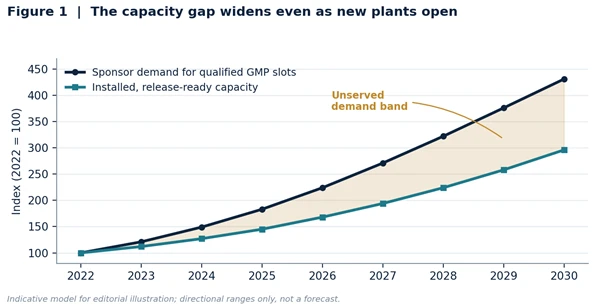
Figure 1: Demand for release-ready manufacturing slots continues to outpace installed capability, and the gap is qualitative as much as quantitative.
Rewriting the Economics of a Single Batch
Conventional manufacturing economics reward scale and punish idle assets. Advanced therapy economics behave differently. Raw material seldom dominates the cost of goods; labour, analytics, changeover and failure risk do. A single contamination event or an out-of-specification potency result can destroy a batch that represents one patient's only realistic treatment and several hundred thousand euros of committed cost.
The consequence for commercial strategy is significant. Utilisation, historically the master metric of a manufacturing network, becomes a misleading one. A facility running at very high occupancy has no slack for a repeat batch, no room for an accelerated clinical programme, and no tolerance for the deviation investigations that early commercial processes inevitably generate. Deliberate under-loading becomes a form of insurance rather than a sign of poor asset management.
Contract structures have adapted accordingly. Reserved-capacity arrangements, take-or-pay minimums and multi-year suite leases transfer part of the demand risk back to the sponsor in exchange for guaranteed access and priority scheduling. For a chief financial officer, this converts an operating expense with uncertain availability into something closer to a committed supply right. For the manufacturing partner, it underwrites expansion before the first steel arrives on site.
A suite that can manufacture forty batches a year is worth little beside a quality control laboratory that can disposition twenty.
The Modular Wager: Why Poured Concrete Became a Liability
If the modality mix cannot be forecast with confidence, the rational response is to buy optionality rather than certainty. That logic explains the decisive shift towards prefabricated cleanroom systems, closed and functionally closed processing, and single-use assemblies that remove much of the cleaning validation burden between campaigns.
Modular delivery does not merely compress the construction schedule. It changes the shape of the investment. Capital is released in tranches tied to demand signals rather than committed in a single irreversible decision made three years before the first patient dose. Suites can be replicated to a standard design, which materially simplifies the comparability exercise when a process moves between rooms or between countries. And a pod that proves surplus to one modality can be re-fitted at a fraction of the cost of re-purposing a traditionally constructed suite.
The trade-off is real. Modular systems carry a premium per square metre, can constrain equipment layout, and shift dependency onto a narrow set of specialist suppliers whose own lead times have lengthened. Nonetheless, when the calculation is expressed as time-to-qualified-output rather than cost-per-square-metre, the balance for advanced therapies has moved decisively.
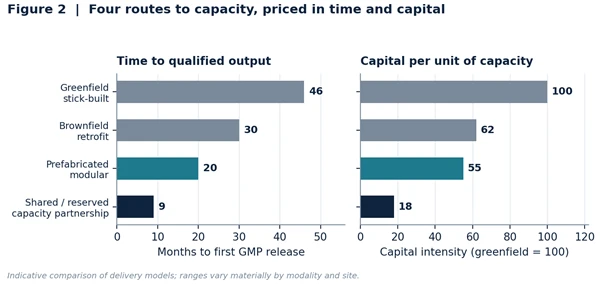
Figure 2: The four principal routes to capacity, compared on the two variables that matter to a board — elapsed time to a released batch, and capital committed per unit of capability.
Where the Money Actually Goes
Follow the expansion budget of a serious advanced therapy operation and a striking pattern emerges: the physical shell is no longer where the money concentrates. Analytical and quality control throughput, closed-system automation, secure digital batch records and validated cold-chain control together absorb the majority of the spend.
This is a rational reallocation. Automation reduces operator-dependent variability in the process steps most likely to cause batch loss. Electronic batch records and integrated environmental monitoring make a site defensible in an inspection where paper-based systems would not be. Cold-chain telemetry protects a product whose value cannot be re-manufactured. None of these appear in a press release about square metres, and all of them determine whether the square metres ever produce a released batch.
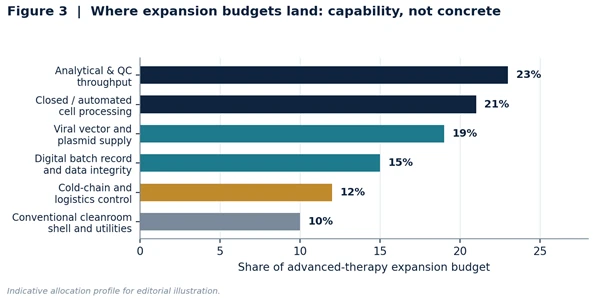
Figure 3: The composition of advanced therapy expansion budgets has shifted decisively towards capability, with the conventional cleanroom shell now a minority of committed spend.
Europe's Quiet Geographic Reshuffle
The European map of advanced therapy manufacturing is being redrawn by three forces that operate largely independently of one another. The first is scientific proximity: clusters continue to consolidate around academic medical centres and translational institutes where process development talent and early clinical demand already coexist.
The second is logistical. An autologous product with a short shelf life is constrained less by manufacturing capacity than by the distance between the apheresis suite and the processing suite. That reality favours a distributed network of smaller, standardised sites over a single flagship facility, and it has revived serious interest in hospital-adjacent and point-of-care manufacture, with all the regulatory novelty such models entail.
The third is fiscal and political. Energy costs, regional grant regimes, skilled-migration policy and post-Brexit customs friction now enter capacity decisions that would once have been settled on engineering grounds. Executives increasingly find that the site selection question has become a sovereignty question: how much of a critical supply chain a company is prepared to place beyond its own regulatory jurisdiction.
Case Study: The Second Site That Paid for Itself in Comparability
Consider a mid-cap European developer with an autologous cell therapy entering pivotal trials. Manufacturing sat at a single contracted site, with a vein-to-vein target of eleven days and no redundancy. Two deviations in one quarter, neither of them product-impacting, were sufficient to threaten the enrolment schedule and to trigger uncomfortable questions from the board's risk committee.
The instinct was to commission a second facility. Modelling showed a greenfield build reaching first qualified output well after the anticipated filing date. The alternative selected was a reserved-capacity agreement with a partner operating a standardised modular suite design, combined with an option to install a dedicated replica pod once volumes were confirmed.
Three outcomes proved decisive. First, the identical suite specification reduced the comparability package to process performance data rather than a full facility-difference assessment, saving several months of regulatory preparation. Second, the option structure meant capital was committed only after the pivotal readout. Third, and least anticipated, dual-site qualification became a commercial asset in partnering discussions, where supply resilience was scrutinised more closely than manufacturing cost. The redundancy was not an insurance premium; it was a valuation input.
The Constraint No Balance Sheet Can Buy Out
Capital can procure isolators, incubators and analytical instruments within a predictable lead time. It cannot procure a qualified person with advanced therapy experience, an aseptic operator with a documented media-fill history, or a manufacturing science team that has transferred a live process between sites and survived the inspection that followed.
Across most European clusters, the binding constraint on expansion is now people rather than plant. The organisations managing it best have stopped competing solely on salary and started building structured internal academies, cross-training operators across modalities, and designing processes that deliberately reduce dependence on individual expertise. Automation, in this reading, is not principally a cost-reduction measure. It is a workforce strategy.
Boards should treat attrition among aseptic operators and quality control analysts as a leading indicator of supply risk, and should ask for it directly during partner due diligence. It is rarely volunteered.
Regulatory Gravity: Build for Inspection, Not Only for Output
Advanced therapy oversight in Europe continues to evolve towards greater expectation of contamination control strategy, data integrity and lifecycle comparability. A facility designed only to produce will, sooner or later, encounter a facility-shaped problem it cannot document its way out of.
Designing for inspection means several concrete things: environmental monitoring architecture defined before the room layout is frozen; audit trails that are reviewed rather than merely enabled; a contamination control strategy that is a living document rather than a validation artefact; and a comparability plan drafted at the point of site selection rather than at the point of technology transfer. Sites that treat these as design inputs consistently reach commercial supply faster than those that treat them as compliance obligations to be satisfied afterwards.
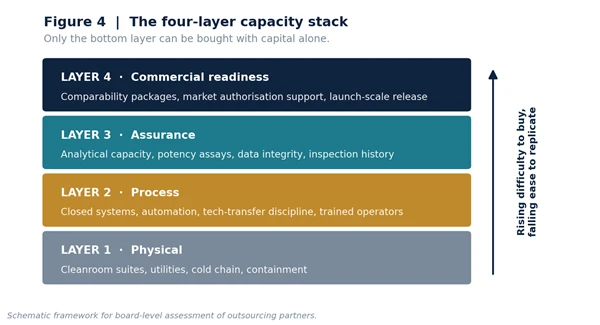
Figure 4: Only the physical layer of the capacity stack can be purchased with capital alone. The upper layers, which determine whether a batch is ever released, must be built and evidenced over time.
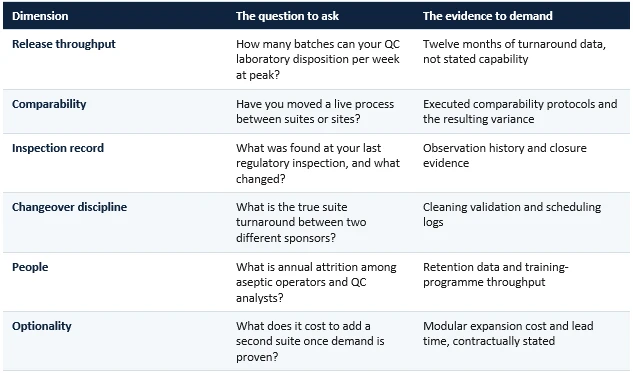
The Boardroom Scorecard
Senior executives evaluating an expansion thesis, whether their own or a partner's, need a small number of questions that resist rehearsed answers. The following framework has proved more diagnostic than a facility tour.
Conclusion: Capacity Is a Verb
The new outsourcing strategy is not a construction programme with a scientific label attached. It is a wager that capability — analytical, digital, procedural and human — can be assembled faster than the therapeutic pipeline matures. Boards that continue to evaluate partners on square metres and headline capital figures will keep buying the one layer of the stack that competitors can replicate. Those that interrogate release throughput, comparability history and inspection record will secure something considerably scarcer: the ability to supply a therapy on the day a patient needs it.

Lakshmi is a science writer with a foundation in the laboratory. She earned her master's in biotechnology and trained through research internships at ICGEB (JNU) and DIPAS, DRDO, with her work appearing in the Egyptian Journal of Veterinary Sciences. Now APCRM-certified and part of the editorial team at Pharma Focus America and Pharma Focus Europe, she reports on pharmaceutical technology, research, and innovation — giving complex science a clear and confident voice for industry leaders.