

The Growing Role of Advanced Therapies in European Drug Development
Lakshmi, Editorial Team, Pharma Focus Europe
Advanced therapy medicinal products (ATMPs) have moved from regulatory curiosity to strategic priority in Europe. Thirty-one have won EU authorisation since 2009, twenty-two of them since 2018, while annual scientific advice requests rose 43% between 2022 and 2025. This article examines what is driving the shift, why nine authorised products have left the market, how new assessment and legislative rules change the calculus, and what a hospital-built CAR-T reveals about Europe's next development model.
Advanced Therapies Step Out of the Niche
For most of the past two decades, European pharmaceutical strategy was built around molecules that could be manufactured at scale, shipped in bulk and dosed repeatedly. Advanced therapies break almost every one of those assumptions. A gene therapy may be given once. A cell therapy may be manufactured for a single patient from that patient's own cells. A tissue-engineered product may sit closer to surgery than to pharmacy. Yet these products, grouped in EU law as advanced therapy medicinal products, are now among the most closely watched assets in European drug development.
The regulatory record shows why. When the EU's dedicated framework for these products became operational in 2009, approvals were rare: by the end of 2013, only four had been recommended. By early 2026, the European Medicines Agency's Committee for Advanced Therapies listed 31 authorised products across gene therapy, cell therapy and tissue engineering, and the pipeline behind them is deeper still.
For European boards and executive teams, the question is no longer whether advanced therapies matter, but how to compete in a field where science, manufacturing, evidence generation and reimbursement must be solved at the same time. The sections that follow set out the numbers, the pressure points and the strategic choices that will separate leaders from followers.
Advanced Therapies by the Numbers: A Market That Found Its Momentum
The trajectory of EU authorisations tells a story of delayed acceleration. Nine advanced therapies were authorised between 2009 and 2017, roughly one a year. From 2018 to January 2026, a further 22 followed, including five in 2022 alone. Gene-based products now dominate: of the 22 advanced therapies still on the market at the time of EMA's March 2026 update, 18 are gene therapy medicinal products, a category that under EU classification also covers genetically modified cell therapies such as CAR-T. Two are cell therapies and two are tissue-engineered products.
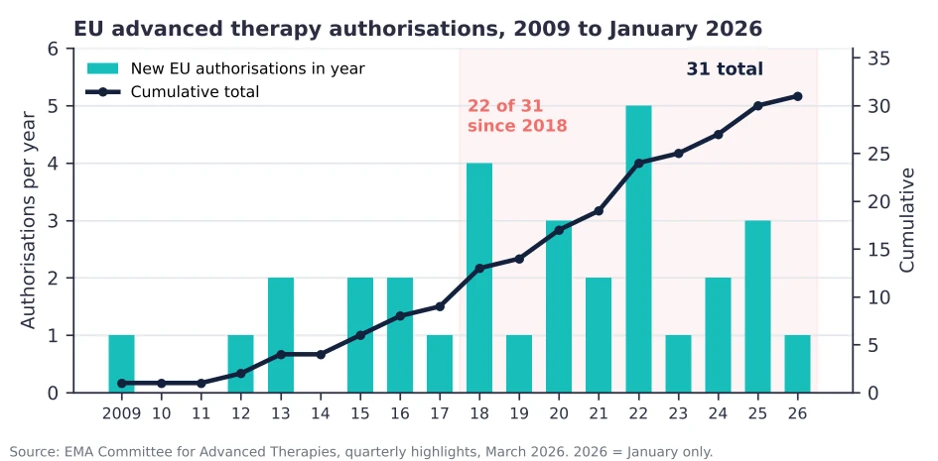
Figure 1: Annual and cumulative EU authorisations of advanced therapy medicinal products. More than two-thirds of all authorisations have come since 2018.
The front end of the pipeline points the same way. EMA recorded 766 scientific advice procedures for these products between 2009 and February 2026, with the annual figure climbing from 53 in 2022 to 76 in 2025. Since the PRIME priority medicines scheme opened in 2016, 172 advanced therapy candidates have been discussed for eligibility and 73 granted enhanced support. Developers have also lodged 725 requests asking the agency to confirm whether a product falls within the advanced therapy definition at all, a reliable early indicator of activity entering the system.
Rare disease remains the natural home of the field. Twenty-four of the 31 authorised products carried orphan designation, reflecting both the concentration of single-gene disorders among rare conditions and the regulatory incentives attached to them.
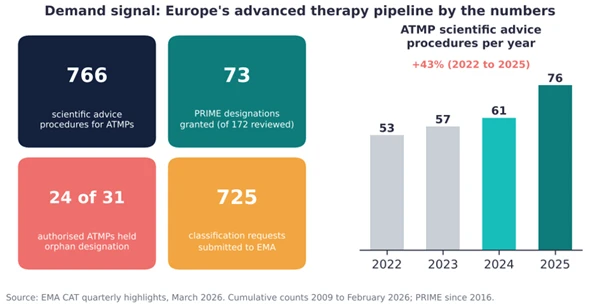
Figure 2: Pipeline indicators for advanced therapies at EMA. Scientific advice demand rose 43% between 2022 and 2025.
The Attrition Paradox: Why Approved Advanced Therapies Still Leave the Market
Authorisation is not the finish line. Of the 31 advanced therapies authorised in the EU, nine have been withdrawn or not renewed, almost three in ten. Some exits came within months of approval; others followed years on the market. Withdrawals have touched every product category, from early tissue-engineered cartilage products to a gene therapy authorised in 2024 and withdrawn in 2025.
The review stage is equally demanding. Of 50 marketing authorisation applications submitted for advanced therapies up to February 2026, 32 resulted in positive draft opinions, seven in negative opinions and 13 were withdrawn before conclusion, with four still under evaluation. In 2025 alone, the committee issued four positive draft opinions alongside three negative ones, while three applications were withdrawn.
The lesson for executive teams is that technical success and commercial durability are separate tests. One-time treatments concentrate cost at the point of care, which strains annual budgets designed around chronic therapies. Small patient populations, spread across 27 national health systems with distinct pricing processes, turn each launch into a series of individual negotiations. Manufacturing, particularly for products made from a patient's own cells, ties revenue to logistical capacity at qualified treatment centres. A product that clears the scientific bar but cannot clear the access bar becomes an expensive asset with a shrinking footprint.
Boards should read these figures as a portfolio signal rather than a warning to stay away. The products that endure tend to combine a clear unmet need, a demonstrable durability of effect and a delivery model that treatment centres can absorb. Building those three elements into a programme from the outset is now as important as the underlying science.
Rewriting the Rulebook: How New EU Policy Reframes Advanced Therapy Strategy
Two policy shifts are changing the economics. The first is the EU Health Technology Assessment Regulation, which began to apply on 12 January 2025. Advanced therapies were placed in the first wave of joint clinical assessment alongside new cancer medicines, so applications submitted after that date face a single EU-level evaluation of relative clinical effectiveness. Orphan medicines join in January 2028 and all new centrally authorised medicines in January 2030. Pricing and reimbursement remain national decisions, but the clinical evidence package is now judged against comparators and outcomes defined at European level.
For advanced therapy developers, this lands where they are most exposed. Single-arm trials, small cohorts and surrogate endpoints are common in the field, and joint assessors will weigh them against the expectations of many member states at once. Evidence strategy must therefore be shaped before pivotal trials begin, not after authorisation. The joint scientific consultations offered under the regulation give companies a route to test that strategy early.
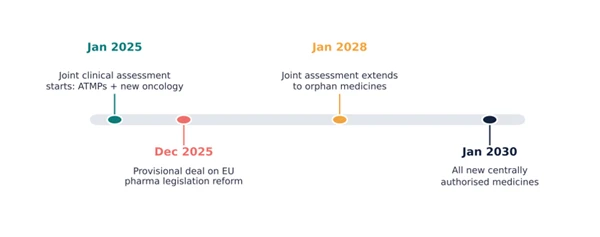
Figure 3: Key EU policy milestones shaping advanced therapy development, from joint clinical assessment to legislative reform.
The second shift is reform of the EU's general pharmaceutical legislation, on which the Council and Parliament reached provisional agreement on 11 December 2025. The deal retains eight years of regulatory data protection but shortens baseline market protection from two years to one, with conditional extensions and an overall cap of 11 years. It also addresses the hospital exemption, the national route through which hospitals may prepare advanced therapies for individual patients without central authorisation, generally keeping such use within the member state where the product is prepared. Formal adoption and implementation follow, so operational detail will matter as much as the headline terms.
Case Study: An Academic CAR-T Charts Europe's Alternative Advanced Therapy Pathway
A public hospital in Barcelona offers one of the clearest examples of how advanced therapy development in Europe is diversifying. Hospital Clínic de Barcelona built a CD19-directed CAR-T cell therapy, known as ARI-0001 (varnimcabtagene autoleucel), entirely within an academic setting. Its targeting component came from a monoclonal antibody the hospital had developed more than 30 years earlier, and laboratory work on the CAR construct began in 2013.
The programme secured Good Manufacturing Practice approval for its production process in 2017, and a clinical study opened in July that year with a partner children's hospital in the same city. The study enrolled 58 adult and paediatric patients, of whom 38 with acute lymphoblastic leukaemia were treated with the CAR-T. The therapy produced complete responses in more than 70% of patients.
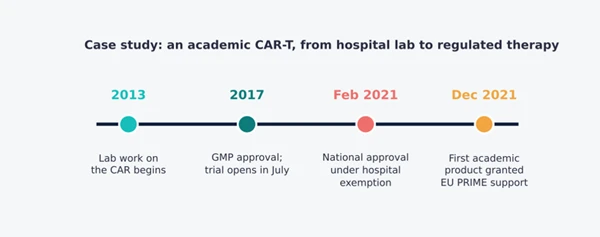
Figure 4: Development milestones of the academic CAR-T, from laboratory construct to national authorisation and EU PRIME support.
In February 2021, Spain's medicines agency authorised ARI-0001 under the hospital exemption for adults over 25 with relapsed or refractory acute lymphoblastic leukaemia, making it the first CAR-T developed entirely in Europe to be approved by a regulatory authority. More than 175 professionals had contributed to the effort, and the hospital estimated that at least 25 patients a year could be treated. In December 2021, it became the first academic product granted PRIME support by the European Medicines Agency.
Three lessons stand out for industry leaders. First, academic centres are now credible originators of regulated advanced therapies, not merely trial sites. Second, manufacturing close to the patient can shorten the distance between diagnosis and treatment, a meaningful advantage where every week counts. Third, hospital-based routes and centralised authorisation need not be alternatives; this programme used one as a stepping stone towards the other. For companies, that opens partnership models built around licensing, co-development and shared manufacturing capacity.
Building to Win: Where Advanced Therapy Leadership Will Be Decided
The next phase of competition will be won less in the laboratory than in the operating model. Manufacturing is the first battleground. Viral vector supply, release testing and vein-to-vein turnaround times still determine how many patients a product can reach, and investment in automated, closed and decentralised production will separate scalable programmes from boutique ones.
Evidence is the second. With joint clinical assessment now in force, the most effective developers will design trials that satisfy regulators and health technology assessors at the same time, building long-term follow-up and real-world data collection into launch plans rather than treating them as post-approval obligations.
Payment innovation is the third. Outcome-based agreements, staged payments and risk-sharing arrangements are becoming part of the standard vocabulary for one-time therapies, and companies that arrive at payer discussions with credible durability data will negotiate from a position of strength.
Early regulatory engagement is the fourth. The rising volume of scientific advice and PRIME requests shows that the most disciplined developers are already treating the agency as a design partner rather than a final examiner. Securing alignment on potency assays, comparability after manufacturing changes and long-term safety monitoring before pivotal studies begin can save years later, and those questions are rarely trivial for living medicines whose production process is inseparable from the product itself.
Finally, Europe's clinical networks remain a genuine asset. Its hospitals have shown they can originate, manufacture and deliver these therapies. Companies that treat those institutions as partners rather than competitors are likely to reach patients, data and capabilities faster.
Conclusion: Advanced Therapies Demand a New European Playbook
Advanced therapies have earned their place in European drug development. The number of EU authorisations has more than tripled since 2017, demand for scientific advice is rising, and gene-based medicines now account for most of the products in use. Yet the record of withdrawals is a reminder that approval opens the door to a market without guaranteeing a place in it.
The policy environment is moving at the same pace. Joint clinical assessment has set a single European bar for clinical evidence, and the reformed pharmaceutical legislation will reshape protection periods and the role of hospital-prepared therapies. Meanwhile, academic programmes have shown that innovation can originate inside public hospitals and progress towards central regulatory pathways.
For C-suite leaders, the implication is clear. Success in advanced therapies requires an integrated strategy that links science, manufacturing, evidence and access from the first clinical study onward. The organisations that build that strategy now will help define the next decade of European medicine.

Lakshmi is a science writer with a foundation in the laboratory. She earned her master's in biotechnology and trained through research internships at ICGEB (JNU) and DIPAS, DRDO, with her work appearing in the Egyptian Journal of Veterinary Sciences. Now APCRM-certified and part of the editorial team at Pharma Focus America and Pharma Focus Europe, she reports on pharmaceutical technology, research, and innovation — giving complex science a clear and confident voice for industry leaders.