The Future of Pharma Data Management: Creating Unified Platforms for Innovation
Lakshmi, Editorial Team, Pharma Focus Europe
Europe's pharmaceutical data agenda is being rewritten by three converging forces: the European Health Data Space, the rewrite of GMP Annex 11 and the new artificial intelligence annex, and regulator-led federated evidence networks. Together they turn the unified data platform from an IT efficiency programme into a compliance capability. This article examines what unification actually requires, why federation is outperforming centralisation, and what boards should decide now.
Introduction:
Why Pharmaceutical Data Management Stopped Being an IT Problem
Ask a European pharmaceutical executive where the company's data actually lives and the honest answer is usually: in about forty places, under a dozen owners, described in half a dozen vocabularies. Research holds assay and translational data. Clinical holds trial and subject data. Manufacturing holds batch, deviation and environmental monitoring records. Pharmacovigilance holds case data. Supply chain holds serialisation and cold-chain telemetry. Commercial holds market and patient-support data. Each estate was built to satisfy a different regulator on a different timetable, and each is entirely defensible on its own terms.
What has changed is that the questions now being asked cut across all of them. Does this manufacturing deviation correlate with the safety observation emerging in one market? Can we demonstrate that the data behind this model is representative of the population in the indication being claimed? Can we produce, inside a statutory deadline, a described and permissioned dataset drawn from an estate that was never catalogued in the first place? A vertically organised data estate answers vertical questions well and horizontal questions slowly. From 2027 onwards, several of those horizontal questions carry legal deadlines rather than commercial ones.
That is the shift European boards should register. Unified data management has moved out of the IT capital plan and into the category of licence-to-operate capability. The remaining decision is not whether to unify. It is how.
Three European Forces Redrawing Pharmaceutical Data Management
The first is the European Health Data Space: Regulation (EU) 2025/327 entered into force on 26 March 2025. Its general and primary-use provisions apply from 26 March 2027; the secondary-use regime follows on 26 March 2029, with clinical trial data and human genetic data on an extended timetable running to 2031. Two features matter commercially. Companies are data users, able to apply through national Health Data Access Bodies for permitted research access to health data across member states. They are also data holders, and can be compelled to share electronic health data they control — with non-compliance carrying penalties that include exclusion from data access for up to five years.
The second is the rewrite of GMP expectations for computerised systems: Drafts of a substantially revised Annex 11, a revised Chapter 4 on documentation, and an entirely new Annex 22 on artificial intelligence were released for consultation on 7 July 2025. Consultation closed that October, an expert workshop followed at the end of June 2026, and final texts are expected during 2026. Annex 11 expands from a five-page guideline into a document of roughly nineteen pages across seventeen chapters, and treats cybersecurity as a core GMP requirement for the first time. Annex 22 restricts critical GMP applications to static, locked models producing deterministic outputs, keeping adaptive and generative models to non-critical use under human oversight.
The third is architectural rather than legal: Europe's regulator-led real-world evidence capability operates on federated principles: the data stays with its custodian and a common data model travels to it. By February 2026 that network could reach roughly 250 million patient records, with 108 research topics assessed and 88 studies completed or under way — a 49 percent increase on the previous year. The regulator has, in effect, published a working reference architecture.
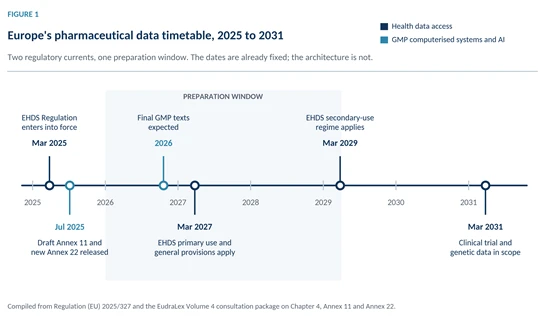
Figure 1: The fixed dates in Europe's pharmaceutical data timetable, and the window in which architecture decisions have to be made.
What a Unified Pharma Data Platform Actually Means — and What It Does Not
The most expensive mistake in this field is to read “unified” as “centralised”. The instinct is to build one lake, move everything into it and declare victory. In European pharma that instinct fails on three counts: residency rules constrain where health data may be processed, GxP validation cost rises with every system migration, and the sheer volume of manufacturing and sensor data makes wholesale copying uneconomic.
What unification actually requires is a thin layer of shared meaning stretched over estates that largely stay where they are. Four capabilities carry it.
One catalogue, not one copy: Every dataset in scope carries an entry naming its owner, its lawful basis, its retention rule and its residency constraint. The catalogue is the platform; the storage is an implementation detail.
Identifiers that survive the crossing: Substance, product, site, batch and study identifiers must resolve to the same entity in every domain. Without this, a cross-domain query returns plausible nonsense, and no amount of analytics investment repairs it.
Governance expressed as code: Purpose limitation, permission, retention and residency should be evaluated by a policy engine at query time, so a request either returns data or returns a documented reason it cannot. Governance written only in policy documents does not scale to a statutory deadline.
Lineage that an inspector can follow: Every derived value should trace back to its source system, its transformation and the validated pipeline that produced it — the expectation the revised Annex 11 and Chapter 4 are converging on.
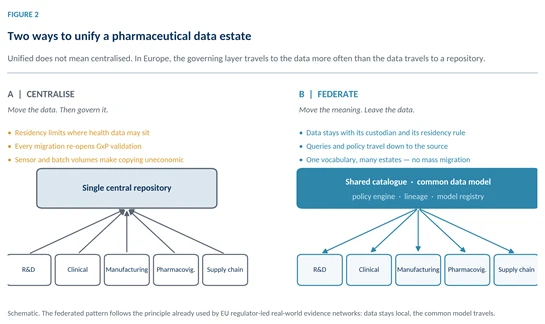
Figure 2: Centralising moves the data and inherits its constraints. Federating moves the meaning and leaves the constraints where they already sit.
Governance Is the Layer That Makes a Unified Pharma Data Platform Legal
Under the secondary-use regime, access is mediated by data permits, processing happens inside secure environments, re-identification is prohibited, and use for advertising or marketing is excluded outright. A platform that cannot demonstrate purpose limitation at the level of an individual query is not merely inelegant; it is unusable for the access route the regulation creates.
The GMP side imposes a parallel discipline. Where an AI model touches a decision with direct impact on product quality, patient safety or data integrity, the draft expectations point to models that are locked after training and produce repeatable outputs, supported by a defined intended use, documented acceptance criteria and independent test data. Accountability stays with the manufacturer even when the model comes from a supplier. In practice this argues for a model registry sitting inside the data platform rather than beside it — versioned, validated and joined to the same lineage records as the data it consumes.
One provision deserves separate attention at board level. The revised Annex 11 treats cybersecurity as a core GMP requirement rather than an IT concern running alongside it. That reclassification matters for any unification programme, because consolidating access to previously siloed estates concentrates risk as well as value. A federated design mitigates part of this by leaving data in place, but it widens the exposure of the query layer that now reaches everything. Boards approving a unification business case should expect the security architecture to be presented as part of the GMP case, not as a separate item from the security function.
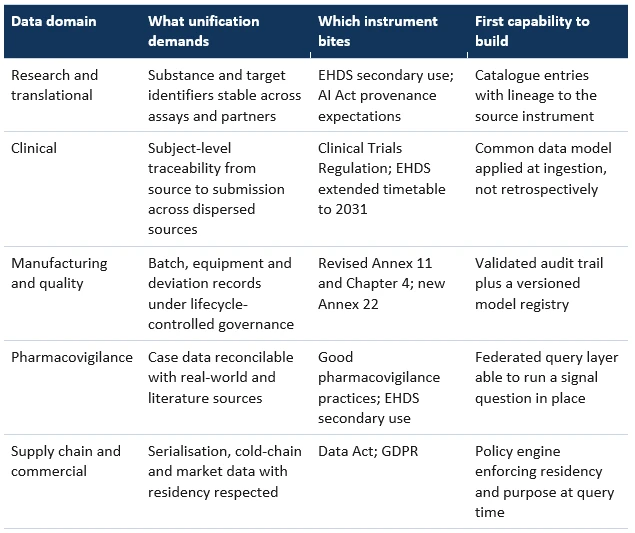
Table 1: A domain-by-domain reading of what a unified pharmaceutical data platform has to deliver, and which European instrument sets the deadline.
Where Unified Pharma Data Platforms Create Innovation, Not Just Savings
Efficiency is the weakest argument for unification, and the one most likely to stall in a finance committee. The stronger case is that several innovation routes are simply closed to a fragmented estate.
Evidence generation is the clearest. The federated model already demonstrates that a well-described, commonly modelled estate can answer regulatory questions at population scale without moving a single record across a border. A sponsor whose own estate is described to the same standard can participate in that ecosystem, respond to evidence requests inside review timelines, and design post-authorisation commitments it can actually meet. A sponsor whose estate is not described will spend the permit window building a catalogue instead of running a study.
The same logic applies inside the company. Process understanding across sites requires batch and deviation records that share a vocabulary. Signal detection improves when case data can be interrogated alongside real-world sources rather than after them. And any serious use of AI now depends on being able to state, with evidence, what the training data was, where it came from and whether it was fit for the claimed population — a provenance question that a unified catalogue answers and a folder structure does not.
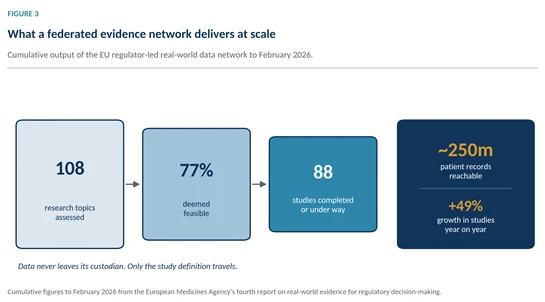
Figure 3: Federated evidence generation at European scale — the reference architecture regulators are already running.
Case Study: Unifying a European Pharmaceutical Data Estate Without Moving It
The following case is a composite drawn from reported European programmes. Figures are directional; no single organisation's results are represented.
A European mid-cap sponsor with two manufacturing sites, an outsourced clinical portfolio and marketed products in eleven member states began an eighteen-month programme after an unremarkable trigger: a request to reconcile a deviation trend against a post-authorisation safety observation took its teams eleven weeks to answer.
The programme deliberately did not begin with a repository. It began with an inventory. Three components followed. A catalogue was built across five domains, each entry naming an owner, a lawful basis, a retention rule and a residency constraint. A common data model was applied at the point of ingestion rather than retrospectively, with product and substance identifiers reconciled to a single master. And a policy engine resolved purpose, permission and residency at query time, so an analyst's question either returned data or returned a documented reason it could not.
Only two systems were replaced. Everything else stayed where it was and was described. Governance ran in parallel rather than behind: every model touching a GMP-critical decision was registered with an intended use, acceptance criteria, an independent test dataset and a locked version identifier — the shape the draft AI annex asks for, adopted ahead of its final text.
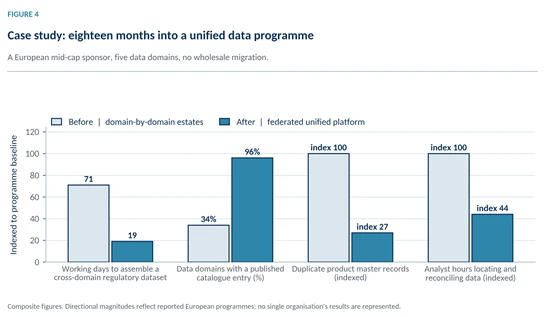
Figure 4: Outcomes eighteen months in, indexed to the programme baseline.
The outcomes are shown in Figure 4. Assembling a cross-domain regulatory dataset fell from 71 working days to 19. Catalogue coverage rose from roughly a third of domains to almost all of them. Duplicate product master records fell by around three quarters, and analyst time spent locating and reconciling data by more than half. The finance case, notably, was carried by the first and last of those figures rather than by any headcount reduction.
Conclusion: The Unified Pharma Data Platform Is a Licence to Operate, Not a Cost Programme
Europe has done something unusual. It has published, several years in advance, both the deadlines and a working reference architecture. The secondary-use regime arrives in 2029 and reaches clinical and genetic data in 2031. The GMP rewrite for computerised systems and artificial intelligence is expected to land far sooner. And the federated pattern — data stays local, meaning travels — is already operating at the scale of a quarter of a billion patient records.
The implication for the pharmaceutical C-suite is that the unified data platform should be planned backwards from those dates rather than forwards from an IT roadmap. Companies that treat unification as a migration project will spend heavily, revalidate repeatedly and still arrive without a catalogue. Companies that treat it as a governance and vocabulary project will arrive with something more valuable: an estate that can be described, permissioned and queried on demand.
Innovation, in this framing, is not what the platform produces. It is what the platform stops preventing. The organisations that can answer a horizontal question in days rather than weeks will run the studies, win the permits and defend the models. That capability is now a condition of competing in the European market, and it is built long before it is needed.

Lakshmi is a science writer with a foundation in the laboratory. She earned her master's in biotechnology and trained through research internships at ICGEB (JNU) and DIPAS, DRDO, with her work appearing in the Egyptian Journal of Veterinary Sciences. Now APCRM-certified and part of the editorial team at Pharma Focus America and Pharma Focus Europe, she reports on pharmaceutical technology, research, and innovation — giving complex science a clear and confident voice for industry leaders.