The Evolving Role of AI in Pharmaceutical Commercial Strategy
Lakshmi, Editorial Team, Pharma Focus Europe
Artificial intelligence has migrated from pharmaceutical R&D into the commercial engine room, reshaping launch sequencing, market access and customer engagement. For European executives, the opportunity is bounded by the EU AI Act, GDPR and joint clinical assessment. This article examines how AI is redefining pharmaceutical commercial strategy, presents an anonymised European launch case study, and sets out the governance questions that separate durable advantage from expensive experimentation.
Introduction:
Why Pharmaceutical AI’s Biggest Payoff Now Sits Outside the Lab
For most of the past decade, the pharmaceutical industry told its artificial intelligence story from the laboratory bench. Molecule generation, protein structure prediction and trial simulation captured the headlines and the capital. Yet the economics of this industry have never been settled in discovery alone. A medicine that reaches approval without a coherent commercial strategy still fails — slowly, expensively, and in full view of the board. The commercial function, which absorbs a substantial share of sector operating expenditure, has until recently run on instruments built for a different era: quarterly sales dashboards, static segmentation, and territory plans revised twice a year.
That gap is closing quickly. AI in pharmaceutical commercial strategy is no longer a curiosity parked in the digital innovation team. It is becoming the connective tissue between medical affairs, market access, marketing and field operations — the layer where evidence, pricing, and customer engagement are reconciled into a single sequence of decisions. For European C-suite leaders, this shift arrives with a distinctive complication. The same technology that promises sharper targeting and faster launch learning must operate inside the world’s most prescriptive environment for both promotion and automated decision-making. The organisations that win will not be those deploying the most AI. They will be those deploying it precisely where the commercial physics of European pharma actually reward it.
From Sales Support to Strategy Engine: The Three Shifts Reshaping Pharmaceutical AI
The first shift is from reporting to anticipation. Traditional commercial analytics explained last quarter. Contemporary AI models forecast uptake curves, detect early deviation between expected and realised prescribing, and flag which accounts are drifting before the numbers confirm it. The value is not the forecast itself but the compression of reaction time — weeks of latency removed from decisions that were previously made on lagging data.
The second shift is from segmentation to orchestration. Legacy models sorted prescribers into deciles and assigned call frequency accordingly. AI-enabled orchestration instead treats each stakeholder relationship as a sequence, selecting the next meaningful interaction — a field visit, a medical science liaison conversation, a peer-reviewed reprint, a formulary discussion — based on what has already landed. In a market where physician access is constrained and consent is fragile, sequencing matters more than volume.
The third and most consequential shift is from function to system. Pharmaceutical commercial organisations have long been structured as adjacent silos: market access negotiates, marketing communicates, field teams execute. AI’s comparative advantage is precisely at the seams. When a payer negotiation in one market alters the reference price environment in three others, when a real-world evidence signal strengthens a value dossier, when an uptake anomaly reveals a supply or reimbursement bottleneck, the intelligence layer that connects those events is where commercial strategy is actually made.
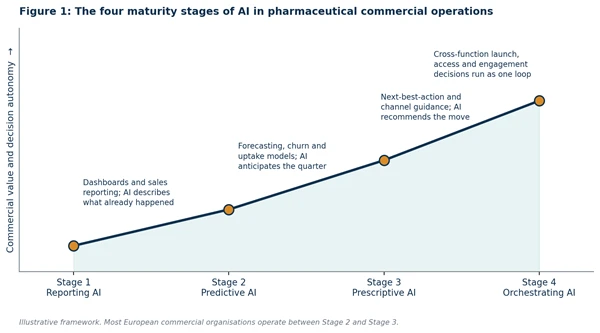
Figure 1: The four maturity stages of AI in pharmaceutical commercial operations. Illustrative framework.
The European Difference: Why Pharmaceutical AI Cannot Be Copied From the US Playbook
European executives are frequently presented with AI commercial models built for the United States and asked why adoption is slower. The honest answer is that the underlying market is structurally different, and the difference is not a maturity gap.
Direct-to-consumer promotion is prohibited, which removes the consumer data flywheel that powers much American commercial AI. Reimbursement is negotiated country by country, so a single European launch is in practice a portfolio of sequenced national launches with interdependent pricing. Physician-level data availability varies sharply between member states, and consent is governed by GDPR rather than commercial convenience. The industry’s own promotional codes impose disclosure and content standards that a generative model cannot be trusted to satisfy unsupervised.
Layered on top is the EU AI Act, which classifies systems by risk rather than by industry. Most commercial pharmaceutical AI sits in the lower tiers, but the boundary is closer than many executives assume — particularly where systems influence patient support programme eligibility or care pathway navigation. Mapping the commercial AI portfolio against these tiers is a board-level exercise, not an IT one.
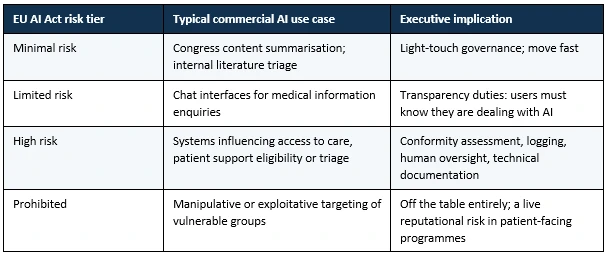
Table 1: Mapping pharmaceutical commercial AI use cases against EU AI Act risk tiers. Indicative classification; legal assessment should be case-specific.
Market Access Under Machine Intelligence: AI, Joint Clinical Assessment and the Pricing Corridor
The most under-appreciated commercial application of AI in Europe is in market access. The move to joint clinical assessment at EU level has raised the stakes on evidence submission: dossiers must anticipate the analytical demands of multiple national bodies simultaneously, under compressed timelines, with limited scope to correct course afterwards.
AI is proving materially useful here in three ways. Large language models accelerate evidence synthesis, scanning published literature, prior assessment decisions and comparator appraisals to identify which endpoints and comparators are likely to attract scrutiny. Predictive models simulate pricing corridors, projecting how an agreed price in an early market propagates through international reference pricing into later markets — turning launch sequencing from an intuition-led decision into a modelled one. Real-world evidence pipelines, structured with machine learning, convert registry and claims data into the post-launch evidence that conditional reimbursement arrangements increasingly demand.
For a chief executive, the strategic point is straightforward: the price achieved in the first three markets constrains the achievable price across the region for years. Any technology that improves the quality of that early sequencing decision has an outsized effect on lifetime product value.
The Field Force Reimagined: AI-Enabled Engagement in a Consent-Constrained Market
Commercial leaders are under sustained pressure to justify field force cost against declining physician access. AI is not resolving that tension by replacing representatives; it is changing what a representative is asked to do.
Content generation is the most visible application. Generative models produce first drafts of promotional and medical material at a fraction of the traditional cycle time, with market-specific adaptation built in. The constraint is review: medical, legal and regulatory approval remains a human function, and organisations that fail to redesign that workflow simply relocate the bottleneck. The genuine gain comes from pairing generative drafting with structured pre-checks that catch claim-substantiation and code-compliance issues before human reviewers see the material.
More strategically, AI-derived next-best-action guidance is replacing call-frequency targets. Rather than instructing a representative to visit a decile-one prescriber eight times a year, the system proposes the specific interaction most likely to advance a defined objective. Adoption depends less on model accuracy than on whether field teams trust the recommendation — which in turn depends on whether they can see why it was made.
Case Study: How AI Rebuilt Launch Sequencing at a European Specialty Pharmaceutical Company
A mid-sized specialty pharmaceutical company headquartered in Western Europe, with annual revenues in the mid-hundreds of millions of euros, faced a familiar problem. Its previous launch of a rare disease therapy had underperformed against internal forecasts by a wide margin. The post-mortem identified the cause not as poor science or weak promotion, but as sequencing: the company had launched first in a market whose negotiated price anchored reference pricing unfavourably across five subsequent markets, and its field resources had been allocated on historical territory logic rather than on where treatment-eligible patients were actually concentrated.
For its next launch, the company built a commercial intelligence layer rather than a set of isolated pilots. Three components were integrated. First, a pricing-corridor simulation modelled the downstream regional price implications of each candidate launch order, using published reference pricing rules and historical appraisal outcomes. Second, a natural language processing pipeline reviewed prior health technology assessment decisions in the therapeutic area to anticipate likely evidentiary objections, which were addressed in the dossier before submission rather than in response to queries. Third, an account prioritisation model combined anonymised, aggregated epidemiological and referral pattern data to identify the treatment centres where eligible patients were most likely to present.
Governance was designed in from the outset. A cross-functional review board including medical, legal, compliance and data protection representatives signed off each model, and every AI-generated recommendation was logged with its rationale so that human decisions could be traced and challenged. No model was permitted to act autonomously on customer-facing decisions.
The results, indexed against the company’s prior launch, are shown in Figure 2. Time to first payer submission fell by roughly a third, field time spent on low-yield accounts fell by more than forty per cent, six-month forecast error narrowed by a quarter, and the proportion of access milestones achieved on schedule rose by more than a third. Management’s own assessment was notable for its restraint: the largest single contributor was not any individual model but the fact that access, medical and commercial teams were, for the first time, working from a shared and continuously updated picture of the launch.
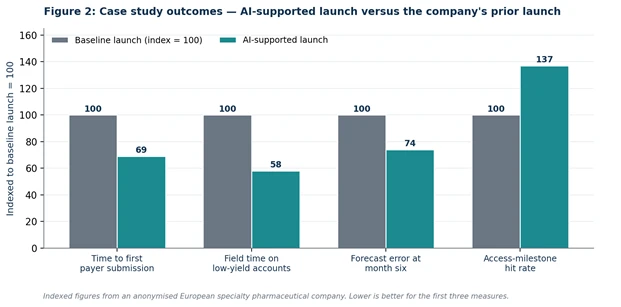
Figure 2: Case study outcomes — AI-supported launch versus the same company’s prior launch, indexed to 100.
The Governance Dividend: Why Responsible AI Is a Commercial Asset in European Pharma
Executives often frame AI governance as a brake on commercial ambition. In European pharmaceuticals, the opposite is closer to the truth. Regulators, payers and health systems are the industry’s customers, and their tolerance for opaque automated decision-making is low and falling. A company that can demonstrate model provenance, documented human oversight, bias testing across patient populations and a clear audit trail is not merely compliant — it is procurement-ready in an environment where others are not.
The practical implication is that governance should be built at the point of model design rather than retrofitted before deployment. Retrofitted controls are expensive, slow, and tend to strip out precisely the functionality that justified the investment.
Organisations that treat explainability as a design requirement also find internal adoption easier, because commercial teams accept recommendations they can interrogate.
The Pilot Trap: Why Most Pharmaceutical Commercial AI Programmes Quietly Stall
The failure mode in pharmaceutical commercial AI is rarely dramatic. Programmes do not collapse; they persist. A model is built, demonstrated, praised internally, and then runs indefinitely alongside the decision-making process it was meant to replace — consuming budget, generating outputs nobody acts on, and never formally cancelled because no one wants to be seen killing the innovation initiative.
Two causes account for most of it. The first is a category error: treating a decision problem as a data problem. Organisations invest heavily in infrastructure on the assumption that better inputs will eventually yield better decisions, without specifying which decision is supposed to change. Warehouses are built, integrations completed, dashboards launched — and the launch sequencing choice is still made in the same room by the same people on the same instincts.
The second is unowned authority. When an AI system recommends a course of action, someone must be accountable for accepting or rejecting it, and that person must be able to override the recommendation without career risk. Where that accountability is undefined, field and access teams default to ignoring the system entirely — rationally, because the downside of following a machine recommendation that fails is asymmetric. The technical build is the easy part; the allocation of decision rights is where commercial AI programmes are won or lost.
A useful diagnostic for any board: if this system were switched off tomorrow, would the commercial organisation notice within a week? If the answer is no, it was a pilot, not a capability, and the investment case should be re-opened rather than renewed.
Conclusion: AI as the Operating System of Pharmaceutical Commercial Strategy
The evolving role of AI in pharmaceutical commercial strategy is not a story about automation displacing commercial judgement. It is a story about where judgement is applied. Pharmaceutical commercial leadership has always involved deciding, under uncertainty, which markets to enter first, which evidence to generate, which stakeholders to engage and in what order. AI does not remove that uncertainty; it narrows it, and it does so fast enough to matter within a launch window rather than after it.
For European C-suite leaders, three conclusions follow. AI investment should be judged by the quality of commercial decisions it improves, not by the number of pilots it produces. Governance built in early is a competitive asset in a market where customers are public institutions. And the greatest returns will come from the seams between market access, medical and commercial functions — the places where information has historically been lost.
The organisations that internalise this will not describe themselves as AI-led pharmaceutical companies. They will simply be the ones whose launches land where they were meant to, at the price they modelled, on the timeline they promised the board.

Lakshmi is a science writer with a foundation in the laboratory. She earned her master's in biotechnology and trained through research internships at ICGEB (JNU) and DIPAS, DRDO, with her work appearing in the Egyptian Journal of Veterinary Sciences. Now APCRM-certified and part of the editorial team at Pharma Focus America and Pharma Focus Europe, she reports on pharmaceutical technology, research, and innovation — giving complex science a clear and confident voice for industry leaders.