Strengthening Clinical Trials Through Digital and Decentralized Technologies
Lakshmi, Editorial Team, Pharma Focus Europe
Europe's clinical trial ecosystem is entering a decisive phase. With the Clinical Trials Regulation fully in force and ICH E6(R3) Annex 2 on decentralised and pragmatic designs taking effect in January 2027, digital and decentralised clinical trials are moving from pilot projects to mainstream practice. This article examines the strategic case for pharma leadership, the regulatory runway, lessons from a six-country proof-of-concept trial, and the design choices that decide whether decentralisation delivers value.
Why Decentralised Clinical Trials Have Become a Boardroom Question
For most of the past half-century, the clinical trial has been organised around the investigator site. Participants travelled to hospitals, data were recorded at the clinic, and monitors travelled again to verify them. That model produced the evidence behind modern medicine, but it asks a great deal of the people it depends on: patients who must take time off work, arrange care for dependants and cross regions for a visit that may last less than an hour. For European pharmaceutical leaders, the cost of that friction appears in familiar places: slow enrolment, participant drop-out, study populations that under-represent rural, older and working-age patients, and timelines that lengthen the path to market.
Digital and decentralised technologies offer a way to rebalance the equation by bringing selected trial activities to the participant rather than the participant to the trial. Yet the conversation has matured. The question facing European boards is no longer whether decentralisation is possible, but where it strengthens a trial, where it can weaken one, and which capabilities a sponsor must build to tell the difference. This article sets out the regulatory landscape, the technology toolkit, the evidence from a real multinational experiment, and the leadership decisions that follow.
From Pandemic Workaround to Pharma Strategy: The New Logic of Decentralised Trials
Decentralised elements are not new. Home nursing, electronic diaries and remote data capture existed long before 2020. What the COVID-19 pandemic changed was scale and necessity: sponsors, sites and regulators accepted telemedicine visits, remote monitoring and home delivery of investigational product to keep ongoing studies alive. Many of those measures were introduced as temporary exceptions. The strategic task today is to separate emergency improvisation from what genuinely improves trial quality.
Three arguments sustain the case. The first is access. When participation no longer depends on living near a specialist centre, the eligible pool widens and trial populations can more closely reflect the patients who will eventually use the medicine, a point payers and health technology assessment bodies increasingly scrutinise. The second is data richness. Connected devices and electronic patient-reported outcomes can capture how patients live and function between visits, not only during a few minutes in a clinic. The third is resilience. A study designed to operate partly outside the hospital is less exposed to local disruption, staff shortages or capacity limits at individual sites.
None of these benefits is automatic. Each depends on design choices made long before the first participant is enrolled, which is why decentralisation belongs in portfolio and development strategy rather than being delegated entirely to clinical operations.
Europe's Regulatory Runway for Digital Clinical Trials Is Now Built
Regulatory uncertainty was long the most frequently cited reason for hesitation among European sponsors. Rules governing home delivery of medicines, remote consent and source data verification still differ between member states. That fragmentation has not disappeared, but the direction of travel is now clear and increasingly codified.
The EU Clinical Trials Regulation, Regulation (EU) No 536/2014, began to apply on 31 January 2022, creating a single submission and assessment route through the Clinical Trials Information System (CTIS). Use of CTIS became mandatory for new initial applications on 31 January 2023, and the transition period for trials authorised under the former Directive ended on 30 January 2025. In December 2022, the European Commission, the Heads of Medicines Agencies and the European Medicines Agency jointly published a recommendation paper on decentralised elements in clinical trials, giving sponsors a common reference point for remote consent, home visits and direct-to-participant supply.
The most consequential development is the revision of Good Clinical Practice. The overarching principles and Annex 1 of ICH E6(R3) came into effect in the EU on 23 July 2025, embedding proportionate, risk-based quality management and technology-neutral language. Annex 2, which addresses decentralised elements, pragmatic designs and real-world data sources, was adopted by ICH on 3 June 2026 and by the CHMP on 25 June 2026, and will come into effect in the EU on 15 January 2027. For the first time, decentralised approaches will sit inside the core international GCP text rather than in its margins.
Adjacent legislation matters too. The EU Artificial Intelligence Act entered into force on 1 August 2024 and will shape how algorithmic tools are deployed in trials, while the European Health Data Space Regulation entered into force on 26 March 2025, with its provisions applying in phases, laying the groundwork for structured secondary use of health data. The General Data Protection Regulation remains the baseline for every data flow. For the C-suite, the implication is straightforward: permission is largely settled at European level; the remaining variation is national and operational, and must be mapped country by country.
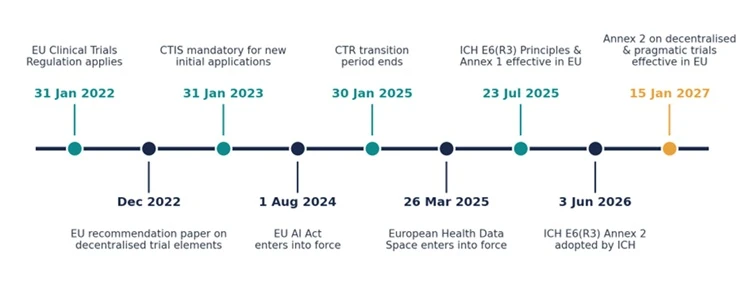
Figure 1. Key European regulatory milestones shaping digital and decentralised clinical trials
Inside the Digital Clinical Trial Toolkit: What Really Moves Beyond the Site
Decentralisation is best understood not as a single trial model but as a set of modular elements that can be combined in different proportions. Electronic consent with remote identity verification allows participants to review information at their own pace and discuss it with family before signing. Telemedicine replaces routine visits that require conversation rather than examination. Home nursing brings procedures such as blood draws or injections to the participant's door, while direct-to-patient supply ships the investigational product from a pharmacy or depot to the home.
On the data side, wearables, sensors and connected packaging generate continuous or event-based measurements, and electronic patient-reported and clinical outcome assessments collect symptoms and quality-of-life data through a smartphone. Home sample collection, including finger-prick blood self-sampling, reduces the need for laboratory visits. Underpinning all of these is centralised, risk-based monitoring, which uses incoming data to direct oversight where risk is highest instead of verifying every data point on site.
Each element carries a different level of evidentiary maturity and operational risk. A regulator may readily accept eConsent yet ask detailed questions about a novel digital endpoint. Treating the toolkit as a menu rather than a package is the first discipline of a successful decentralised strategy.
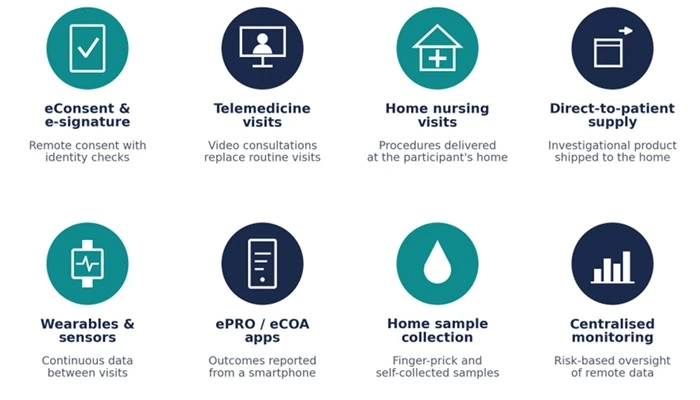
Figure 2. Pictograph of the core building blocks of a digital and decentralised clinical trial
Case Study: What a Six-Country Decentralised Trial Taught European Pharma
Few initiatives have tested decentralisation as rigorously as RADIAL, a proof-of-concept trial run by a 31-partner public-private consortium funded under the EU's Innovative Medicines Initiative. Rather than asking whether a medicine works, RADIAL asked whether the way a trial is conducted changes its feasibility and quality. It was designed as a three-arm, open-label, multicentre, low-intervention phase IV trial in people living with type 2 diabetes in six European countries: Denmark, Germany, Italy, Poland, Spain and the United Kingdom.
All three arms used the same insulin therapy; only the degree of decentralisation differed. In Part A, participants recruited at sites were randomised 1:1 to a conventional arm with in-clinic visits or a hybrid arm combining clinic and telemedicine visits. Part B was a fully decentralised arm with online recruitment and remote consent. The decentralised elements included eConsent with electronic identification and signature, telemedicine, home nursing, a smart cap to monitor adherence, an app for patient-reported outcomes, direct-to-patient medication shipment and finger-prick blood self-collection at home. Participation lasted 24 weeks, and the study deliberately went through the full regulatory approval process for medicinal product trials.
The results were instructive precisely because they were sobering. The trial aimed to enrol 300 participants in Part A and 300 in Part B. Across 32 sites, Part A screened 175 people and enrolled 100. In Part B, six sites pre-screened 133 interested individuals, screened 15 and enrolled eight. Online advertising and social media campaigns generated many impressions but very few completed pre-screeners or enrolments; outreach through existing research databases proved far more effective, accounting for seven of the eight participants enrolled in the fully decentralised arm.
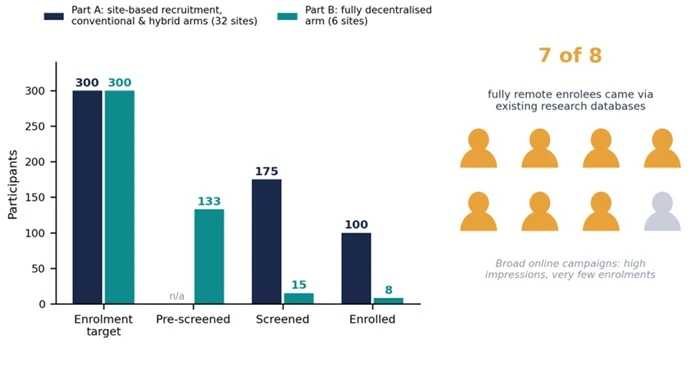
Figure 3. Recruitment funnel in the RADIAL proof-of-concept trial, with the pictograph showing the source of fully remote enrolments
Operationally, sites struggled at first with technology management and participant onboarding despite proactive training and a centralised helpdesk. Participant satisfaction analysis found that decentralisation was acceptable to participants, but it did not produce the higher satisfaction many had predicted; technology problems were the main reason for lower satisfaction in the hybrid arm.
For executives, the lesson is not that decentralised trials fail. It is that digital reach does not automatically convert into enrolment, that trust still travels through clinicians and established research networks, and that every additional device or app adds friction unless it is genuinely fit for purpose. Decentralisation demands more design discipline, not less.
Hybrid by Design: Where Decentralised Clinical Trials Create the Most Value
The most productive way to apply these lessons is to begin with the patient journey rather than the technology catalogue. Sponsors should ask which visits genuinely require a physical examination, imaging or specialist equipment, and which exist largely for convenience of data collection. Chronic conditions with stable, measurable endpoints and frequent follow-up often lend themselves to substantial decentralisation. Complex oncology or cell and gene therapy protocols, which depend on infusions and specialist monitoring, may still benefit from moving selected follow-up visits and outcome reporting into the home.
Recruitment strategy deserves equal attention. RADIAL suggests that patient registries, research databases, patient organisations and treating physicians remain more reliable routes to enrolment than broad digital advertising. Technology should be selected for usability, provisioned where needed, and kept to the minimum number of devices and logins. Crucially, investigator sites should be repositioned as hubs of a distributed network, supported with training, staffing and clear reimbursement for remote activities, rather than bypassed. Offering participants a genuine choice between site-based and remote options protects inclusivity for those with limited digital access or confidence.
Data, Trust and Digital Clinical Trials: The Governance Agenda for Pharma Leaders
As trial activity disperses, data flows multiply across devices, platforms, home health providers and logistics partners. Each hand-off is a potential point of failure for data integrity, privacy or chain of custody. ICH E6(R3) places explicit emphasis on data governance and on the fitness of computerised systems, which means sponsors must understand how every system is validated, how audit trails are maintained and who controls access to what. Under GDPR, remote collection of identity documents, video consultations and continuous sensor streams each require a clear lawful basis, transparent participant information and proportionate security.
Algorithmic tools add another layer. Where artificial intelligence is used to flag safety signals, identify potential participants or process digital endpoints, leadership teams will need documented oversight, validation evidence and a clear view of how the AI Act applies. Cybersecurity, meanwhile, becomes a patient-safety issue when dosing reminders or adherence data depend on connected systems.
These are not purely technical questions. They determine regulatory confidence, partner selection and ultimately the credibility of submission dossiers. Boards should therefore assign clear, cross-functional ownership of decentralised capability, spanning clinical development, quality, data protection, IT and medical affairs, and decide deliberately which competencies to build internally and which to source.
Conclusion:
Building the Decentralised Clinical Trial Capability Europe Needs
Europe now has the regulatory architecture to support digital and decentralised clinical trials at scale. A single application system is in place, a common recommendation paper exists, and from 15 January 2027 decentralised and pragmatic elements will be addressed directly in the EU's GCP framework. What remains is execution, and the evidence suggests it is harder than early enthusiasm implied.
The pharmaceutical organisations that benefit most will treat decentralisation as a design capability rather than a technology purchase. They will build trials around real patient journeys, recruit through channels patients already trust, choose technology for usability over novelty, and invest in the governance that keeps distributed data credible. Done well, digital and decentralised technologies will not replace the clinical trial site; they will extend its reach, strengthening the speed, inclusivity and resilience of the evidence on which European medicines depend.

Lakshmi is a science writer with a foundation in the laboratory. She earned her master's in biotechnology and trained through research internships at ICGEB (JNU) and DIPAS, DRDO, with her work appearing in the Egyptian Journal of Veterinary Sciences. Now APCRM-certified and part of the editorial team at Pharma Focus America and Pharma Focus Europe, she reports on pharmaceutical technology, research, and innovation — giving complex science a clear and confident voice for industry leaders.