Strategic Risk Management in Pharmaceutical Supply Networks
Lakshmi, Editorial Team, Pharma Focus Europe
Europe's pharmaceutical supply disruptions increasingly arise not from single supplier failures but from hidden correlations between suppliers that appear independent. This article argues that pharmaceutical supply risk belongs on the balance sheet rather than the procurement scorecard. It examines network concentration, resilience measurement, Europe's incoming critical medicines framework and an anonymised case study, and sets out a governance model for C-suite leaders.
Introduction: Why Pharmaceutical Supply Risk Has Outgrown the Procurement Function
Ask a European pharmaceutical executive team how many qualified suppliers stand behind its ten highest-value products, and the answer arrives quickly and precisely. Ask how many of those suppliers would still be shipping if a single industrial estate lost power for six weeks, and the room falls silent. That silence is the strategic problem in one sentence.
Shortages of essential medicines in Europe have stopped behaving like episodic shocks and become a structural condition. A Europe-wide survey of community pharmacy organisations covering 27 EU and EFTA countries found shortages persisting in 96 per cent of responding countries; in more than a third, over 600 medicines were in short supply at the time of reporting, and close to nine in ten member states recorded treatment interruptions. Pharmacy teams now spend roughly twelve hours a week managing unavailability, a burden that has grown steadily for a decade.
Policymakers have moved. In May 2026 the European Parliament and Council reached a provisional agreement on the Critical Medicines Act, which steers public procurement away from lowest-price awards, designates strategic manufacturing projects for accelerated funding and administrative handling, and supports collaborative purchasing between member states. The final text is expected in the Official Journal by late 2026.
For boards, this changes the question being asked. Supply reliability is migrating from an operational metric into a condition of market access and a determinant of enterprise value. The organisations that navigate it well will not be those with the longest supplier lists. They will be those that understand which of their suppliers fail together.
The Diversification Illusion: Where Pharmaceutical Supply Networks Actually Break
Most pharmaceutical risk registers rest on an assumption borrowed from finance and then quietly misapplied: that spreading exposure across several counterparties reduces the probability of loss. In capital markets that holds only where returns are imperfectly correlated. In supply networks the same condition applies, and it is violated far more often than boards realise.
Consider a marketing authorisation holder with three qualified sources for a key intermediate. On a supplier scorecard this reads as robust. Trace the material two tiers further upstream and the three sources frequently converge on the same chemical park, the same single-site producer of a key starting material, or the same specialist converter of borosilicate tubing. The contractual structure is diversified. The physical structure is not. When the upstream node stops, all three nominally independent suppliers stop within the same fortnight.
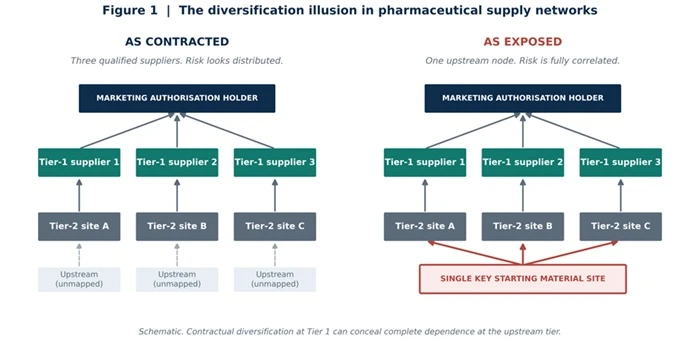
Figure 1: Contractual diversification at Tier 1 can conceal a single point of physical failure further upstream.
This convergence is not accidental. It is the predictable output of three decades of cost optimisation. Consolidation rewarded scale, and scale concentrated precisely where capital intensity was highest and margins thinnest: intermediates, sterile fill-finish capacity, specialised primary packaging. Every individual sourcing decision was rational. The aggregate outcome is a network in which correlation, not capacity, is the binding constraint.
The practical implication for European leadership teams is that supplier count is a misleading resilience indicator and should be retired from board reporting. What matters is the number of genuinely independent failure paths behind each critical product. That number is almost always smaller than the number of contracts, and can only be established by mapping past the direct supplier — through disclosure clauses, audit rights, shipping and customs records, and, where necessary, by paying for visibility a supplier has no incentive to volunteer.
Pricing Fragility: Turning Pharmaceutical Supply Risk into a Number the Board Can Use
Risk that cannot be quantified will not be funded. This is the second failure point, and it explains why resilience proposals lose to cost-reduction proposals in almost every budget cycle: the savings are precise, the avoided losses hypothetical.
A more disciplined approach borrows two measures from operations research and puts them on the same page. Time-to-recover is the interval a node needs to restore normal output after a disruption, governed by qualification timelines, regulatory variation approvals, technology transfer and equipment lead times rather than by supplier goodwill. Time-to-survive is how long the organisation can keep supplying patients from inventory, alternate routings and material already in flight. Where time-to-recover exceeds time-to-survive, the difference is the exposure window: the period in which patients, not the balance sheet, absorb the failure.
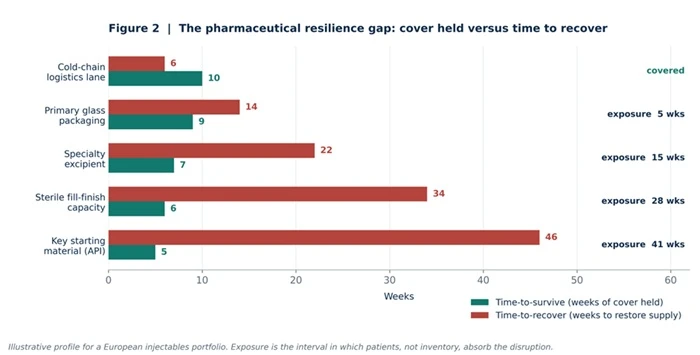
Figure 2: The exposure window is the gap between how long cover lasts and how long recovery takes.
The framing works in a boardroom because it converts an argument about probability into one about consequence. Executives rarely agree on the likelihood of a fire at a named site. They agree quickly that a forty-week qualification pathway sitting behind five weeks of cover is unacceptable for a product with no therapeutic alternative.
The exposure window then translates into money. Multiply weeks of exposure by weekly contribution at risk, add the regulatory and commercial consequences — tender exclusion, penalties under supply obligations, the durable share loss that follows a stock-out in a substitutable category — and supply risk becomes a capital allocation question rather than a procurement complaint. Against that figure, a second qualified line, twelve months of upstream reserve or a strategic stake in a critical supplier can be judged on its merits.
The same arithmetic settles the investment question itself. A resilience measure carries a fixed, one-off cost, while losses accumulate for as long as the exposure window stays open. On a product carrying nine hundred thousand euros of weekly contribution, six weeks of cover and a forty-six-week requalification pathway, the cost of a second qualified line is recovered roughly a fortnight after cover runs out — and some thirty weeks before supply returns.
Europe's New Rules Are Repricing Pharmaceutical Supply Risk
The regulatory floor beneath these decisions is rising, and it now rewards resilience rather than merely penalising failure.
The Critical Medicines Act is the clearest signal. Its procurement provisions discourage awards made on lowest price alone, allowing contracting authorities to weight security of supply and diversification of manufacturing. Its strategic projects mechanism offers accelerated administrative handling and improved access to national and Union funding for manufacturing capacity for critical medicines and their active ingredients within the EU. Collaborative procurement between member states will be supported where they request it.
Read commercially, this changes the shape of the market. For two decades, European tender design in generics and hospital products selected almost exclusively for price, and the industry responded exactly as designed: it concentrated production at the lowest-cost node and stripped out redundancy. If award criteria now carry genuine weight for security of supply, resilience investments acquire a revenue-side return rather than only a risk-avoidance return. That materially alters the internal business case.
It also raises the evidentiary bar. Claiming resilience in a tender response will increasingly mean demonstrating it, with mapped multi-tier dependencies, documented alternate capacity and stated cover positions. Organisations that have not built that evidence base cannot manufacture it inside a bid window. Boards should treat the implementation period as a commercial opportunity rather than a compliance exercise: the companies that can substantiate supply security while competitors are still circulating supplier questionnaires will win the contracts these rules are designed to reward.
Case Study: How One European Injectables Manufacturer Rebuilt Its Supply Risk Position
A mid-sized European manufacturer of sterile injectables — presented here as an anonymised composite drawn from patterns common across the sector — entered a strategic review with what appeared to be a sound risk position: three qualified vial suppliers, dual-sourced excipients and a fully compliant risk register.
The review began with dependency mapping rather than supplier assessment. Working through disclosure clauses in existing agreements and, where those were absent, through shipment and customs data, the team traced material flows two and three tiers upstream. Two findings reframed the discussion. All three vial suppliers drew tubing from a single converter. And the company's highest-margin product depended on one fill-finish line whose contamination-control upgrade would take that line out of service for considerably longer than the finished-goods cover held for the product. Neither exposure appeared on the supplier scorecard, because neither involved a direct supplier.
The response was deliberately unequal. For the vial dependency, the team qualified a second converter through an existing supplier and negotiated a reserved-capacity clause — a modest cost, because glass is substitutable. For the fill-finish exposure it made a capital decision, sequencing the upgrade against a qualified external line and building bridging cover, financed by savings released from resilience spending de-prioritised elsewhere in the network.
The outcome was not fewer suppliers or more inventory in aggregate; total working capital was broadly unchanged. What changed was its distribution. The exposure window on the critical product closed from roughly six months to under six weeks, and the documentation the company can now place in a tender demonstrates security of supply rather than asserting it.
Governing Pharmaceutical Supply Risk from the Board, Not the Warehouse
Structural change rarely survives contact with a quarterly cost target unless ownership sits above the function asked to sacrifice it.
In most European pharmaceutical organisations, supply risk is still owned where it is executed, in procurement or manufacturing operations. Those functions are measured on unit cost and service level, precisely the metrics that resilience investment degrades in the short term. Expecting them to fund structural redundancy is an organisational design error, not a performance failure.
The correction is to place supply network exposure on the board agenda with the same standing as financial exposure, reported in comparable terms. A small set of measures suffices: the exposure window for each critical product, the number of independent failure paths behind it, the share of revenue dependent on single-site nodes, and the depth to which each critical chain has actually been mapped. Four numbers, reviewed quarterly, reveal more than a hundred-page risk register.
Two further design choices matter. The chief financial officer should co-own the metric, because resilience is a capital allocation decision and will otherwise be managed as an operating cost to be minimised. And contractual architecture must catch up with the analysis: disclosure of sub-tier manufacturing sites, notification obligations on site changes, audit rights extending beyond the direct supplier, and reserved capacity priced honestly rather than assumed.
None of this eliminates disruption. Pharmaceutical supply networks are long, technically constrained and heavily regulated, and they will continue to fail. The objective is narrower and more achievable: to ensure that when they fail, the organisation already knows where, for how long, and at what cost.
Conclusion: Building Pharmaceutical Supply Networks That Fail Predictably
The strategic shift required of European pharmaceutical leadership is not a shift towards more suppliers, more inventory or more onshoring. It is a shift in what the organisation chooses to know and to measure.
Three commitments follow. Map dependency to the point of genuine independence, accepting that this costs money and takes eighteen months rather than a quarter. Quantify exposure as a window and a number, so that resilience competes for capital on equal terms with every other proposal. And govern it from the board, with finance co-owning the metric, so that structural decisions are not quietly reversed by functional incentives.
Europe's regulatory direction now rewards this work rather than merely requiring it. Security of supply is becoming a criterion on which contracts are awarded and strategic projects are funded, which means boards that invest early will capture commercial return alongside risk reduction.
The medicines that fail patients are rarely the ones nobody thought about. They are the ones everybody assumed were covered.

Lakshmi is a science writer with a foundation in the laboratory. She earned her master's in biotechnology and trained through research internships at ICGEB (JNU) and DIPAS, DRDO, with her work appearing in the Egyptian Journal of Veterinary Sciences. Now APCRM-certified and part of the editorial team at Pharma Focus America and Pharma Focus Europe, she reports on pharmaceutical technology, research, and innovation — giving complex science a clear and confident voice for industry leaders.