

Strategic Investments in Continuous Manufacturing for Competitive Advantage
Lakshmi, Editorial Team, Pharma Focus Europe
European pharmaceutical manufacturers face a rare convergence: a harmonised regulatory framework for continuous manufacturing, a new EU industrial policy that rewards domestic production capacity, and sustained margin pressure across innovative and generic portfolios alike. This article examines why continuous manufacturing has moved from engineering experiment to board-level capital decision. It sets out the economic evidence, explains where value is created beyond cost, presents a pilot-plant case study, and outlines how C-suite leaders can sequence investments to build durable competitive advantage across the product lifecycle.
Retiring the Batch Mindset in Pharmaceutical Manufacturing
For more than a century, pharmaceutical production has run on a simple rhythm: charge a vessel, process, stop, sample, wait for release, and begin again. That rhythm built the industry, but it also locked in idle capacity, large inventories of intermediates and release cycles that stretch across weeks. Continuous manufacturing replaces this stop-start cadence with an integrated flow in which materials move steadily from raw input to finished dosage form, monitored in real time by process analytical technology and governed by automated control.
For European boards, the question is no longer whether the technology works. It does, at commercial scale, for small molecules and increasingly for therapeutic proteins. The question is where, when and how much to invest, and how to turn a plant-level engineering upgrade into an enterprise-level competitive advantage. That decision now sits squarely with the C-suite.
From Engineering Curiosity to Boardroom Imperative: Why Continuous Manufacturing Has Arrived
Three forces have converged. First, regulatory uncertainty has largely been resolved. ICH Q13, the first harmonised guideline dedicated to the continuous manufacturing of drug substances and drug products, came into effect in the EU in July 2023. It covers chemical entities and therapeutic proteins, applies to new products and generics alike, and explicitly addresses the conversion of existing batch processes. The World Health Organization has since issued complementary points to consider, extending the framework to markets without dedicated guidance. For a multinational manufacturer, a single scientific language for control strategy, batch definition and process validation lowers the cost of filing the same continuous process across jurisdictions.
Second, the market is scaling. One widely cited industry estimate places the global continuous manufacturing market at roughly USD 5.1 billion in 2025, rising to more than USD 16 billion by 2034, a compound annual growth rate of nearly 14 percent. Third, and most important for Europe, industrial policy has turned decisively towards domestic production capacity, creating incentives that change the payback arithmetic for capital projects.
Yet adoption remains uneven. North America still holds the largest share of commercial continuous capacity, and many European networks continue to treat continuous lines as showcase assets rather than the backbone of supply. That gap is the opportunity.
The Continuous Manufacturing Balance Sheet: What the Evidence Tells Boards
The economic case has been studied rigorously for more than a decade, and the findings are consistent in direction even where they differ in magnitude. A landmark techno-economic analysis of an integrated process, running from API synthesis through to tablet, estimated capital expenditure 20 to 76 percent lower than an equivalent batch plant, with overall cost savings of 9 to 40 percent depending on drug loading and process configuration. Plant-wide modelling of two continuous API routes, for a common analgesic and an antimalarial, found CapEx reductions of up to 57 and 20 percent respectively, OpEx reductions of up to 52 and 29 percent, and projected twenty-year savings above 50 percent in the stronger case.
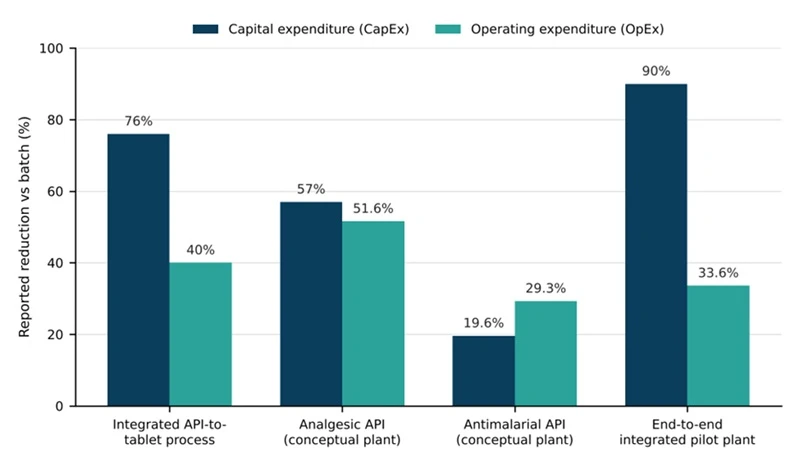
Figure 1: Reported cost reductions for continuous versus batch manufacturing. Values show the upper bound reported in each study. Source: peer-reviewed process-economics studies of continuous pharmaceutical manufacturing.
The savings originate in predictable places. Continuous equipment is smaller, so facilities need a fraction of the cleanroom footprint and the HVAC load that comes with it. Work-in-progress inventory shrinks because intermediates are not held between unit operations. Real-time release testing reduces quality-control laboratory time, and scale is achieved by running longer rather than building larger vessels, removing costly scale-up campaigns between clinical and commercial supply.
Leaders should, however, read the evidence with discipline. Studies that benchmark continuous lines against modern, lean batch plants report smaller margins, and savings rise with production volume. The business case is therefore portfolio-specific: high-volume, long-lifecycle oral solids and APIs with hazardous chemistry typically deliver the fastest return, while low-volume niche products may not.
Beyond the Cost Line: Continuous Manufacturing as a Strategic Weapon
Treating continuous manufacturing purely as a cost project understates its value. Its most strategic dividends appear in speed, resilience, quality and sustainability.
Speed matters because a continuous line used for mid-stage clinical material can, in many cases, be the same line that supplies launch. Eliminating scale-up and technology-transfer steps compresses the critical path to market, and every month of earlier launch on a protected asset is worth far more than a plant's annual operating savings.
Resilience matters because volume flexibility is built in. Output responds to demand by changing run time rather than requalifying equipment. In a period when medicine shortages have become a political issue, the ability to surge supply without new capacity is both a commercial and a reputational asset.
Quality matters because continuous processes are monitored at every moment rather than sampled at the end. Deviations are detected and diverted in real time, reducing batch failures, investigations and recalls, costs that rarely appear in a capital appraisal but routinely surface in quarterly results.
Sustainability completes the picture. Smaller equipment, lower solvent volumes and reduced energy demand translate into less waste per kilogram of product, giving manufacturers measurable progress against the environmental commitments that European investors and payers increasingly scrutinise.
Policy Meets Capital: How the Critical Medicines Act Reshapes Continuous Manufacturing Economics
Europe's Critical Medicines Act changes the context for capital allocation. In January 2026, the European Parliament adopted its position by 503 votes to 57, with 108 abstentions, citing evidence that more than half of recent medicine shortages trace back to manufacturing problems. During the debate, parliamentarians explicitly called for public and private investment in advanced production technologies, naming continuous manufacturing, automation and robotics.
The provisional agreement subsequently reached between the EU institutions confirms two levers of direct relevance to boards. The first is a framework of strategic projects to create, modernise or expand EU manufacturing capacity for critical medicines and their active substances. The second is an EU-preference mechanism in public procurement, allowing contracting authorities to reward suppliers in proportion to the share of a medicine and its API produced in Europe.
For C-suite leaders, the implication is clear. A continuous API or drug-product line built in Europe can now be justified on three value streams rather than one: lower unit cost, preferential standing in public tenders and potential eligibility for support as a strategic project. Proposals that failed internal hurdle rates two years ago deserve a fresh appraisal.
Case Study: The Continuous Manufacturing Pilot Plant That Cut Capital by Ninety Percent
One of the most instructive published examples comes from a transatlantic collaboration between a US continuous-processing specialist and an Italian pharmaceutical equipment manufacturer, with regulatory scientists contributing to the work. The team designed and operated an end-to-end integrated pilot plant that converts starting materials into a small-molecule API and then into finished oral solid dosage forms in one uninterrupted flow, built from the outset on quality-by-design principles.
The reported economics are striking. Compared with a conventional batch route, the integrated plant required roughly 90 percent less capital investment. Operating costs fell by 33.6 percent for the API and 29.4 percent for tablets. The authors also highlighted tighter quality control and greater supply-chain flexibility as direct consequences of integration.
Two lessons stand out for European executives. First, the largest gains came from integrating drug substance and drug product rather than converting individual unit operations. Many companies stop at hybrid processes, in which only selected steps run continuously, and so capture only part of the value. Second, European engineering capability was central to the outcome. The equipment and know-how needed to lead this transition already exist within the continent's industrial base.
Where Continuous Manufacturing Investments Stall, and How Leaders Break the Deadlock
If the economics are compelling, why has adoption lagged? The barriers are rarely technical. The first is sunk-cost inertia: networks with depreciated batch assets find it hard to justify new capital while existing plants run at acceptable margins. Leaders overcome this by appraising continuous projects on total lifecycle value, including launch acceleration and avoided scale-up, rather than on direct replacement cost.
The second barrier is organisational. Continuous processes demand fluency in process modelling, control engineering and data science that batch-trained teams may lack. Companies that succeed build dedicated centres of excellence and rotate talent between development and manufacturing, so that knowledge moves with the product.
The third barrier is regulatory caution inside the company itself. Although ICH Q13 provides clarity, quality functions often default to familiar batch paradigms. Early dialogue with regulators, including the European Medicines Agency's innovation channels, de-risks first filings and builds internal confidence for those that follow.
Sequencing the Bet: A Continuous Manufacturing Investment Roadmap for European Leaders
The most successful adopters do not convert entire networks at once. They begin with new molecules entering mid-stage development, where designing for continuous flow costs little more than designing for batch and avoids later conversion. They then target high-volume legacy products whose batch lines face major refurbishment, using that capital event as the trigger for conversion. Finally, they extend into API synthesis, particularly chemistries involving hazardous reagents or extreme conditions, where small continuous reactor volumes deliver safety benefits as well as cost savings.
Running alongside this sequence is a digital backbone. Process analytical technology, advanced process control and digital twins turn a continuous line into a self-optimising asset, and they form the foundation for the artificial-intelligence applications now being addressed in European GMP guidance. Investment in data infrastructure should therefore sit inside the manufacturing programme, not in a separate IT budget.
Partnership models also deserve board attention. Contract manufacturers are expanding continuous capacity in Europe, giving sponsors a route to the technology without carrying the full capital burden while internal capability matures.
Conclusion:
Continuous Manufacturing as Europe's Next Competitive Moat
Continuous manufacturing has crossed the line from promising technology to strategic necessity. The regulatory framework is harmonised, the economics are documented, and European policy is aligning incentives behind domestic, advanced production. What remains is leadership: the willingness to appraise manufacturing investments on lifecycle value, to integrate rather than patch, and to build the talent and data foundations that make continuous lines perform.
The companies that move decisively over the next three to five years will enter the next decade with leaner cost bases, faster launches, more resilient supply and stronger standing with European payers and procurers. Those that wait may find that the advantage once on offer has hardened into the cost of entry.

Lakshmi is a science writer with a foundation in the laboratory. She earned her master's in biotechnology and trained through research internships at ICGEB (JNU) and DIPAS, DRDO, with her work appearing in the Egyptian Journal of Veterinary Sciences. Now APCRM-certified and part of the editorial team at Pharma Focus America and Pharma Focus Europe, she reports on pharmaceutical technology, research, and innovation — giving complex science a clear and confident voice for industry leaders.