Smarter, Faster, Cheaper: The Quiet Revolution in Pharma's First Half of 2026
Preeti Singh, Director Healthcare and Life Sciences, PSTRIDE SOLUTIONS LLP
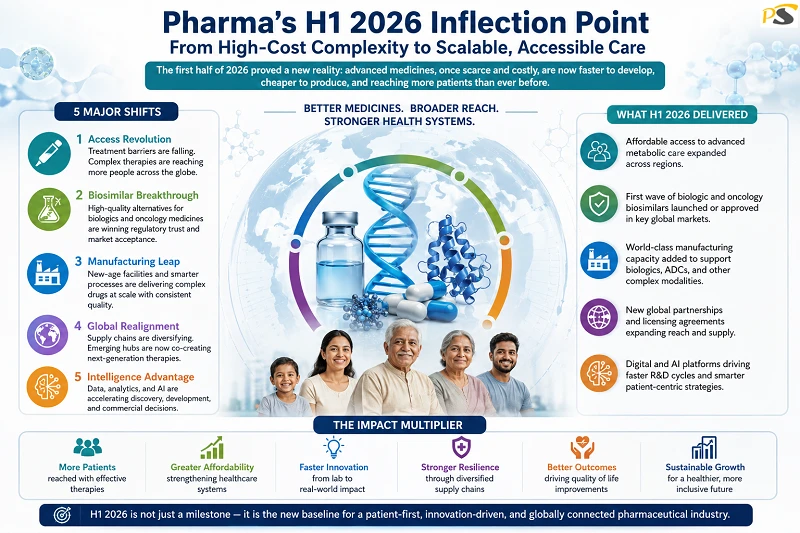
The first half of 2026 marked a major shift in the pharmaceutical industry. Drugmakers proved they can produce complex medicines faster, cheaper, and at scale. Affordable biosimilars, GLP-1 therapies, oncology advances, hospital medicines, and smarter manufacturing improved patient access while reshaping global competition and the future of healthcare.
Introduction:
If you took a step back to look at the pharmaceutical industry during the first six months of 2026, one thing became obvious very quickly. The old rules of global drug manufacturing were quietly rewritten. For decades, major low-cost production centers were viewed mostly as high-volume factories for basic, everyday pills. If a patient needed a routine pill for blood pressure or a common antibiotic, these suppliers had it covered. But whenever treatment required complex biological drugs, specialized cancer therapies, or cutting-edge injections, the market remained tightly controlled by a handful of high-cost western developers.
The first half of 2026 shattered that division for good. From dramatic price drops on weight-loss shots in domestic clinics to historic biosimilar launches across North American and European pharmacies, the first six months of the year proved that modern drugmakers can handle complex biopharmaceuticals faster, cheaper, and at a much larger scale than many expected. Looking across the competitive intelligence data from January through June, this transformation was not just about making copycat medicines. It was about taking sophisticated treatments that used to cost small fortunes and bringing them within reach of regular healthcare systems and everyday families.
The Great Weight-Loss Equalizer
Nowhere was this industry shift clearer than in the explosive demand for GLP-1 metabolic therapies. As weight-management medications captured global headlines, supply shortages and soaring price tags left millions of patients unable to afford continuous treatment. In early 2026, regional formulation leaders stepped directly into that gap. The green light for locally produced generic semaglutide injections in early January triggered a rapid wave of commercial activity that fundamentally changed the market by spring.
What followed in March was a masterclass in market democratisation. Multiple domestic drugmakers introduced their own semaglutide products almost simultaneously, sparking intense competition that drove therapy costs down to unheard-of levels. Patients saw weekly treatment costs fall to as low as two hundred and twenty rupees per dose, making modern obesity and diabetes care accessible to a vastly broader demographic. By June, manufacturers had even perfected single-shot pre-filled syringes priced around three hundred and fifty rupees, solving key convenience issues for patients who prefer pre-measured doses.
This was not merely a local domestic story, either. Recognizing that metabolic health is a global crisis, major generic players expanded their footprint internationally during the same six-month window. Strategic licensing agreements were signed to supply semaglutide across more than twenty countries, while generic injectable weight-loss formulations were rolled out in North American markets like Canada. Meanwhile, multinational innovator brands adapted to this new reality by partnering with regional distribution leaders to co-market therapies rather than fighting local pricing pressure. The lesson from the first half of the year is simple: when manufacturing efficiency meets huge patient demand, expensive specialty drugs quickly become everyday medicine.
Breaking Barriers in Complex Cancer Care
While weight-loss therapies dominated public attention, an equally profound revolution took place in oncology. Cancer care has traditionally relied on biological drugs—large, fragile molecules produced inside living cells that are far more difficult to replicate than simple chemical tablets. Creating reliable "biosimilars" of these drugs requires top-tier scientific expertise and sophisticated facilities. Yet, the first half of 2026 delivered landmark victories in this exact arena.
In January, clinicians witnessed the world's very first biosimilar launch of nivolumab, a landmark immuno-oncology treatment used to help the human immune system fight multiple cancer types. This was followed in April by the commercial launch of denosumab biosimilars in both the United States and Canada, giving bone cancer and osteoporosis patients significantly cheaper treatment options. European regulators also approved advanced eye-care biosimilars like ranibizumab during the spring, showing that high-quality biological alternatives are gaining rapid acceptance across the world's strict regulatory agencies.
To support this technical leap, forward-thinking drugmakers spent the first half of the year securing physical assets where the therapies are consumed. Rather than shipping everything from home facilities, leading biopharmaceutical players completed targeted acquisitions of specialized manufacturing plants in the United States. This move gave them an established operational base inside major Western markets, enabling them to offer contract development and manufacturing services to global partners while accelerating their own product pipelines.
At the same time, hospital cancer departments gained access to better diagnostic tools and targeted medications. In May, health regulators cleared a landmark tissue testing assay capable of analyzing both DNA and RNA profile changes in solid tumors. This advance allows oncologists to pinpoint precise genetic mutations in a patient's cancer, ensuring they prescribe the right targeted therapy on day one. Combined with newly approved therapies for advanced skin cancers and gastroesophageal tumors, the first six months of 2026 proved that high-tech precision oncology is becoming standard practice.
Protecting Hospitals and Operating Rooms
Beyond headlines about new drugs, a quieter but vital transformation took place inside surgical operating rooms and hospital wards. Modern surgery relies heavily on specialized medications that most people never think about until they need an operation. One of the most important is general anesthesia drug, an injection used by anesthesiologists to rapidly reverse muscle relaxation so surgical patients can breathe safely on their own after an operation.
During the first half of 2026, a coordinated wave of regulatory approvals brought generic general anesthesia drug injections to market across North America. By late spring and early summer, multiple major formulation suppliers received clearances to launch this critical hospital drug. For surgical centers, having several reliable producers meant immediate relief from supply bottlenecks and lower overhead costs, ensuring that routine surgeries could proceed without drug shortages.
Respiratory medicine saw a similar leap forward in accessibility. Millions of adults and children suffer from asthma and chronic obstructive pulmonary disease, relying on daily inhalers that have historically been protected by complex patent setups. In the spring of 2026, regulators approved the first fully interchangeable generic versions of widely used rescue inhalers in the United States, along with generic oral treatments for rare, debilitating lung conditions like idiopathic pulmonary fibrosis. To help doctors evaluate lung function more accurately, medical technology firms introduced non-invasive diagnostic devices called oscillometers in May, allowing clinics to test breathing mechanics easily even in elderly or frail patients.
Critical care teams also gained powerful new weapons against hospital superbugs. Antimicrobial resistance has become one of the scariest threats in modern medicine, with common bacteria developing resistance to standard hospital antibiotics. In late May, health authorities approved a novel intravenous combination antibiotic specifically engineered to fight drug-resistant bacterial infections in complicated urinary tract and kidney conditions. Having this therapy available gives intensive care doctors a life-saving option when standard antibiotics fail.
Public Health Milestones and Business Realignment
While laboratories worked on chronic conditions and surgical drugs, public health initiatives made essential progress against infectious threats during the January to June window. Early in the year, health authorities approved a novel recombinant vaccine for Hepatitis E, providing adult immunization against a dangerous liver virus that disproportionately impacts vulnerable communities. On the global stage, regional vaccine research institutes partnered with international university groups to launch human clinical trials for specialized viral threats like Ebola, proving that local manufacturing infrastructure plays a crucial role in international biosecurity.
Behind these medical updates sat a pragmatic wave of corporate deal-making designed to keep companies agile. Rather than spending years building new drug divisions from scratch, major players used smart corporate acquisitions to strengthen their focus. Established brands in central nervous system care, anxiety management, and hormone replacement therapy changed hands as companies streamlined their portfolios. Public research institutions also transferred several indigenous biomedical discoveries to commercial manufacturers, ensuring that promising laboratory concepts moved quickly onto factory floors and into clinical practice.
Medical technology kept pace with pharmaceutical growth. Hospitals saw the rollout of advanced cardiovascular tools, including next-generation drug-eluting stents and minimally invasive transcatheter systems designed to repair leaking heart valves without requiring open-heart surgery. These mechanical innovations complemented the pharmaceutical side, giving cardiologists a complete toolkit for managing heart disease.
What the First Half of 2026 Means for the Future
When you connect all these developments from the first six months of 2026, a clear narrative emerges. The global healthcare industry is undergoing a structural realignment. The boundaries that once separated basic pill makers from advanced biopharmaceutical innovators have permanently blurred.
By taking on complex biological drugs, pioneering affordable weight-loss therapies, securing critical surgical supplies, and developing novel antibiotics, generic and specialty drugmakers proved that high quality and reasonable prices can coexist. For competitive intelligence professionals, health policy makers, and clinic directors, the takeaway from H1 2026 is undeniable: the speed at which complex therapies travel from top tier labs to everyday healthcare settings has accelerated forever. And for millions of patients around the world, that shift means better treatment options, safer surgical care, and far more manageable medical bills.

Preeti Singh is Director of Competitive Intelligence at PSTRIDE Solutions, specializing in oncology, the Indian pharmaceutical market, vaccines, and pharmaceutical strategy. She brings expertise in developing evidence-based insights, competitive intelligence analyses, and strategic perspectives that help healthcare and life sciences leaders navigate evolving market landscapes. With a passion for AI-enabled healthcare and precision medicine, Preeti translates complex scientific advancements into clear, meaningful intelligence that informs strategic decision-making.