Smart Quality Management: AI-Powered GMP Compliance and Release by Exception
Lakshmi, Editorial Team, Pharma Focus Europe
Europe's quality organisations are shifting from retrospective paperwork to smart quality management, where artificial intelligence verifies GMP compliance continuously and batch release becomes a confirmation rather than an investigation. This article examines what release by exception changes in cost, cycle time and inspection readiness, how draft EU GMP Annex 22 and the amended AI Act draw the boundaries, and which decisions European pharmaceutical C-suites should take within the next eighteen months.
Introduction:
Why AI-Powered GMP Compliance Became a Board Decision, Not an IT Upgrade
European pharmaceutical manufacturing has rarely faced this many simultaneous pressures. Tightened sterile expectations have raised the bar across the continent's fill-finish capacity, biosimilar competition is compressing biologics margins, and procurement authorities are pushing prices down while demanding supply security in return. Boards have answered with investment in capacity, automation and shop-floor analytics. Yet the step that decides whether product reaches a patient has barely changed in thirty years.
Most European plants still release medicines through a process that is essentially clerical. A batch generates thousands of recorded values, and quality assurance reads them page by page to confirm the overwhelming majority that were always within limits. Published field data puts the review of a single batch report at around 48 hours on average, while right-first-time performance in some operations runs as low as 47 per cent. Quality organisations grew to absorb that load; release cycle times did not improve in proportion.
Smart quality management proposes a different division of labour. Software verifies every parameter, every time, and people examine only what deviates. That is the principle of release by exception, and artificial intelligence extends it beyond simple rule checking. The question for European leadership teams is no longer whether the technology works, but whether their data, quality system and governance are ready to let it.
The Quiet Tax: What Manual GMP Batch Review Costs a European Plant
Manual GMP review is expensive in ways that rarely surface as a line item. The visible cost is quality assurance labour, with experienced scientists spending their week confirming transcription accuracy instead of assessing risk. The larger cost sits in working capital. Every day a batch waits in quarantine is a day of finished goods carrying full manufacturing cost and earning nothing, and a single high-value biologics batch can represent several million euros. Across a portfolio, release cycle time becomes a balance-sheet variable rather than a shop-floor metric.
Then there is the compliance return on all that effort. Inspection data published by European authorities has for years placed quality system and documentation failures at the top of the deficiency rankings, so exhaustive manual review is evidently not buying immunity. It spreads scarce attention thinly across records that were compliant from the first line. Deviation backlogs build, investigations close late, and the same failure modes recur because no one has the capacity to analyse them across batches.
The final cost is strategic. Sterile and biologics capacity in Europe is constrained, and release velocity is a form of capacity: a site that halves disposition time adds saleable output without a euro of capital expenditure.
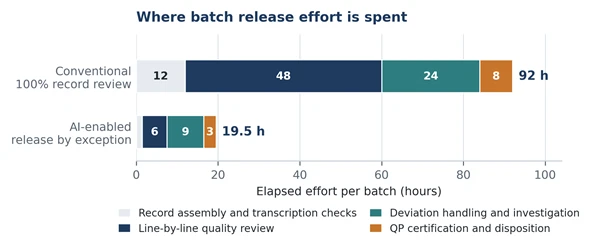
Figure 1: Where batch release effort is spent, conventional review versus AI-enabled release by exception.
From Page-Turning to Pattern-Reading: What AI Actually Does Inside a GMP Quality System
Artificial intelligence in a GMP quality system is less exotic than the term suggests. Four workloads account for most of the value.
The first is automated verification. Every recorded parameter, in-process result and equipment status is checked against its specification the moment it is captured rather than weeks later. Much of this is deterministic rule execution; the intelligence lies in awkward cases such as reconciling instrument timestamps or interpreting free-text operator entries.
The second is anomaly detection. Multivariate models learn the normal signature of a process and flag batches drifting within specification but away from their own history, catching a trend no single limit would register while the batch is still in the tank.
The third is deviation triage. Models classify incoming events, cluster them against prior investigations and surface the root causes and corrective actions that resolved comparable cases, so the reviewer begins with the plant's own memory rather than a blank template.
The fourth is prediction, forecasting environmental monitoring excursions, equipment failures and stability trends early enough to intervene rather than investigate.
What AI does not do, in any defensible European implementation, is decide. It converts a mass of undifferentiated data into a ranked and evidenced set of questions for a qualified human. That distinction between decision support and decision making is exactly where the regulators have drawn their line.
Release by Exception: When Batch Disposition Stops Being an Investigation
Release by exception applies that machinery to disposition. The system verifies one hundred per cent of the record and presents quality assurance only with entries that failed a check, breached a trend or could not be reconciled. Review stops being a search for problems and becomes a judgement on problems already found.
It is worth separating this from real-time release testing, which substitutes validated in-process measurement for end-product testing. The two are complementary: real-time release testing removes analytical waiting time, while release by exception removes documentary waiting time. Sites that pursue both arrive at a genuine release-ready state at the end of manufacture.
The prerequisites are unglamorous, and they are where most programmes fail. Data must be structured and captured at source, since direct instrument integration is what delivers the error reductions of seventy-five to ninety-five per cent reported in the field, eliminating transcription instead of policing it. Master batch records must be redesigned so every check is machine-verifiable, which is a process engineering exercise rather than a software one. Exception taxonomies must be validated in advance, with the criticality of each category agreed by quality before the first batch runs. Electronic records alone can cut manual data entry time by at least sixty per cent, but that saving converts into release velocity only when reviewers trust the logic enough to stop quietly double-checking it.
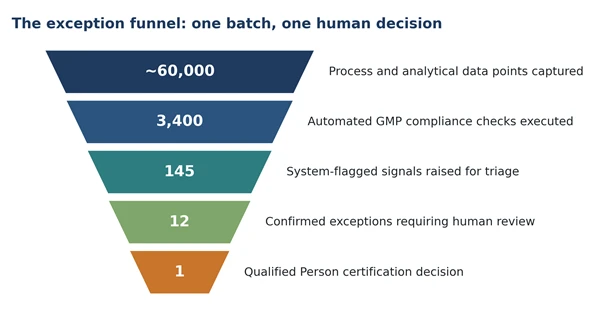
Figure 2: The exception funnel. Machine verification narrows a batch's data to a single human certification decision.
The advantage is not that machines read records faster. It is that a plant's scarce review capacity is pointed at the handful of events that genuinely carry patient risk.
Annex 22 and the AI Act: The European Rulebook Your Quality AI Must Survive
Europe now holds the most specific regulatory position on AI in medicines manufacturing anywhere in the world. In July 2025 the European Commission issued a linked consultation package: a revised Chapter 4 on documentation, a substantially revised Annex 11 on computerised systems, and an entirely new Annex 22 devoted to artificial intelligence, drafted jointly by the inspectors' working group of the European Medicines Agency and PIC/S. The consultation closed in October 2025 and attracted roughly 1,300 comments, with a final text expected around the end of 2026.
Two features of the draft matter at board level. First, it confines critical GMP applications to static, deterministic models, those returning the same output for the same input, and excludes generative AI and large language models from such uses. Second, it sets model-specific evidence expectations beyond conventional computerised system validation: a precisely written intended use, independent test data, predefined performance metrics, explainability proportionate to risk, change control over model versions and continuous performance monitoring. A two-day expert workshop convened in mid-2026 examined whether risk-based guardrails could admit more dynamic models.
The horizontal law has moved the other way. The Digital Omnibus, in force since July 2026, postponed the EU AI Act's high-risk obligations for stand-alone systems to December 2027 and for AI embedded in regulated products to August 2028, while transparency duties applied as originally scheduled. The temptation is to read that as breathing space. GMP expectations were never tied to the AI Act's clock, and an inspector arriving next year will ask about intended use, validation evidence and model drift whichever deadline applies.
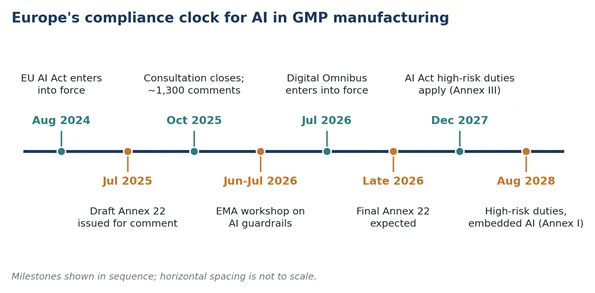
Figure 3: Europe's compliance clock for AI in GMP manufacturing, from the AI Act to the expected finalisation of Annex 22.
The Qualified Person Question: Accountability That AI Cannot Absorb
European law makes one thing immovable. A Qualified Person certifies each batch personally before release, and no annex, algorithm or vendor architecture transfers that accountability. Smart quality must therefore be engineered to serve a named individual's judgement.
The system must therefore produce evidence rather than verdicts, giving the reviewer the underlying data, the rule or model that fired, and enough traceability to reconstruct the conclusion months later under inspection. It must also account for what it did not flag, because the harder question here is not why an exception was raised but why thousands of records passed silently. Negative assurance rests on documented coverage of the rule set, not on confidence in the software.
Models also become GMP-critical systems in their own right, subject to change control, periodic review, supplier qualification and defined ownership inside the pharmaceutical quality system. Quality staff need the training and the standing to overrule the system, with a documented escalation path for when they do. An organisation whose reviewers have quietly stopped disagreeing with the model has lost the control it believes it holds.
Case in Point: A European Biologics Site That Re-Engineered Release, Not Just Review
The pattern is best illustrated through a composite of European programmes of this type rather than any single named site. Consider a mid-sized sterile fill-finish operation in Western Europe supplying EU and export markets, running a hybrid of paper and scanned records, with a nine-day average release cycle and batch records of several hundred pages.
The programme ran for roughly eighteen months and began nowhere near the algorithms. The first nine months went into instrument and equipment integration so that critical parameters arrived electronically, and into rewriting master batch records so every entry carried a machine-checkable acceptance criterion. Only then was the rules engine switched on, with quality assurance running a parallel manual review for three months to evidence that the exception logic caught everything the humans caught.
Machine learning entered last, applied to deviation triage and environmental monitoring trends rather than to release decisions. Review effort per batch fell from roughly ninety hours to under twenty. Exception volumes then fell again as recurring operator-driven errors were designed out, because the system had made their frequency visible for the first time. The decisive lesson was organisational: the returns came from record redesign and data discipline, and the AI layer multiplied gains that structured data had already unlocked.
The Economics of Smart Quality: How AI-Enabled GMP Compliance Reads on the P&L
For a chief executive or finance director, the case rests on four pools of value: working capital released by shorter quarantine; quality assurance labour redeployed from verification to improvement; cost avoided on deviations, rejected batches and repeat investigations; and reduced exposure to inspection findings, whose remediation routinely costs more than the digital investment would have.
Sequencing matters more than budget size. Sites that open with an AI pilot on unstructured data produce a demonstration and no value; sites that begin with data foundations and rules-based exception review produce value first and accumulate the labelled history that makes later models credible. The maturity path runs from paper, to electronic records, to rules-based release by exception, to AI-augmented quality in which models predict and prioritise. Skipping a stage is how programmes stall in year two.
A practical governance test applies before any budget is approved. If the quality organisation cannot state today how many exceptions a typical batch generates and how each is classified, it is not ready for AI. It is ready for the data work that has to come first.
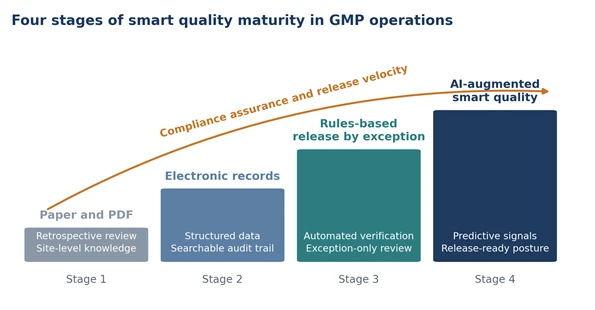
Figure 4: The four stages of smart quality maturity. Each stage supplies the data discipline the next one depends on.
Conclusion: Smart Quality as Europe's Next Manufacturing Advantage
Europe's regulatory density is often described as a competitive handicap. On this subject it is the opposite. European manufacturers are the only ones operating with a draft annex that spells out what defensible AI in GMP looks like, and with inspectors consulting openly on how far it should extend. That is a head start in a discipline where the binding constraint is not model performance but demonstrable control.
The window is narrow. Annex 22 is expected to be finalised around the end of this year, and the deferred AI Act deadlines arrive in December 2027 and August 2028. Programmes started now will have structured data and validated exception logic in place before the guidance hardens; those that wait will be retrofitting both under inspection pressure.
The prize is a quality function that verifies continuously, involves people where judgement is genuinely required, and turns batch release from a bottleneck into a confirmation. For European boards weighing capacity, cost and supply reliability at once, that is not a technology decision. It is one of the few operational levers that improves all three together.

Lakshmi is a science writer with a foundation in the laboratory. She earned her master's in biotechnology and trained through research internships at ICGEB (JNU) and DIPAS, DRDO, with her work appearing in the Egyptian Journal of Veterinary Sciences. Now APCRM-certified and part of the editorial team at Pharma Focus America and Pharma Focus Europe, she reports on pharmaceutical technology, research, and innovation — giving complex science a clear and confident voice for industry leaders.