


Single-Use Technologies: Accelerating Flexible Biopharmaceutical Manufacturing
Lakshmi, Editorial Team, Pharma Focus Europe
Single-use technologies have moved from pilot-scale novelty to the default architecture of new biopharmaceutical capacity. This article examines what that maturity means for senior leadership: how disposable trains convert fixed capital into operating flexibility, why qualification and supply continuity now carry the sharper risk, how the May 2026 compendial standard reshapes assurance obligations, and what one European multi-product site achieved by rebuilding its operations around single-use manufacturing.
Introduction:
Why the Single-Use Debate Has Left the Plant and Reached the Board
For most of the past two decades, the case for single-use technologies in biopharmaceutical manufacturing was argued in the language of the plant. Disposable bags and flow paths removed clean-in-place and steam-in-place loops, shortened turnarounds, and allowed engineers to stand up a suite without a validation campaign measured in seasons. That argument has been won. Disposable systems now appear at every stage of development and commercial production, and more than 200 suppliers compete in the segment. The conversation in European boardrooms has shifted accordingly. The question is no longer whether to adopt single-use technologies, but what strategic return the flexibility they create is actually delivering.
That shift matters because the medicines being manufactured have changed faster than the facilities built to make them. Small and mid-sized companies now originate roughly 60 per cent of new drug approvals, about double their contribution fifteen years ago, and their pipelines lean toward precision medicines, cell and gene therapies, and biologics aimed at narrower patient populations. Capacity designed around a single high-volume product is a poor answer to a portfolio of a dozen candidates at a fraction of that scale. Single-use technologies are the mechanism by which pharmaceutical manufacturing capacity becomes a portfolio asset rather than a product-specific bet. Understanding that reframing, and paying for the obligations it carries, is the work now sitting with senior leadership.
Single-Use Technologies Are No Longer the Innovation. They Are the Baseline.
The commercial signal is unambiguous even where the definitions differ. Narrow assessments that count single-use technologies specifically for biopharmaceuticals place the global market at around USD 8.3 billion in 2025, rising to roughly USD 16.3 billion by 2031 at a compound annual growth rate of about 12.2 per cent. Broader definitions that sweep in the full disposable bioprocessing toolkit put the 2025 figure near USD 30 billion with a fifteen per cent trajectory through the following decade. Executives should treat the spread between those numbers as informative rather than contradictory: it reflects how far disposable components have diffused beyond the bioreactor into filtration, mixing, storage, transfer and, increasingly, fill and finish.
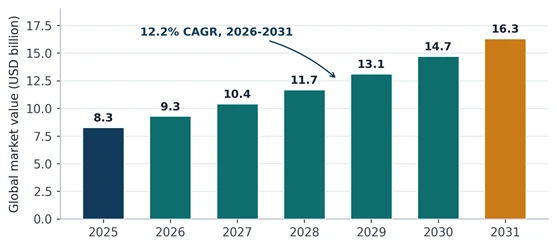
Figure 1. Single-use technologies for biopharmaceuticals: global market value, 2025-2031. Source: published market forecasts, 2026.
Maturity has changed what buyers ask for. The basic capabilities the industry spent twenty years requesting are now assumed, and satisfaction with existing hardware is high. The next wave of value is therefore not in the disposable component itself but in what is built around it: intensified and continuous processing, deeper automation, closed and integrated flow paths, and analytics that make a disposable train as observable as a fixed one. Leaders who still frame single-use technologies as a procurement decision are competing against organisations that have started treating them as a platform decision.
Stainless Steel Buys Capacity. Single-Use Technologies Buy Optionality.
The familiar comparison against stainless steel remains valid. Published facility comparisons consistently report materially lower capital expenditure, faster build and commissioning, dramatically reduced process water demand, and shorter changeovers, with the exact spread depending on scale, modality and site conditions. Those savings are real, but they are also the least interesting part of the argument at board level, because they describe a cheaper version of the same thing.
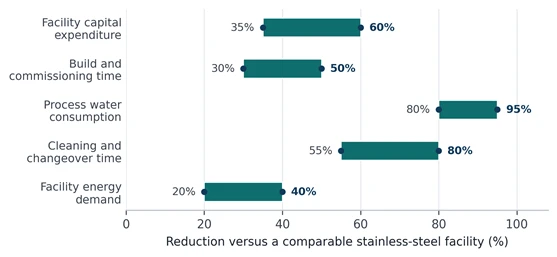
Figure 2. Indicative reductions reported for single-use facilities against comparable stainless-steel operations; outcomes are process- and scale-dependent.
The strategic value lies elsewhere. A stainless-steel plant converts cash into a fixed, product-shaped asset that must then be filled. A single-use facility converts a large share of that same commitment into variable cost attached to consumables, which means capacity can be re-pointed as a portfolio moves. When a candidate reads out poorly in phase two, a disposable suite absorbs the loss by turning to the next programme; a hard-piped train absorbs it as stranded capital. For European companies managing tight development budgets and volatile capital markets, that optionality is worth more than the headline saving on construction.
Single-use technologies do not simply make capacity cheaper. They make the decision to build capacity reversible, and reversibility has a price that most balance sheets never capture.
The same logic explains why contract manufacturers across Europe have adopted single-use configurations faster than many originators. A disposable suite can host successive clients without a facility modification programme between them, which converts a fixed asset into a service that can be sold repeatedly. Any originator weighing internal build against outsourcing is, in effect, buying or renting that flexibility.
The Single-Use Invoice That Nobody Puts in the Business Case
Flexibility has an unglamorous cost structure, and it is the part most often underwritten optimistically in the business case. A single-use flow path is an assembly of films, tubing, filters and connectors, frequently supplied by one qualified vendor in one validated configuration. Once that configuration is embedded in a licensed process, the manufacturer has quietly accepted a dependency. A supplier change notification concerning a resin, a sterilisation method or a moulding site can trigger comparability work, additional testing and, in some jurisdictions, a regulatory filing.
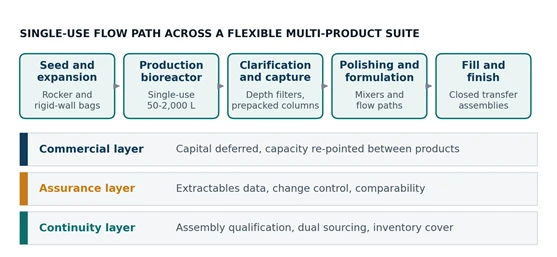
Figure 3. A single-use flow path across a flexible multi-product suite, with the three management layers it carries.
Recent years have made this exposure explicit. Periods of allocation, trade friction and freight disruption showed that a facility with no cleaning validation burden can still be halted by a missing bag. The mitigations are known and expensive: qualifying second-source assemblies in parallel, holding deeper consumable inventory, standardising component specifications across sites so that stock is fungible, and negotiating supply agreements with real continuity commitments rather than best-efforts language. Each of these erodes some of the working-capital advantage the technology was bought to deliver. Boards should insist that the single-use business case shows this cost rather than assuming it away, because the alternative is discovering it during a supply interruption.
May 2026: The Month Single-Use Assurance Stopped Being a Judgement Call
Extractables and leachables have long been the technical soft spot of single-use manufacturing. Compounds migrating from polymeric contact surfaces into a process stream can, at low levels, affect stability, safety or efficacy, and for years the industry assessed that risk using standards borrowed from medical devices and container closure systems. The result was fragmented data packages and inconsistent regulatory expectations across markets.
That changed on 1 May 2026, when the first compendial chapter written specifically for plastic components and systems used to manufacture drug substances and drug products took effect, supported by a companion guidance chapter on characterisation and qualification. The framework is risk-scaled, so testing expectations rise with the severity of the contact rather than applying uniformly, and it is deliberately positioned as a baseline rather than a substitute for scientifically justified assessment. Classification of a component's risk remains the end user's responsibility and can differ by process step, formulation and contact conditions.
Two consequences follow for senior leadership. The first is commercial: risk-scaled testing avoids expensive characterisation of low-exposure components, which for many portfolios reduces qualification spend relative to running the full harmonised industry protocol on everything. The second is structural. Extractables and leachables evaluation has moved from a case-by-case exercise into a standing element of chemistry, manufacturing and controls strategy, and parallel international harmonisation work points the same way. Organisations that treat this as a documentation exercise handled late will find it on the critical path of their next filing.
Case Study: The European Site That Bet Its Second Suite on Single-Use
A mid-sized contract biologics manufacturer in Western Europe entered the decade with a facility built for a different market: two hard-piped stainless-steel trains sized for high-volume antibody campaigns, running at roughly half their nominal utilisation as client demand fragmented into smaller, faster programmes. Turnaround between clients took several weeks, dominated by cleaning validation and changeover documentation, and the site was losing bids to competitors offering shorter slot times.
Rather than expand, the operator converted. One stainless train was retained for its largest legacy contract and the second suite was stripped and rebuilt as three modular single-use lines at 500 and 2,000 litres, with disposable mixing, filtration and transfer assemblies specified to a common component standard so that inventory could be shared across all three lines. The conversion was completed inside eighteen months, well below the timeline the organisation had previously assumed for comparable new capacity, and at a capital cost roughly half that of an equivalent fixed-asset build.
The operational outcome was measured in slot time. Changeover between client programmes fell from a multi-week exercise to a matter of days, and the site moved from serving four clients a year in that footprint to more than a dozen. Process water demand across the converted suites dropped by an order of magnitude, which had the unplanned benefit of relieving a utilities constraint that would otherwise have required its own capital project.
Two lessons proved more durable than the numbers. First, the standardised component specification, initially adopted for procurement convenience, became the site's principal supply-chain defence: when one assembly type went into allocation, qualified alternatives were already validated on adjacent lines. Second, the organisation underestimated the analytical workload. Extractables and leachables assessment for a multi-client, multi-configuration facility required a dedicated internal capability that had not existed before, and building it consumed budget the conversion case had not carried. The operator now treats that function as fixed overhead of running a flexible plant rather than a project cost. Both lessons generalise, and both are cheaper to learn from someone else's conversion.
The Green Arithmetic of Single-Use: Better Than Feared, Harder Than Claimed
The environmental question is where European operators face the sharpest scrutiny, and the honest answer is more favourable than the intuition suggests. Life cycle assessments comparing disposable and fixed-asset operations generally find lower energy demand, substantially lower water consumption and reduced global warming potential for single-use configurations, because the burden avoided in cleaning, steam generation and water-for-injection production outweighs the burden embedded in the polymer.
What that analysis does not resolve is the waste stream, which is highly visible and structurally difficult. Components that have contacted biological material cannot leave a good manufacturing practice facility as untreated solid waste; they must be biologically inactivated under a validated procedure before any recycling or energy recovery pathway opens. That requirement, not a shortage of goodwill, is why conventional recycling infrastructure absorbs so little bioprocessing plastic. Progress is being made through supplier take-back schemes, chemical recycling routes and design changes that reduce material intensity, but none of it scales without validated decontamination and documented chain of custody. As sustainability disclosure hardens into formal reporting obligation across Europe, boards should expect to be asked for facility-level waste data by component category and per batch, and most sites cannot yet produce it. Establishing that baseline is the prerequisite for any credible reduction target.
Conclusion: Single-Use Flexibility Is Rented, Never Owned
Single-use technologies have delivered what their early advocates promised. They compress construction timelines, lower the capital threshold for entering biologics manufacturing, and make multi-product operation practical at scales that suit the modalities now dominating development pipelines. For European manufacturers facing fragmented demand and constrained capital, that combination is the most reliable route to matching capacity with a portfolio rather than with a forecast.
The strategic risk has simply relocated. It sits now in supplier concentration, in the qualification and change-control burden attached to every validated configuration, in the analytical capability that a compendial standard has made non-negotiable, and in an environmental account that must be measured before it can be defended. None of these is an argument against single-use manufacturing. They are the running costs of flexibility, and organisations that fund them deliberately will convert disposable technology into durable competitive advantage. Those that treat single-use adoption as a completed capital project will find that the flexibility they bought is considerably harder to keep than it was to install.

Lakshmi is a science writer with a foundation in the laboratory. She earned her master's in biotechnology and trained through research internships at ICGEB (JNU) and DIPAS, DRDO, with her work appearing in the Egyptian Journal of Veterinary Sciences. Now APCRM-certified and part of the editorial team at Pharma Focus America and Pharma Focus Europe, she reports on pharmaceutical technology, research, and innovation — giving complex science a clear and confident voice for industry leaders.