Reshaping Biologics Production Integrating Human Intelligence, AI, and Digital Twins for a Resilient Biologics Future
Manish Garg, Principal Engineer, Associate Director, Hikma Pharmaceuticals
This article examines how biologics manufacturers can unlock a $176 billion biosimilars opportunity by integrating human expertise with AI, digital twins, and robotics. Framed through Industry 5.0, it explores scale-up risk, variability, cold-chain fragility, and regulatory complexity, arguing that governed human–machine symbiosis is now the defining architecture for resilient biologics production.
Introduction:
BIOLOGICS MANUFACTURING | INDUSTRY 5.0 | BIOSIMILARS

Biological medicines are not manufactured. They are cultivated. Every monoclonal antibody, plasma-derived immunoglobulin, and biosimilar molecule begins its journey inside a living cell. That origin creates a category of operational challenge with no equivalent in small-molecule production: the product is the process. Variations in temperature, pH, dissolved oxygen, or nutrient concentration do not merely affect yield. They change the medicine itself, at the molecular level, in ways that are clinically consequential.
Bottlenecks That Hold the Industry Back
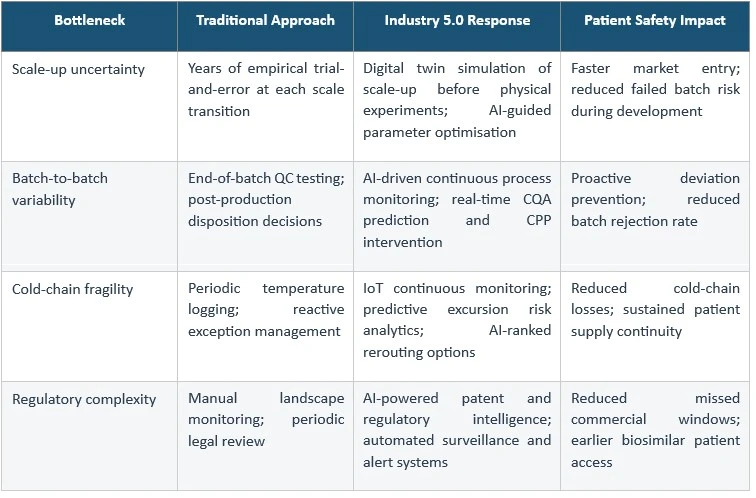
Scale-up uncertainty
The transition from a 10-litre development bioreactor to a 10,000-litre commercial vessel is not a scaling exercise — it is a qualitatively different engineering challenge. Any process drift affecting glycosylation patterns, aggregation profiles, or post-translational modifications must be characterised and justified against the reference biologic. This analytical burden drives the USD 100–300 million development cost per biosimilar programme and explains why organisations have historically spent years in empirical trial-and-error before achieving a viable commercial process.
Batch-to-batch variability
Living cell systems introduce variability that chemical synthesis does not. For a biosimilar, variability must be controlled within the analytical comparability corridor established against the reference product. A batch that meets internal specifications but falls outside the reference product’s established CQA range is a regulatory and patient safety event, not merely a quality deviation.
Cold-chain fragility
Most biologics must be maintained within strict temperature ranges from bioreactor harvest through hospital storage. Extended lead times for primary packaging components, geopolitical sensitivity around cell culture media sourcing, and limited alternative qualified suppliers compound distribution risk. Supply chain resilience is now a patient access issue, not merely a risk management consideration.
Regulatory and competitive complexity
The biosimilar pathway requires analytical, pharmacokinetic, and clinical comparability evidence that evolves as regulatory science develops. Patent litigation, interchangeability requirements, and pharmacovigilance obligations extend well beyond approval. Where multiple biosimilar approvals occur in compressed timeframes, formulary positioning and payer tier decisions shift commercial dynamics rapidly.
What Industry 5.0 Actually Means for Biologics Manufacturers
Industry 5.0 is often described as a framework, but it is more usefully understood as a correction. Industry 4.0 asked how machines could replace human labour. Industry 5.0 asks a better question: how can human intelligence and machine capability work together in ways that neither could manage alone?
In biologics manufacturing, this distinction is not academic. Biological variability, regulatory accountability, and the scientific interpretation of ambiguous process signals require human judgment that no current AI system can substitute. AI, digital twins, and robotics provide speed, precision, and the ability to process data at a scale human teams cannot match. The result is a manufacturing model where machines carry the data burden, and humans carry the accountability. Both are essential. Neither is sufficient alone.
Digital Twins: Compressing Scale-Up from Years to Months
The most transformative application of digital technology in biologics is in process design and scale-up. AI systems now screen thousands of cell culture media formulations, feeding strategies, and temperature profiles against predicted glycosylation outcomes and aggregation risk before a single physical experiment is conducted. What historically required years of empirical trial-and-error can be compressed into months.
Digital twins make this compression possible. A bioreactor digital twin, built from the organisation’s own historical process data, physicochemical principles, and mechanistic cell biology understanding, simulates process behaviour at different scales and under different conditions. Process engineers and scientists run hundreds of virtual scale-up experiments before committing to a physical run, identifying parameter ranges most likely to maintain CQA comparability at commercial scale. Leading plasma fractionation facilities now operate with exactly this infrastructure, enabling engineers to model interventions before physical implementation in environments where unplanned downtime has direct patient access consequences.
The digital twin does not replace the scientist. It gives them the computational leverage to test hypotheses at a scale and speed that physical experimentation cannot match.
Collaborative Robotics: Precision Without Contamination Risk
In sterile fill-finish operations, contamination is an absolute risk. A single microbiological event in a Grade A/ISO 5 environment does not produce a rework opportunity it produces a batch loss, a regulatory investigation, and a patient supply disruption. Fill-finish is also highly susceptible to human-introduced variability: gowning integrity, operator technique, and fatigue across extended shifts.
Collaborative robots (cobots) work alongside human operators with force-limitation safety systems and vision-guided precision. In sterile environments, cobots handle the contamination-risk-intensive physical operations vial handling, stoppering, capping, and automated visual inspection — while human operators manage line setup, exception handling, and quality oversight requiring contextual judgment. Consistency in stoppering force and fill volume directly affects container closure integrity, a CQA with direct sterility and stability implications. For cell and gene therapy products, where a single batch may represent treatment for one patient at a cost exceeding one million pounds, cobot-assisted fill-finish is a patient safety imperative, not a productivity tool.
AI-Driven Process Monitoring: Catching Problems Before They Become Batches
Traditional biologics quality control follows a familiar sequence: run the batch, take samples, send them to the laboratory, wait days for results, compare against specifications, and make a disposition decision. By the time a critical quality attribute falls outside specification, the batch is already finished. Whatever that result reveals arrives too late to change anything.
This is not a failure of effort or attention. It is a structural limitation of end-of-batch testing — one that AI-driven process analytical technology is fundamentally redesigning.
A commercial bioreactor generates thousands of sensor readings every minute: dissolved oxygen, pH, online biomass estimates, metabolite concentrations from in-line spectroscopic sensors, and cell viability readings from capacitance probes. No human team can monitor all of these simultaneously, correlate them against historical process behaviour, and detect the early signal of a developing glycosylation deviation before it crosses a specification limit. AI systems trained on the relationship between process parameters and critical quality attribute outcomes can.
When the system detects an anomaly, it generates a recommended intervention and presents it to the qualified process scientist with full data context. The scientist evaluates that recommendation against their understanding of the specific cell line, the batch's history, and the regulatory comparability implications of any corrective action. The AI identifies the signal. The scientist owns the response. That division of responsibility is not a compromise it is the design.
Supply Chain AI: Building Resilience from Lowest Cost to Value-Creating Operations
The word 'resilience' gets used so frequently in supply chain discussions that it risks becoming hollow. In biologics, it carries a very specific and very human weight: patients on chronic biological therapies — managing autoimmune conditions, osteoporosis, rare haematological disorders, or cancer cannot tolerate supply gaps the way a consumer product customer can substitute another brand. A supply disruption is a clinical event.
Building resilience for those patients requires a different kind of intelligence. IoT temperature loggers integrated with AI monitoring platforms provide continuous visibility from bioreactor dispatch to hospital delivery, across every carrier handoff and customs transition. Predictive analytics assess excursion probability before an excursion occurs, based on ambient temperature forecasts, carrier transit time variability, and historical performance data. The alert goes out before the product is at risk, not after.
When disruption arrives, a port closure, a carrier failure, a component shortage, AI models every rerouting option against cold-chain risk parameters and supply continuity requirements, presenting ranked alternatives to the logistics coordinator who holds the final decision. What would take a human team hours to model manually, the system makes available in minutes. The human brings relationship knowledge, commercial judgment, and accountability. The AI brings analytical reach.
Demand forecasting in competitive biosimilar markets works the same way. A forecast built only on internal sales data misses the competitive signals, interchangeability designation changes, formulary tier shifts, competitor market entry that can reshape demand within weeks. AI systems integrating external signals with internal data produce forecasts that are more useful and more honest about the uncertainty that these markets create.
Governance: The Part That Makes the Rest Work
There is a version of AI adoption in pharmaceutical manufacturing that looks impressive in a conference presentation and fails the first regulatory inspection. It is the version where technology is deployed without the governance to make its outputs trustworthy, auditable, and defensible to the agency scientists who will eventually examine how decisions were made.
The EU AI Act, in force since 2024, is direct on this: AI systems influencing pharmaceutical manufacturing quality decisions are classified as high-risk. They require conformity assessments, documented human oversight mechanisms, and transparency about how outputs are generated. ISPE's GAMP AI Practitioner Guide, published in 2025, and the FDA's January 2025 Draft Guidance on AI for regulatory decision-making are building the framework the industry needs.
In practice, governance means defining in writing before deployment, not after a problem, which AI-generated interventions go to the process team as awareness information, and which require a qualified scientist's explicit authorisation before action. It means monitoring models for drift as real-world data diverges from training distributions. It means building explainability into systems so that when a regulator asks why an AI flagged a process parameter at 2 a.m., there is a traceable, comprehensible answer.
Organisations that embed governance from the foundation rather than retrofitting it afterwards are the ones whose AI deployments survive inspection. The others discover that remediation costs more than their automation ever saved.
Action for Manufacturing Leaders
Biologics manufacturing leaders must act decisively to reduce scale-up risk, strengthen quality, and build resilience. Digital twins should precede every bioreactor scale-up, as a single failed commercial batch can outweigh the entire digital investment. Collaborative robots should first be piloted in high-value fill-finish operations, using container closure integrity data to anchor the patient safety case before broader rollout. AI-driven CPP monitoring must include predefined escalation pathways and clear human authorisation controls within validated processes. Cold-chain handoffs require accountability alongside IoT visibility. Finally, structured AI literacy for process scientists should enhance model judgment without diluting core biological expertise.
Symbiosis Is Not a Choice — It Is the Architecture
Biologics manufacturing has always required intellectual humility, the willingness to accept that living systems do not behave on command, and that the best processes are designed around that reality rather than against it. The same humility applies to technology. AI will not replace the cell biologist who understands why a glycosylation pattern is shifting. Digital twins will not substitute for the process engineer who has spent fifteen years learning how a specific bioreactor behaves under pressure.
What these technologies do, when deployed thoughtfully, governed properly, and integrated with genuine respect for human expertise, is give people the leverage to solve problems that were previously too fast, too complex, or too data-intensive to manage alone. Digital twins compress years of scale-up learning into months. Cobots hold fill-finish precision constant across ten thousand units without fatigue. AI monitoring catches the signal before it becomes a batch failure. Supply chain AI maps options in minutes that would take teams hours.
For biologics organisations that understand this as an architecture rather than a technology purchase, the decade ahead offers a genuine opportunity to expand patient access at a scale the industry has not previously achieved. That is worth building for.
References
- European Commission. Industry 5.0: Towards a Sustainable, Human-Centric and Resilient European Industry. Publications Office of the European Union, 2021.
- GlobalData. Biosimilars Global Market Forecast 2024–2034. 2024.
- Challener CA. Overcoming Biosimilar Scaling Challenges. BioPharm International, April 2025.
- Patheon / Thermo Fisher Scientific. The Real Challenge of Biologics Manufacturing Scale-Up. December 2025.
- ISPE. GAMP® AI Practitioner Guide for GxP Applications. July 2025.
- U.S. Food and Drug Administration. Artificial Intelligence to Support Regulatory Decision-Making. Draft Guidance, January 2025.
- ISPE. Facility of the Year Awards 2025: Overall Winner Citation. ispe.org/facility-year-awards.
- EMA. Guideline on Similar Biological Medicinal Products. EMA/CHMP/437/04 Rev 1, 2014 (updated).
- McKinsey & Company. Biopharma’s Next Horizon: The Path to AI-Enabled Drug Development. 2024.
- WHO. Access to Biotherapeutic Products Including Similar Biotherapeutic Products. WHO Guidelines, current edition.

Manish Garg is a Senior IT Leader at Hikma Pharmaceuticals, specialising in digital transformation for manufacturing and supply chains. With over 20 years of experience, including roles at Apple and HP, he has deep expertise in end-to-end serialisation and global regulatory compliance. An IEEE Senior Member and frequent industry keynote speaker, Manish also serves as a judge for the Fierce Pharma and Stevie Awards.