Real-World Evidence in Pharmaceutical Drug Development
Lakshmi, Editorial Team, Pharma Focus Europe
Real-world evidence has moved from post-marketing footnote to strategic currency in pharmaceutical drug development. With regulators on both sides of the Atlantic now accepting registry, claims and health record data in decision-making, American leaders face a new competitive frontier. This article examines where real-world evidence creates value, how regulators judge it, and what executives must build.
Introduction
For most of the past half-century, the randomised controlled trial has been the undisputed gatekeeper of pharmaceutical value. It remains the gold standard for establishing causality, and nothing in this article suggests otherwise. Yet the controlled trial answers a narrow question under artificial conditions: does a drug work in a carefully selected population, managed by expert investigators, over a fixed window of time? Payers, physicians, patients and increasingly regulators want answers to a broader question: does it work for the people who actually receive it, in the health systems where they actually live?
Real-world evidence (RWE), the clinical evidence derived from analysing real-world data such as electronic health records, insurance claims, disease and product registries, and patient-generated data, is designed to answer that second question. What has changed in recent years is not the existence of these data but their regulatory standing. The United States formalised a pathway for real-world evidence through the 21st Century Cures Act, and Europe has followed with its own data infrastructure and methodological guidance. For American C-suite leaders whose portfolios are launched, priced and defended on both continents, real-world evidence is no longer a function of the medical affairs department. It is a board-level capability that shapes development speed, label breadth and market access.
The Real-World Evidence Shift: From Post-Market Afterthought to Boardroom Asset
Historically, real-world data entered the pharmaceutical lifecycle after approval, primarily to monitor safety signals and to support health economics dossiers. That sequencing is now collapsing. Leading organisations are deploying real-world evidence before the first patient is dosed, using it to size patient populations, refine eligibility criteria, select trial sites with genuine patient density and model the natural history of rare diseases where untreated comparators would be unethical.
Three forces explain the acceleration. First, the volume and digitisation of health data have reached a scale that makes rigorous observational research feasible, particularly in oncology and rare disease. Second, the cost and duration of late-stage trials continue to climb, making any credible tool that reduces enrolment burden strategically valuable. Third, regulators have published concrete frameworks, removing much of the uncertainty that once made executives hesitant to stake a submission on non-randomised data.
The executive implication is simple but uncomfortable: real-world evidence strategy now has to be designed at the same time as clinical development strategy, not bolted on afterwards. Organisations that treat it as a downstream reporting exercise will find that the most valuable questions, those that could have shortened a programme or widened a label, were never asked in time.
Where Real-World Evidence Creates Value Across the Pharmaceutical Lifecycle
Real-world evidence is not a single tool but a portfolio of applications, each with a different evidentiary bar and a different return on investment. Table 1 maps the principal use cases against the lifecycle stage and the strategic payoff for leadership teams.
Table 1: Real-world evidence applications across the pharmaceutical drug development lifecycle
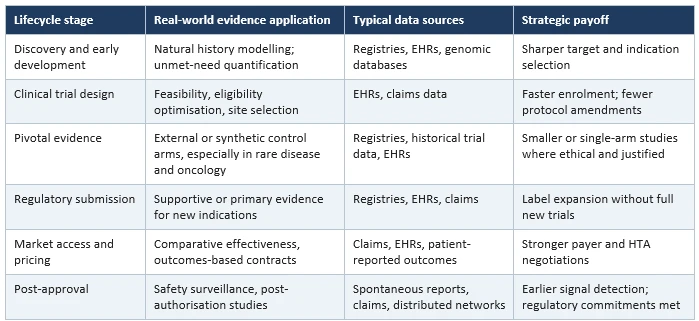
The highest-value applications sit in the middle of the table. External control arms and evidence for label expansion directly affect time to market and revenue. They also carry the highest scrutiny, which is why investment in methodological rigour pays off precisely where the commercial stakes are greatest.
The Transatlantic Real-World Evidence Rulebook: What Regulators Now Expect
For a leader headquartered in the United States, the temptation is to treat the FDA position as the global default. That would be a costly mistake. The FDA and the European Medicines Agency share a common destination, credible and fit-for-purpose real-world evidence, but they are travelling there by different routes.
In the United States, the 21st Century Cures Act of 2016 required the FDA to establish a programme for evaluating real-world evidence, leading to a framework published in 2018 and a steady series of guidance documents on electronic health records, claims data, registries, data standards and regulatory considerations for non-interventional studies. The FDA has also run a dedicated Advancing Real-World Evidence programme under its user fee commitments, giving sponsors early dialogue on study designs.
Europe's approach is more infrastructure-driven. The EMA and the network of national authorities established DARWIN EU, a coordinated network that allows regulators themselves to commission studies on real-world data from across member states. Alongside it, the European Health Data Space regulation is creating a legal framework for the secondary use of health data across the bloc. In effect, European regulators are building the capacity to generate their own real-world evidence, which means sponsor-submitted data may increasingly be checked against independent regulator-led analyses.
Table 2: Comparing the United States and European approaches to real-world evidence
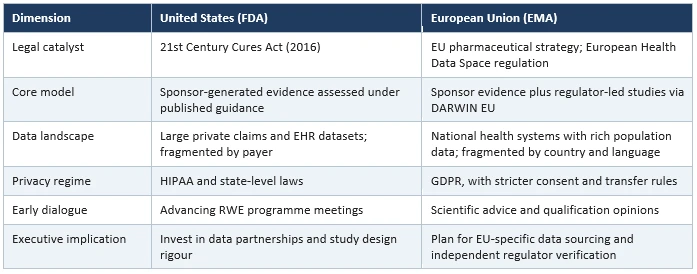
The practical consequence for American leadership teams is that a real-world evidence package built exclusively on US claims data may satisfy one regulator and fall short with another. European assessors and health technology assessment bodies frequently ask whether evidence generated in the American care setting is transferable to their populations and treatment pathways. Building transatlantic data strategies from the outset avoids an expensive second round of evidence generation.
Case Study: How a Transplant Registry Rewrote a Pharmaceutical Label
One of the most instructive examples of real-world evidence carrying regulatory weight involves tacrolimus, a long-established immunosuppressant. The drug had been approved for preventing organ rejection in kidney, liver and heart transplant recipients, and physicians had been using it off-label in lung transplantation for years. A traditional randomised trial in lung transplant patients was neither practical nor ethical, because withholding effective immunosuppression from a control group would expose patients to near-certain organ rejection.
In 2021, the FDA approved tacrolimus for the prevention of organ rejection in adult and paediatric lung transplant recipients. The approval rested substantially on a non-interventional study using data from the national Scientific Registry of Transplant Recipients, which captures outcomes for essentially every transplant performed in the United States. The study compared outcomes for lung transplant recipients treated with tacrolimus-based regimens against what was known about outcomes without effective immunosuppression. Because the treatment effect was large and the registry comprehensive, the agency concluded that the real-world study constituted an adequate and well-controlled clinical investigation.
Why this case matters to the C-suite
Three lessons stand out. First, the data source was the decisive asset: a mature, nationally mandated registry with consistent data capture and long follow-up. Real-world evidence is only as strong as the data beneath it. Second, the clinical context favoured the design. Where the expected treatment effect is dramatic and the untreated outcome is well understood, observational evidence can be persuasive. Third, the outcome was a label update for an existing product, a reminder that real-world evidence often delivers its fastest returns on in-line brands rather than pipeline assets.
A second example reinforces the pattern. In 2019, the FDA expanded the label of palbociclib, a breast cancer therapy, to include men with hormone receptor-positive, HER2-negative advanced disease. Male breast cancer is rare enough that a dedicated randomised trial would have taken years to recruit. The expansion drew on electronic health records, insurance claims and post-marketing safety reports, demonstrating that real-world evidence can close evidence gaps for underrepresented populations that conventional trials struggle to reach.
The Hidden Fault Lines in Real-World Evidence: Bias, Quality and Credibility
For every successful real-world evidence submission, there are programmes in which observational data failed to persuade. Leaders should understand the reasons, because they are largely predictable and largely avoidable.
The first fault line is confounding. In routine care, physicians do not assign treatments at random. They give newer therapies to particular patient types for particular reasons, and those reasons can themselves drive outcomes. Without careful study design, techniques such as target trial emulation, propensity score methods and pre-specified sensitivity analyses, a real-world study can mistake patient selection for drug effect.
The second is data fitness. Claims data were built for billing, not research. Electronic health records were built for care delivery. Key endpoints such as tumour progression, disease severity or cause of death may be missing, inconsistently coded or recorded only in unstructured notes. Regulators increasingly ask sponsors to demonstrate that data are relevant and reliable for the specific question, not merely abundant.
The third is transparency. Regulators are wary of analyses that appear to have been chosen after the results were known. Pre-registering protocols, sharing statistical analysis plans and engaging regulators before the study begins are now seen as the price of credibility. Organisations that skip these steps to save time often lose far more time in review.
Building a Real-World Evidence Capability: The Executive Investment Thesis
Real-world evidence capability is not a technology purchase. It is an organisational design choice that touches data partnerships, epidemiology talent, governance and cross-functional decision rights. Table 3 sets out a maturity model that leadership teams can use to benchmark where their organisation stands.
Table 3: Real-world evidence maturity model for pharmaceutical organisations
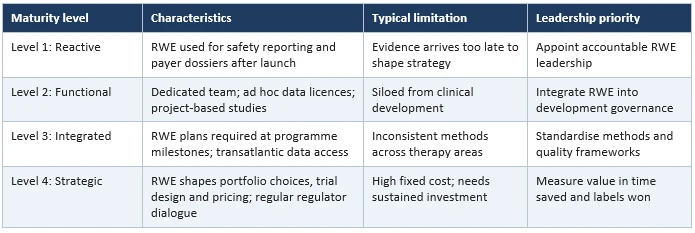
Most mid-sized organisations sit between Levels 1 and 2. The leap to Level 3 is where value compounds, because it is the point at which real-world evidence starts influencing decisions rather than documenting them. The decisive enabler is governance: requiring every development programme to answer, at each stage gate, what real-world evidence could de-risk, accelerate or broaden it.
Partnership strategy matters equally. Few organisations can or should own all the data they need. The more durable advantage lies in long-term relationships with academic registries, health systems and national data custodians, combined with in-house methodological expertise strong enough to challenge any external analysis. In Europe in particular, where data sit with national systems and access is governed by strict privacy rules, these relationships take years to build and cannot be bought at the last minute before a submission.
The Next Frontier for Real-World Evidence: Federated Data and Shared Standards
The coming decade will be defined less by more data and more by better-connected data. Federated analysis, in which questions travel to the data rather than data being pooled centrally, is becoming the preferred model in privacy-sensitive jurisdictions. It allows multinational studies to run across health systems without moving patient records across borders, a particularly important feature under European data protection law.
Global harmonisation is also advancing. International guideline work on pharmacoepidemiological studies using real-world data aims to align expectations among regulators, reducing the risk that a study designed for one agency is rejected by another. Meanwhile, common data models are making it easier to run the same protocol across many datasets, strengthening the reproducibility that regulators prize. For American companies, the strategic message is to design for interoperability now, so that evidence generated today remains usable in tomorrow's multinational submissions.
Conclusion
Real-world evidence will not replace the randomised controlled trial, and leaders who frame it that way will set unrealistic expectations. Its true value is complementary: answering the questions trials cannot, reaching the patients trials miss and extending the life of evidence long after a pivotal study closes. The tacrolimus and palbociclib decisions demonstrate that, with the right data and the right design, real-world evidence can carry genuine regulatory weight.
For American C-suite leaders operating across the Atlantic, the agenda is clear. Treat real-world evidence as a strategic capability rather than a reporting function. Build data partnerships in Europe as deliberately as in the United States. Invest in methodological credibility before it is needed, and hold development teams accountable for using real-world evidence early. The organisations that do so will not simply generate more evidence. They will make better pharmaceutical decisions, faster, and with greater confidence in front of regulators, payers and patients alike.

Lakshmi is a science writer with a foundation in the laboratory. She earned her master's in biotechnology and trained through research internships at ICGEB (JNU) and DIPAS, DRDO, with her work appearing in the Egyptian Journal of Veterinary Sciences. Now APCRM-certified and part of the editorial team at Pharma Focus America and Pharma Focus Europe, she reports on pharmaceutical technology, research, and innovation — giving complex science a clear and confident voice for industry leaders.