

Real-World Evidence in Pharma: Closing the Regulatory Trust Gap
Lakshmi, Editorial Team, Pharma Focus Europe
Real-world evidence promises faster, richer insight into how medicines perform outside the controlled walls of clinical trials, yet European regulators and payers remain cautious about relying on it for pivotal decisions. This article examines why that trust gap persists, how Europe's evolving data infrastructure is reshaping expectations, and what pharmaceutical leaders must do to turn real-world data into evidence that decision-makers can defend.
The Evidence Europe Already Owns but Hesitates to Trust
Every day, European health systems generate an extraordinary volume of clinical information. Electronic health records, disease registries, insurance claims, pharmacy dispensing logs and connected devices together capture how millions of patients actually respond to treatment, far beyond the few thousand who typically enrol in a randomised controlled trial. For the pharmaceutical industry, this is an asset of strategic importance. It can reveal long-term safety signals, show how a therapy performs in elderly or multimorbid patients, and demonstrate value in the settings where reimbursement decisions are ultimately made.
Yet a paradox sits at the centre of this opportunity. Pharma companies increasingly invest in real-world evidence (RWE), while regulators and health technology assessment (HTA) bodies continue to treat much of it with reserve. Submissions built on observational data are frequently questioned on bias, data quality and reproducibility. The result is a trust gap: a distance between what real-world data could prove and what decision-makers are prepared to accept. For C-suite leaders across Europe, closing that gap is no longer a technical matter for epidemiologists alone. It is a question of portfolio speed, market access and competitive position.
Why Real-World Evidence Still Struggles to Win Regulatory Confidence
The scepticism is not irrational. Randomisation remains the most powerful tool medicine has for separating cause from coincidence. When patients are assigned to treatments by chance, hidden differences between groups are balanced out. Real-world data offers no such protection. Physicians choose therapies for reasons that are often invisible in a database, such as frailty, patient preference or disease severity, and those reasons can distort apparent outcomes. This confounding by indication is the single most cited reason reviewers discount observational findings.
Data quality compounds the problem. Health records are created to manage care and payment, not to answer research questions. Key variables may be missing, coded inconsistently across countries or recorded at irregular intervals. A diagnosis captured in one national system may not exist in another. When a sponsor cannot demonstrate where its data came from, how it was cleaned and why it suits the question at hand, regulators reasonably ask whether the conclusion reflects the medicine or the dataset.
The third concern is behavioural rather than statistical. Reviewers worry that observational analyses can be run many ways until a favourable answer appears. Without evidence that the study design was fixed in advance, even a well-executed analysis can look like a selective one. Trust, in other words, depends as much on process transparency as on analytical sophistication.
Europe's Real-World Evidence Infrastructure Is Rewriting the Rules
What makes this moment different is that Europe is building the institutional scaffolding to make real-world data more reliable and more accessible. The European medicines regulatory network has established a federated data analysis network that allows regulators to commission observational studies across multiple national data sources using common data models and standardised methods. The significance for industry is subtle but profound: regulators are becoming sophisticated generators of real-world evidence themselves, which raises the bar for what sponsors must bring to the table.
In parallel, the European Health Data Space regulation, which entered into force in 2025, is creating a legal framework for the secondary use of health data for research, innovation and policymaking, with obligations phasing in over the coming years. Over time, this should ease one of the most persistent frustrations in European RWE: fragmented access governed by divergent national rules. Meanwhile, the joint clinical assessment process under the EU HTA Regulation, which began with oncology medicines and advanced therapies in 2025, is pushing companies to present comparative evidence in a consistent format to multiple member states at once. Real-world data will inevitably play a role in filling evidence gaps that trials leave open.
For pharma leaders, the strategic message is clear. Europe is moving from asking whether real-world evidence can be used to asking how well it has been generated. Companies that treat this shift as a compliance exercise will lag behind those that treat it as a capability to be built.
Five Disciplines That Turn Real-World Data into Decision-Grade Pharma Evidence
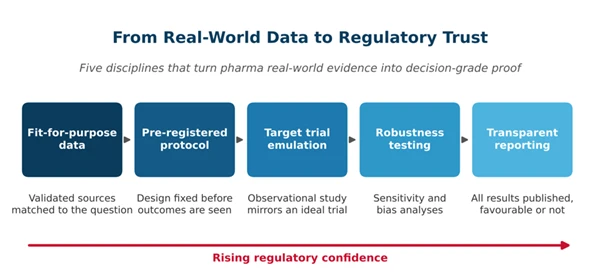
Figure 1: The five disciplines that build regulatory trust in real-world evidence
Organisations that consistently earn regulatory confidence share a recognisable pattern of behaviour. It begins with fit-for-purpose data. Rather than starting with whatever dataset is convenient, leading sponsors start with the regulatory question and then justify why a specific source is capable of answering it, documenting completeness, provenance and the validity of key outcome definitions. This turns a likely reviewer objection into a pre-emptive answer.
The second discipline is pre-registration. Publishing a study protocol and statistical analysis plan before outcomes are examined signals that the conclusions were not engineered after the fact. It is a simple act with an outsized effect on credibility, and it mirrors the expectations long applied to clinical trials.
Third is the growing use of target trial emulation, a framework in which researchers explicitly specify the randomised trial they would ideally run and then design the observational study to mimic it as closely as possible, including eligibility criteria, treatment strategies, follow-up and the start of the observation period. Many historical errors in observational research, such as immortal time bias, stem from mismatched timelines that this approach is specifically designed to prevent.
Fourth is rigorous robustness testing. Sensitivity analyses, negative control outcomes and quantitative bias assessments show reviewers how strong an unmeasured confounder would need to be to overturn a result. Instead of claiming the absence of bias, the sponsor quantifies its plausible impact.
Finally, transparent reporting completes the chain. Sharing code, data definitions and all prespecified results, including those that disappoint, demonstrates that the evidence package is complete rather than curated. Together, these practices convert real-world data from a supporting anecdote into an argument that can withstand scrutiny.
Inside a Real-World Evidence Success: An Illustrative Rare Disease Case
Consider a composite scenario that reflects patterns increasingly seen in European rare disease development. A sponsor developing a therapy for an ultra-rare paediatric metabolic disorder faces a familiar dilemma: the patient population is too small and the condition too severe to justify a placebo arm. Instead, the company proposes a single-arm trial supported by an external control group drawn from a long-standing disease registry.
Early dialogue with regulators proves decisive. The sponsor seeks scientific advice before finalising the design, agrees on the registry as an acceptable source, and aligns on how patients will be matched on age, genotype and baseline disease severity. The protocol and analysis plan are registered in advance. When results arrive, the treated group shows a markedly slower decline than matched historical controls, and multiple sensitivity analyses, including alternative matching methods and a quantitative assessment of unmeasured confounding, point in the same direction.
The lesson is not that real-world data replaced the trial. It is that real-world data, generated with trial-like discipline and agreed in advance with decision-makers, made a feasible development path credible where a conventional one was ethically and practically impossible.
The C-Suite Real-World Evidence Agenda: From Pilot Projects to Enterprise Capability
Many pharmaceutical organisations still run RWE as a collection of isolated projects, commissioned late in development to answer a specific payer question or rescue a struggling dossier. This approach rarely earns lasting regulatory trust because it starts too late and varies too widely in quality. The more successful model treats real-world evidence as an enterprise capability embedded from early development onward.
That shift has organisational consequences. It means aligning medical, regulatory, market access and data science teams around shared evidence plans rather than separate agendas. It means investing in long-term data partnerships, governance frameworks and privacy-preserving analytics, including federated approaches that analyse data where it resides rather than moving it across borders. It also means building internal methodological standards so that every study carries the same signature of rigour, regardless of which team or vendor executes it.
Equally important is early and continuous engagement with regulators and HTA bodies. Scientific advice on real-world study designs, ideally sought jointly where possible, allows sponsors to discover objections while there is still time to address them. Leadership teams should measure success not by the volume of studies completed, but by how often RWE submissions are accepted without fundamental challenge.
Artificial intelligence will play a supporting role, particularly in extracting structured information from unstructured clinical notes and in harmonising data across systems. But technology will not close the trust gap on its own. Trust will follow transparency, methodological rigour and a track record of evidence that holds up when independently replicated.
Conclusion: Real-World Evidence Must Earn Its Seat at the Regulatory Table
Real-world evidence is not a shortcut around clinical trials, and pharmaceutical leaders who present it that way will continue to meet resistance. Its true value lies in complementing randomised evidence: extending insight into broader populations, longer timeframes and contexts where trials cannot reach. Europe is rapidly building the data infrastructure and legal frameworks to make this possible, and regulators are developing their own analytical capabilities in parallel.
The trust gap will narrow fastest for organisations that hold their real-world studies to the same standards of design, transparency and accountability as their trials. For the European C-suite, the opportunity is significant. Companies that master decision-grade real-world evidence will move faster through approval, negotiate more confidently with payers and demonstrate value with greater precision. Those that do not risk watching regulators answer the questions themselves.
Frequently Asked Questions on Real-World Evidence in Pharma
What is the difference between real-world data and real-world evidence?
Real-world data refers to health information collected outside traditional clinical trials, such as health records, registries and claims. Real-world evidence is the clinical insight produced when that data is analysed using sound scientific methods.
Can real-world evidence replace randomised controlled trials?
Generally not. It is most persuasive as a complement to trials, or in situations such as rare diseases where randomised studies are unethical or impractical.
Why are European regulators cautious about real-world evidence?
Their main concerns are confounding, inconsistent data quality across health systems, and the risk of selective analysis when study designs are not fixed in advance.
How can pharma companies strengthen the credibility of real-world studies?
By selecting fit-for-purpose data, pre-registering protocols, emulating target trials, testing robustness against bias, reporting results transparently and engaging regulators early.
How will the European Health Data Space affect real-world evidence?
By establishing a common framework for secondary use of health data, it is expected to make cross-border data access more consistent and predictable over time.

Lakshmi is a science writer with a foundation in the laboratory. She earned her master's in biotechnology and trained through research internships at ICGEB (JNU) and DIPAS, DRDO, with her work appearing in the Egyptian Journal of Veterinary Sciences. Now APCRM-certified and part of the editorial team at Pharma Focus America and Pharma Focus Europe, she reports on pharmaceutical technology, research, and innovation — giving complex science a clear and confident voice for industry leaders.