

Pharmaceutical Commercial Strategy in Europe: Market Access, Pricing and Financial Planning Across European Markets
Kate Williamson, Editorial Team, Pharma Focus Europe
European pharmaceutical markets share one regulatory approval but operate through separate national pricing and reimbursement systems. This article explains how companies can build a practical European pharma commercial strategy, covering market access, drug pricing mechanics, launch sequencing, evidence planning, and net-revenue financial forecasting to improve reimbursement outcomes and commercial performance.

Introduction:
Europe looks like one market on a slide deck. In reality, it is dozens of separate ones.
Each country has its own health technology assessment (HTA) body, its own payer logic, its own price rules and its own timeline. A drug can be reimbursed in Germany within months and still be waiting for a pricing decision in Italy or Spain a year later. If your commercial plan treats “Europe” as a single line in a forecast, it will miss, probably by a lot.
What is a European pharma commercial strategy?
A European pharma commercial strategy is a country-by-country plan that links a product’s clinical value to pricing, reimbursement, launch sequencing and revenue forecasts. It accounts for the fact that EU marketing authorization is centralized, while pricing and reimbursement decisions stay national.
That last point is where most plans go wrong. The European Medicines Agency (EMA) can approve a medicine for the whole EU. But whether a patient in Lyon, Milan or Madrid can actually get it paid for is decided by each country’s payers. Approval opens the door. Access is a separate battle.
Why market access decides your revenue
Pharmaceutical market access in Europe is the process of getting a approved medicine funded and available to patients through national health systems. Everything depends on it, because most European healthcare spending flows through public payers, not individual consumers.
Payers in Europe ask roughly the same three questions, even if they phrase them differently:
- Does this drug work better than what we already use?
- Is the added benefit worth the added cost?
- Can our budget absorb it?
Your job is to have a clear, evidence-backed answer to all three before launch, not after the first rejection.
The big shift: EU Joint Clinical Assessments
Since January 2025, the EU HTA Regulation has required joint clinical assessments (JCAs) for new oncology medicines and advanced therapies. Orphan drugs follow in 2028, and all new centrally authorized medicines by 2030.
This does not replace national pricing decisions. But it does mean the clinical evidence package you submit will be assessed once at EU level and then reused by member states. In practice, that raises the stakes of your pivotal trial design, your comparators and your choice of endpoints. If those choices are weak, the weakness now travels across borders.
How European drug pricing actually works
European drug pricing is mostly governed by national negotiation, clinical benefit ratings and reference to prices in other countries. There is no single price. There is a web of prices that influence each other.
A few mechanics shape almost every launch:
- External reference pricing (ERP). Many countries benchmark your price against what other countries pay. A low price in one market can drag down several others.
- Value-based assessment. Germany’s AMNOG process and France’s HAS assessment both rate added therapeutic benefit, and that rating influences the price you can negotiate.
- Confidential discounts. Many companies keep a higher list price and offer rebates or managed entry agreements, so reference prices stay protected.
- Budget controls. Clawbacks, payback mechanisms and spending caps can reduce net revenue after the fact.
- A quick look at key markets
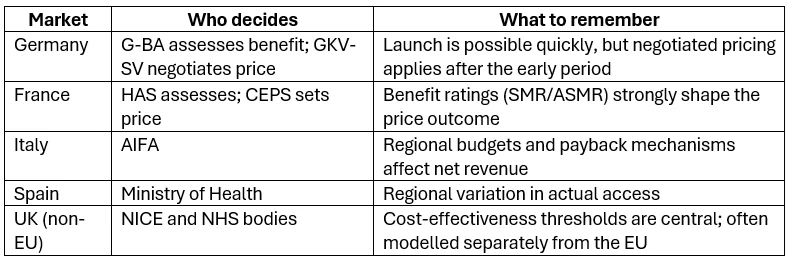
Treat this table as a starting point. Rules change, so verify current procedures before you build a forecast on them.
Which countries should you launch in first?
Most companies launch first in markets with faster access and strong price visibility, then roll out to slower or more price-sensitive ones. Germany is the usual first choice because of its early access pathway. The UK, France, Italy and Spain often follow.
But “Germany first” is a default, not a rule. Sequencing should be a deliberate decision based on four things:
- Reference price exposure. Which markets reference which others? Launching low in the wrong one can create a price floor you regret.
- Evidence fit. Does your trial data match what that country’s HTA body values?
- Timeline to revenue. A fast market with a modest price can beat a slow one with a high price once you factor in time.
- Parallel trade risk. If prices differ a lot, products can move from low-price to high-price countries.
The right launch sequence can have a lasting impact on a product’s pricing potential and commercial performance. A well-planned market entry strategy should account for how pricing decisions in one country influence opportunities in others. By evaluating reference pricing relationships, market access requirements and revenue timelines together, manufacturers can prioritise markets that support both early commercial returns and sustainable long-term pricing.
Building evidence payers will actually believe
Payers are not impressed by statistical significance alone. They want to know whether the improvement matters to patients and to the system.
Strong market access strategy for Europe usually includes:
- Early scientific advice from HTA bodies, before pivotal trials lock their design.
- Comparators payers actually use, not just what regulators accepted.
- Real-world evidence plans to answer the questions trials cannot.
- Health economic models that can be adapted country by country, with local costs and pathways.
- Patient-reported outcomes where quality of life is the true benefit.
If your evidence plan starts after Phase 3 readout, you are already late.
Managed entry agreements: bridging the gap
When payers like a drug but fear the cost or the uncertainty, they often propose a managed entry agreement. These come in two broad types:
- Financial agreements, such as discounts, price-volume deals or spending caps.
- Outcomes-based agreements, where payment depends on how well the drug performs in real patients.
They can unlock access, but they add operational weight: data collection, contract tracking, rebate processing. Before you agree to one, ask whether your systems can even deliver on it. A clever deal that you cannot administer becomes a revenue leak.
Financial planning for pharmaceutical commercial operations across Europe
This is where strategy meets the spreadsheet. Pharma financial planning for European markets means forecasting revenue net of price cuts, rebates, delays and currency effects, country by country, and linking it to realistic launch investment.
Good finance teams do a few things differently.
They forecast net, not gross. List price is a headline. Net price after confidential rebates, clawbacks and payback is what funds your business. Build the net view from day one.
They model timing risk explicitly. Pricing and reimbursement timelines vary from months to well over a year. Instead of one launch date per country, use scenarios: fast, expected, slow. The difference between them can swing first-year revenue dramatically.
They plan for price erosion. Reference pricing, generics, biosimilars and budget caps all push prices down over time. A flat price assumption over ten years is optimistic at best.
They account for currency and tax. Selling across euro and non-euro markets introduces exchange-rate exposure that can quietly alter margins.
They tie spend to access milestones. Rather than funding full sales force deployment everywhere at once, link investment to confirmed reimbursement. It protects cash and reduces the cost of being wrong.
A simple planning rhythm
- Build a base case per country using evidence-based assumptions for price, uptake and timing.
- Add upside and downside scenarios for HTA outcomes.
- Stress-test the portfolio for reference pricing spillover.
- Review quarterly, as decisions arrive, and reallocate budget.
The point is not a perfect forecast. It is a plan that updates faster than the market surprises you.
Pharmaceutical product launch and reimbursement strategies: a practical checklist
If you are preparing a launch, work through these questions with your cross-functional team:
- Is our evidence package aligned with JCA requirements and national HTA preferences?
- Have we mapped reference pricing links between our target countries?
- Do we have a launch sequence with a clear rationale for each market?
- Are our target net prices defined, with a walk-away point for each country?
- Can our finance and operations teams handle rebates and managed entry agreements?
- What does our forecast look like if the first two markets come in slower than expected?
- Who owns each decision, and how fast can we escalate?
If you cannot answer most of these confidently six to twelve months before launch, that is your priority list.
Common mistakes to avoid
- Treating Europe as one market. It isn’t, and your plan shouldn’t pretend it is.
- Designing trials without payer input. You may win regulatory approval and lose reimbursement.
- Ignoring reference pricing. One low-price deal can echo across many countries.
- Over-optimistic uptake curves. Access barriers at regional or hospital level often slow real adoption.
- Siloed teams. Market access, pricing, medical and finance need to work from the same assumptions.
Frequently asked questions
What is market access in the pharmaceutical industry?
It is the work of ensuring that an approved medicine is reimbursed and available to patients, by demonstrating its clinical and economic value to payers and negotiating price and access conditions.
Why is European drug pricing so complicated?
Because pricing and reimbursement are national responsibilities. Each country applies its own rules, and external reference pricing links prices across borders.
What is external reference pricing?
It is a method where a country sets or benchmarks a drug’s price using prices in a basket of other countries.
How long does reimbursement take in Europe?
It varies widely by country, product type and pathway. Some markets can provide access within months, while others take a year or more. Always check current national timelines.
Which European country should pharma launch in first?
Germany is a common first launch because of its early access framework, but the right sequence depends on your reference pricing exposure, evidence and strategy.
What is the EU HTA Regulation?
It is EU legislation that introduces joint clinical assessments of new medicines, starting with cancer drugs and advanced therapies in 2025, to reduce duplicated evidence work across member states.
Final thoughts
Europe rewards companies that plan for complexity instead of hoping it goes away. The winners usually share three habits: they build evidence with payers in mind, they treat price as a portfolio decision rather than a country-by-country one, and they let finance and market access plan together.
Get those right, and a fragmented continent becomes a manageable, even predictable, growth market.

Kate, Editorial Team at Pharma Focus Europe, leverages her extensive background in pharmaceutical communication to craft insightful and accessible content. With a passion for translating complex pharmaceutical concepts, Kate contributes to the team's mission of delivering up-to-date and impactful information to the global Pharmaceutical community.