Strategic Partnerships and Collaborations in the European Pharmaceutical Industry
Sarah Richards, Editorial Team, Pharma Focus Europe
European pharmaceutical companies increasingly rely on strategic partnerships to share risk, cut costs, and reach fragmented markets. This article explains licensing, co-development, joint ventures, and public-private consortia, compares each collaboration model, highlights what makes alliances succeed, and outlines common pitfalls and emerging trends shaping partnerships across Europe's pharmaceutical industry.

The Short Answer
Pharma strategic partnerships are formal agreements in which two or more companies share resources, risk, and rewards to develop or commercialize medicines. In Europe, the main models are licensing, co-development, co-commercialization, joint ventures, and public-private consortia. Companies choose based on how much risk they want to share, how much control they need to keep, and how far along the asset is.
That's the quick version. Here's how it plays out in practice.
Why Do Partnerships Matter So Much in Europe?
Bringing a new drug to market often takes over a decade and costs well over a billion euros once failures are counted. No single company, however large, can carry every bet alone.
Europe adds its own complications. There are 27 EU member states with different reimbursement systems, one central regulator (the EMA) alongside national health technology assessment bodies, and a research landscape spread across universities, biotech hubs, and mid-sized firms. Regulation, pricing, and market access vary from country to country.
Partnerships are how European companies cope with this fragmentation. A small biotech in Copenhagen, a mid-sized specialty firm in Madrid, and a global player in Basel each hold a different piece of the puzzle. Pharmaceutical strategic alliances put those pieces together.
What Is Pharma Licensing?
Pharma licensing means the owner of a drug candidate, technology, or approved product (the licensor) grants another company (the licensee) rights to develop, manufacture, or sell it, usually in exchange for money and future royalties.
A typical deal has three financial layers:
- Upfront payment: cash paid at signing
- Milestone payments: released when development, regulatory, or sales goals are hit
- Royalties: a percentage of net sales
Licensing is popular because it is flexible. It can be global or limited to specific territories, and to one indication or many.
How Does European Pharma Licensing Work?
European pharma licensing is often territorial, and that matters a lot here. A company might license rights for the EU5 (Germany, France, Italy, Spain, and the UK) while keeping rights elsewhere. Or a US biotech may license European rights to a regional partner that understands local reimbursement, medical affairs, and hospital procurement.
Licensing suits you when:
- You have a promising asset but lack commercial infrastructure in Europe
- You want to fill a pipeline gap quickly without building from scratch
- You'd like to monetize a non-core asset
What Is Pharma Co-Development?
Pharma co-development goes further than licensing. Both parties contribute to R&D, sharing the scientific work, the costs, and often the decision-making. Costs are commonly split by an agreed ratio, and profits follow a similar logic.
Think of licensing as renting a house and co-development as building one together. Both sides have skin in the game, so trust and governance matter far more.
Co-development tends to work best when:
The asset is high-risk and high-cost (late-stage oncology or cell and gene therapy, for example)
Each partner brings complementary expertise, such as a discovery platform on one side and clinical and regulatory muscle on the other
Both want long-term upside, not just a one-time transaction
A well-known transatlantic example is the long-running collaboration between Sanofi and Regeneron, which co-developed antibody therapies and shared responsibilities across development and commercialization. It shows how a co-development structure can extend across many programs over time.
Which Collaboration Models Do Pharmaceutical Companies Use in Europe?
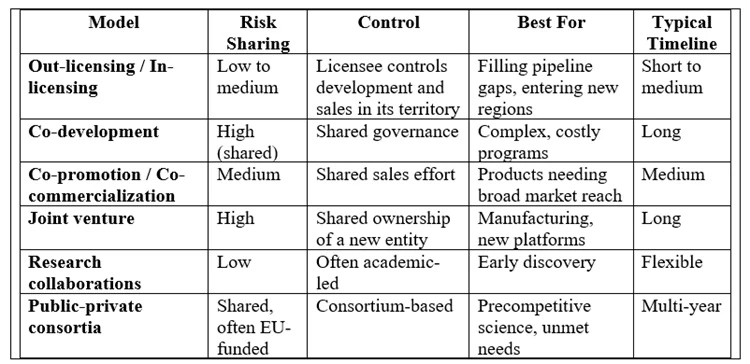
Not every alliance needs to be a mega-deal. Here are the main collaboration models for pharmaceutical companies in Europe, compared side by side.
A Note on Public-Private Partnerships
Europe has a strong tradition of publicly backed collaboration. Programs like the Innovative Medicines Initiative and its successor, the Innovative Health Initiative, bring industry, academia, and regulators together on precompetitive challenges. Companies that would normally compete sit at the same table to solve shared problems, such as better biomarkers or antimicrobial resistance.
How Do Strategic Partnerships Between European Pharmaceutical Companies Work?
Deals between two European firms have their own dynamics. They share regulatory context, time zones, and often similar compliance cultures, which can smooth negotiations.
One frequently cited example is the collaboration between Germany's Bayer and Finland's Orion on the prostate cancer drug darolutamide. It shows how a large multinational and a smaller regional company can play different, complementary roles: one brings global reach, the other deep development expertise.
These intra-European European pharma partnerships often succeed for three reasons:
1. Regulatory familiarity. Both sides understand EMA processes and EU-wide requirements.
2. Market complementarity. A partner strong in Nordic markets can pair with one strong in Southern Europe.
3. Talent and research ecosystems. Clusters like Basel, Cambridge, Munich, and Leiden encourage cross-border collaboration.
What Makes a Strategic Alliance Actually Work?
A signed contract is only the beginning. Many alliances underperform not because the science failed, but because the relationship did. Here's what successful pharmaceutical collaborations tend to get right.
1. Clear strategic fit. Both sides should be able to answer, in one sentence, why this partnership makes each of them stronger. If one party's answer is vague, be careful.
2. Honest due diligence. Look beyond the data package. Check the partner's track record, culture, and capacity to deliver.
3. Defined governance. Set up a joint steering committee, clear escalation paths, and agreed rules for decisions. Ambiguity is expensive.
4. Fair economics. Deals that heavily favor one side tend to sour. Balanced upfronts, milestones, and royalties keep both motivated.
5. Regulatory and IP clarity. Spell out who owns what, who files what, and who handles pharmacovigilance and supply. In Europe, add data protection (GDPR) and competition law to that list.
6. Cultural fit and communication. A weekly call and a shared sense of urgency often matter more than a perfect clause.
Common Pitfalls to Avoid
- Chasing the headline number. A huge "biobucks" figure can hide a tiny upfront and unlikely milestones.
- Underestimating integration. Different quality systems, IT tools, and decision speeds create friction.
- Neglecting exit terms. Every alliance should define what happens if a program fails or priorities change.
- Ignoring market access early. In Europe, a drug approved centrally still needs country-by-country pricing and reimbursement. Partners should plan for this from day one.
- Trends Shaping European Pharma Partnerships Right Now
- Oncology and advanced therapies continue to attract heavy collaboration because of their cost and complexity.
- AI and digital tools are bringing tech companies into pharma alliances, especially for discovery and trial design.
- Supply chain resilience is now a partnership driver, with more attention to regional manufacturing.
- Regulatory reform in the EU, including the revision of pharmaceutical legislation, may influence incentives and deal structures. Details continue to evolve.
- Biotech and big pharma pairings remain central, with large companies gaining innovation through licensing while biotechs gain funding and scale.
Frequently Asked Questions
What is the difference between pharma licensing and co-development?
Licensing transfers rights to use, develop, or sell an asset, usually for fees and royalties. Co-development involves both parties actively working on and funding development, sharing risk and reward.
Why do European pharma companies form strategic partnerships?
To share R&D costs, access new technologies, speed up development, and navigate the fragmented European market more efficiently.
What are the main types of pharmaceutical collaborations?
Licensing agreements, co-development deals, co-commercialization arrangements, joint ventures, research collaborations, and public-private consortia.
How long do pharma partnership negotiations take?
It varies widely. Simple licensing deals can close in a few months, while complex co-development or joint venture agreements may take considerably longer.
Are partnerships better than mergers and acquisitions?
Not always. Partnerships offer flexibility and lower upfront commitment. Acquisitions provide full control but require more capital and integration effort. The right choice depends on strategy and risk appetite.
Final Thoughts
The strongest partnerships in the European pharmaceutical industry aren't built on clever legal drafting alone. They're built on aligned goals, honest communication, and a shared belief that the patient at the end of the pipeline matters more than the deal terms.
Whether you're exploring pharma licensing and co-development partnerships in Europe or building a broader alliance strategy, start with the fundamentals: clarity of purpose, fair economics, and a partner you'd trust when things get difficult. The rest can be negotiated.
Planning a partnership? Start by mapping your pipeline gaps and the capabilities you lack, then look for partners whose strengths fill them, not just mirror yours.

Sarah Richards, Editorial Team at Pharma Focus Europe, leverages her extensive background in pharmaceutical communication to craft insightful and accessible content. With a passion for translating complex pharmaceutical concepts, Sarah contributes to the team's mission of delivering up-to-date and impactful information to the global Pharmaceutical community.