

Pharma Distribution in Europe: Parallel Trade and Shortages
Lakshmi, Editorial Team, Pharma Focus Europe
Europe's pharma distribution system is under strain as parallel trade, national export curbs and persistent medicine shortages collide. Auditors found regulators split on whether parallel trade causes shortages or relieves them, while incoming EU rules will shift supply accountability towards boardrooms. This article examines the evidence, two national case studies and the new obligations, and argues that cross-border flow visibility is becoming a core executive responsibility for pharmaceutical leaders.
Introduction
A box of medicine crossing a European border can be two things at once: proof that the single market works and a warning that it does not. Parallel trade, the cross-border resale of authorised medicines by traders operating outside a manufacturer's own distribution system, moved an estimated €6.5 billion of product in 2023, valued at ex-factory prices. Meanwhile, community pharmacists across the continent describe shortages as a routine part of their working week.
For pharmaceutical executives, the link between these two realities was long treated as a matter for market access teams and competition lawyers. That position is becoming harder to hold. European auditors have criticised the policy vacuum around parallel trade, member states are building their own barriers, and a sweeping EU reform is poised to place supply accountability on a far firmer legal footing. Pharma distribution in Europe is no longer a back-office function. It is becoming a test of corporate governance.
Follow the Pack: How Parallel Trade Redraws the Pharma Distribution Map
Price is the engine. Member states decide medicine prices and reimbursement nationally, and confidentiality obscures the true gaps: the European Court of Auditors reports that negotiated discounts on list prices can reach 50%. Traders buy where prices are low and sell where they are high, concentrating on expensive branded products and on medicines in limited supply.
Reliance on this channel is strikingly uneven. Parallel imports accounted for an estimated 26.7% of pharmacy market sales in Denmark in 2023, against 8.0% in the United Kingdom, 7.8% in Sweden, 7.0% in Germany and 1.3% in Poland. A strategy built on a pan-European average would miss the real exposure, which sits market by market.
The economics of the chain help explain the appeal. Across 25 European countries, manufacturers retain on average 67% of a medicine's retail price, pharmacists 17.5%, the state 10.5% and wholesalers just 5%. With so narrow a regulated share, cross-border margin can look attractive.
Packaging adds friction. Names, pack sizes and labelling differ between countries; auditors cite one marketer's amoxicillin sold in 12 pack sizes across member states. Those differences raise the cost of moving stock in ordinary times and slow redistribution in an emergency.
Medicine Shortages: Pharma Distribution's New Permanent Weather
Shortages have stopped behaving like episodes. The latest annual survey by Europe's community pharmacy organisations, covering 27 EU and EFTA countries, found shortages in 96% of responding countries. In 70%, the situation had stagnated at a high level, and in 37%, more than 600 medicines were in shortage. Pharmacies now spend an average of 12 hours a week managing the problem, and 89% of responding EU member states report treatment interruptions. At the most severe level, national authorities reported 136 critical shortages to the European Medicines Agency between 2022 and October 2024.
Parallel trade is not the main cause. When national authorities analysed 83,266 shortage notifications from 24 European Economic Area countries for 2022 and 2023, manufacturing issues represented half of all root causes. Distribution cannot repair a failed production line. It does, however, decide who receives what remains, which makes early warning decisive. Here the system falters: for centrally authorised medicines, 55.9% of notifications to the agency between May 2023 and October 2024 arrived on or after the day the shortage began, despite an expectation of two months' notice (Figure 1).
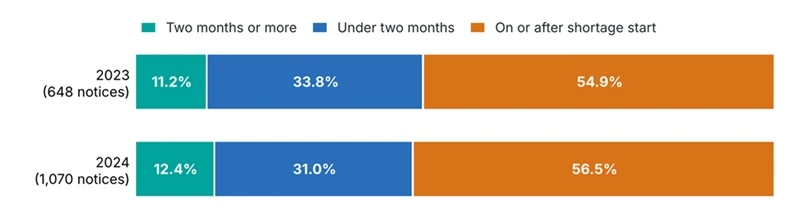
Figure 1: How much warning regulators received of shortages of centrally authorised medicines (2023 from May; 2024 to end-October). Source: European Court of Auditors, Special Report 19/2025.
Parallel Trade, Culprit or Cure? The Verdict European Regulators Cannot Reach
When auditors surveyed 30 national competent authorities, 12 said parallel trade had caused shortages in their member state and 15 said it had helped mitigate them (Figure 2). Both answers can be true, because the channel that drains a low-priced market can also rescue a market that has run short. Auditors add that parallel trade can lower prices and bring in medicines not otherwise marketed locally. The research-based industry's European federation disagrees sharply, arguing that the practice benefits neither social security systems nor patients and disrupts supply in smaller markets.
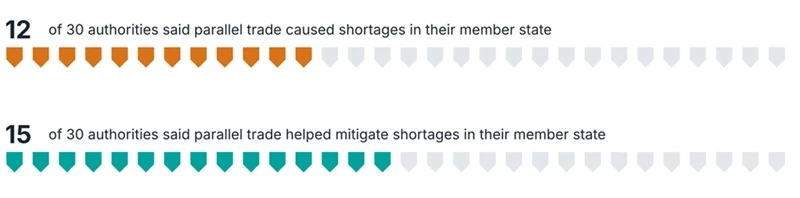
Figure 2: Pictograph of regulators' divided experience; each shield is one of 30 national authorities surveyed, and the two questions were asked separately. Source: European Court of Auditors, Special Report 19/2025.
The deeper problem is missing evidence. A 2021 European Commission study recommended greater transparency because reliable data on parallel trade and supply quotas did not exist, and auditors found the issue was not pursued further. Manufacturers, meanwhile, often respond with supply quotas that cap deliveries to a market at estimated national demand. Quotas are considered legal, yet they may constrain the supply obligation. The legal boundary also matters: in a 2008 Grand Chamber judgment, the EU's top court held that a dominant company abuses its position if it refuses ordinary orders from wholesalers in order to stop parallel exports. Whether orders are ordinary depends on national need and previous business relations.
When Borders Close: Export Curbs and the Medicine Shortage Domino Effect
Faced with empty shelves, governments have acted alone. Auditors documented barriers across several member states, including a Greek export ban that covered 119 medicines in 2024 and Spanish dual pricing that sets a higher price for parallel trade. Export bans are permitted to protect human health, but some were neither temporary nor narrow, and were renewed for years. In 2018, the Commission closed infringement proceedings against Poland, Romania and Slovakia, saying it needed other ways to solve the issue.
Stockpiling has followed the same pattern. Because capacity is finite, national stock requirements can pull supply away from neighbours, particularly smaller ones. The Commission asked Denmark to reduce its proposed list from 924 medicines to between 400 and 600 and to extend the build-up period from three months to six.
Case Study: Poland and Denmark, Two Faces of the Parallel Trade Dilemma
Poland: when pharma export controls outrun enforcement
After official prices for reimbursed medicines fell sharply, exporting from Poland became profitable. Part of that trade ran through what Polish authorities call the reverse distribution chain, in which product is diverted from pharmacies back to wholesalers and then abroad. Unlike genuine parallel trade, this is illegal. Legislation from 2015 required companies to notify the Chief Pharmaceutical Inspector before exporting medicines on a ministerial at-risk list, giving the inspector 30 days to object.
The results were mixed. According to Poland's human rights ombudsman, the inspector issued 1,630 objections by the end of 2016 and none in 2017, and the illegal trade was not eliminated. The first penalty for exporting listed medicines, PLN 47.1 million, came only on 12 September 2018. By 31 July 2019, penalties had reached PLN 280 million, although a peer-reviewed analysis recorded that none had been enforced. The lesson is that controls are only as strong as the data and enforcement behind them.
Denmark: when a market depends on the parallel channel
Verteporfin, an essential eye medicine, has been in shortage since 2021, with some patients across the EU suffering irreversible vision loss. Auditors recorded that industry was not supplying Denmark directly, because the market had been served indirectly by parallel traders. The European Medicines Agency escalated the matter and organised a joint industry hearing, yet a commitment to provide some supply was not always fulfilled in good time. A market that looks well supplied through a secondary channel may have no safety net when that channel dries up.
The New Pharma Rulebook: Parallel Trade and Shortages Meet Legal Accountability
On 28 September 2026, the Council of the EU adopted the pharma package, and the European Parliament's final vote was still pending at the time of writing. The texts enter into force 20 days after publication in the Official Journal. Under the agreed text, companies must give at least 12 months' notice of permanent cessation of marketing, and six months' notice of a temporary suspension or an expected supply disruption lasting more than two weeks. Marketing authorisation holders must also maintain shortage prevention plans for prescription medicines and produce them within two days of a request.
Revised guidance from the European Medicines Agency in 2026 turns much of this assessment into arithmetic. An EU market share above 50% signals high patient impact. More than five notifications of shortages lasting over a month within three years, combined with a structural vulnerability, signals high supply chain risk. Notifications are counted per authority, so one interruption across several countries can cross that line.
Distribution is directly in scope. Member states may require wholesalers to notify the source country of an intention to conduct parallel trade, and that country may impose restrictions justified on public health grounds. Alongside this, the Critical Medicines Act, provisionally agreed in May 2026 and awaiting formal approval, targets diversified supply chains and EU-based production.
The Boardroom Agenda: Turning Pharma Distribution into a Strategic Asset
The first priority is visibility. Market share by member state typically sits with commercial teams, while notification history sits with regulatory affairs, and a two-day response window punishes that separation. Companies that can see demand, quotas, wholesaler orders and likely parallel flows in one view will answer regulators faster and spot trouble sooner. The European Medicines Agency's recommendation that senior leadership oversee shortage prevention plans points in the same direction.
The second priority is defensibility. A supply quota should rest on documented, regularly refreshed demand evidence, because a limit that looks prudent in a stable market may read very differently during a shortage. Parallel trade exposure belongs in the same discussion: leaders should know which markets supply it, which depend on it, and what happens if a national authority suddenly restricts it.
The third priority is treating pack design as resilience spending. Multi-country packs and simpler presentations cost money to implement, but auditors identify fragmented packaging as a barrier to redistribution during shortages. For high-risk products, that investment may prove cheaper than a stranded national stock when a neighbouring market runs out.
Conclusion
Parallel trade is neither the villain nor the saviour of European medicine supply. It is a symptom of a market that shares one set of free movement rules but keeps its prices, packs and stockpiles national. What has changed is the cost of not knowing. As new EU rules move towards application, pharma distribution will be judged on foresight as much as on logistics. Executives who map their cross-border flows now, and treat supply continuity as a board-level duty, will be better placed to protect patients, reputations and market access in the years ahead.

Lakshmi is a science writer with a foundation in the laboratory. She earned her master's in biotechnology and trained through research internships at ICGEB (JNU) and DIPAS, DRDO, with her work appearing in the Egyptian Journal of Veterinary Sciences. Now APCRM-certified and part of the editorial team at Pharma Focus America and Pharma Focus Europe, she reports on pharmaceutical technology, research, and innovation — giving complex science a clear and confident voice for industry leaders.