Patient-Centric Clinical Trials: Improving Recruitment, Retention, and Diversity
Lakshmi, Editorial Team, Pharma Focus Europe
Recruitment delays, participant withdrawal and unrepresentative study populations remain the most expensive avoidable failures in European clinical development. Patient-centric trial design addresses all three at once, and Europe's regulatory and health technology assessment environment now rewards it directly. This article sets out where patient-centricity delivers measurable returns in recruitment, retention and diversity, and what pharmaceutical leadership must change to capture them.
Introduction:
Patient-centricity has spent a decade as a value statement in pharmaceutical annual reports and comparatively little time as an operating discipline. That gap is now closing, not because the argument became more persuasive, but because the economics and the regulatory environment stopped tolerating the alternative.
The pattern across European clinical development is consistent. Most trials miss their recruitment timelines. Roughly one in five investigator sites contributes little or no enrolment. A substantial minority of randomised participants withdraw before the final visit, and each replacement carries the full cost of screening, consent, treatment and monitoring a second time. Meanwhile, the populations who actually use medicines in European health systems — older patients, those with multiple long-term conditions, people living far from academic centres — remain systematically underrepresented in the studies that support authorisation and reimbursement.
Two regulatory shifts have raised the stakes. Revised good clinical practice expectations place explicit emphasis on proportionality and participant burden, requiring sponsors to justify what they ask of people rather than defaulting to maximal data collection. Separately, European joint clinical assessment has made generalisability a formal question at market access: a trial population that does not resemble clinical practice invites challenge from assessors and payers long after the data are locked. Patient-centric design is therefore no longer a matter of goodwill. It is a determinant of speed, cost and reimbursement.
Where Patient-Centric Recruitment Really Breaks Down in Europe
Recruitment failure is rarely a single event. It is cumulative attrition across a funnel that begins long before consent: patients who are never identified because they attend a hospital that was not selected, patients who are approached but cannot commit to the visit schedule, patients who are screened and fail on a criterion of questionable clinical relevance, and patients who randomise and then leave.
Read that funnel honestly and the leverage points become obvious. Screen failure driven by over-tight eligibility is a protocol problem. Failure to identify patients at all is a site and channel problem. Withdrawal after randomisation is an experience problem. Each responds to a different intervention, and sponsors that treat them as one undifferentiated recruitment challenge tend to buy more sites — the most expensive and least reliable remedy available.
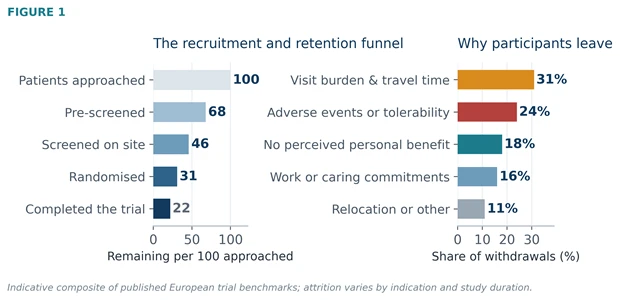
Figure 1: Attrition compounds across the recruitment funnel, and the largest single driver of withdrawal is burden the protocol imposed by design.
Patient-Centric Protocol Design: Ask Patients Before the Protocol Is Locked
The most consequential patient-centric intervention costs comparatively little and happens earliest: structured input from patients and treating clinicians on a draft protocol, before the document is finalised and before a single site is contracted.
Patient advisory panels routinely identify problems that internal review does not. A washout period that means weeks of uncontrolled symptoms. A visit window so narrow that anyone in full-time employment must take unpaid leave. An imaging sub-study scheduled on a separate day from the main visit, effectively doubling travel for rural participants. A quality-of-life questionnaire so long that completion collapses after month three, undermining the very endpoint it was designed to capture.
Formalising this input also produces a documentation benefit. Regulators and assessors increasingly expect sponsors to show how participant burden was considered and mitigated, and a recorded patient consultation with resulting design changes is far stronger evidence than a retrospective assertion that burden was reasonable.
Patient advisory panels routinely identify what internal review does not — and by then the fix costs a conversation rather than an amendment.
Retention Is Earned Between Visits, Not at Consent
Sponsors invest heavily in the moment of consent and comparatively little in the eighteen months that follow. Yet withdrawal is overwhelmingly driven by the accumulated friction of participation: travel and parking costs advanced from a participant's own pocket, appointments that cannot be moved, no clarity on what happens after the trial ends, and no sense that anyone noticed the effort involved.
The corrective measures are unglamorous and well evidenced. Reimbursing travel and out-of-pocket costs promptly, and covering a companion or carer where attendance depends on one. Allowing a proportion of assessments to be done at home, at a local laboratory or by a visiting nurse — an approach that in most European jurisdictions requires careful attention to national rules on home healthcare and to data protection obligations when patient data moves outside the site. Offering flexible and weekend visit slots. Providing a named contact who is reachable between visits. Communicating results and next steps to participants in language they can read, which lay summary requirements under European clinical trials legislation now make a compliance matter as well as a courtesy.
None of this is expensive relative to the alternative. Replacing a withdrawn participant in a late-phase trial can cost several times the annual outlay on the retention measures that would have kept them.
Diversity in European Trials: Representativeness as a Payer Test
Diversity in the European context is framed differently from the United States, where regulators have moved to formal enrolment planning around race and ethnicity. European sponsors face a broader and, in some respects, more demanding question: does the study population resemble the patients who will actually receive this medicine across member states with very different demographics, health systems and languages?
On current evidence, frequently not. Older patients — the majority in most chronic disease populations — are consistently underrepresented, often excluded by renal function thresholds, polypharmacy restrictions or upper age limits that no longer reflect clinical practice. Patients with multiple comorbidities are excluded to protect internal validity, then form the bulk of real-world prescribing. Rural populations are underrepresented as a direct arithmetic consequence of siting trials in a handful of academic centres. Populations with limited proficiency in a country's dominant language are excluded by the simple absence of translated materials and interpreters.
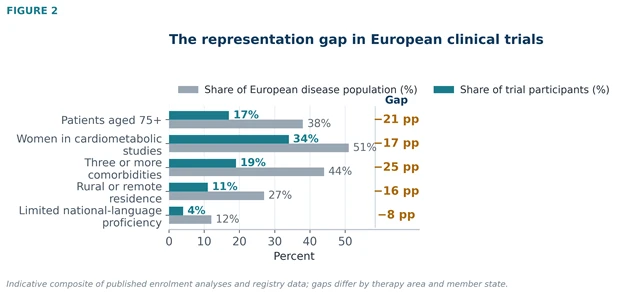
Figure 2: Systematic gaps between the European disease population and the population actually studied, expressed in percentage points.
These are not abstract equity concerns. Each gap becomes a question at joint clinical assessment and in national reimbursement negotiations, where assessors ask whether the trial population supports the claimed effect in routine practice. An unrepresentative pivotal trial is a commercial liability with a delayed onset.
Widening the Net: Patient-Centric Recruitment Channels Beyond the Academic Centre
Reaching underrepresented populations requires changing where trials are offered, not simply advertising harder. Community hospitals, primary care networks and regional treatment centres reach patients who never appear on an academic centre's list, but they are typically excluded from feasibility because they lack research infrastructure — a solvable problem when a sponsor funds shared study coordinators, mobile nursing capacity or a satellite arrangement with a nearby experienced site.
Two further measures matter in a multilingual, multi-jurisdictional market. Recruitment and consent materials should be produced in the languages actually spoken in the catchment and tested for readability rather than simply translated from a legally dense original. And referral pathways should be built with treating clinicians rather than around them, since a patient's own physician remains by a wide margin the most trusted source of information about participation.
CASE IN POINT
Rebuilding a Pan-European Respiratory Trial Around Its Patients
The following is a de-identified composite, drawn from sponsor experiences described publicly at European industry forums; figures illustrate the pattern rather than a single organisation's results.
A sponsor running a Phase III chronic respiratory study across eleven European countries reached the twelve-month mark with recruitment at roughly two-thirds of plan, a screen failure rate approaching half of those assessed, and withdrawal at more than a quarter by month six. Participants aged over 70 accounted for a fifth of the enrolled population despite representing a substantial majority of the disease burden.
Rather than adding countries, the team convened a patient and investigator panel and rebuilt the participant journey. Two eligibility criteria — an exercise-capacity threshold and a restriction on common cardiovascular co-medication — were relaxed after review showed neither was required for the primary endpoint. The visit schedule was reduced by a third, with three remaining assessments moved to home nursing and local laboratory collection where national rules permitted. Travel and carer costs were reimbursed within a fortnight instead of at study close. Materials were rewritten at a plain-language reading level and produced in nine languages, and four community respiratory clinics were added alongside the academic sites.
Over the following three quarters, screen failure fell by roughly a third, six-month retention improved by double digits and the share of participants aged over 70 nearly doubled. The instructive point is that no element of this was technologically novel. Every change was available at the design stage, when it would have cost a series of conversations rather than a year of lost enrolment.
What Actually Moves the Needle: Ranking the Patient-Centric Levers
Not all patient-centric measures are equal, and the ones sponsors adopt most readily are not the ones with the largest effect. Reimbursement policies and digital questionnaires are widely implemented because they are administratively simple. Reducing the number and length of visits, and enabling assessments outside the hospital, deliver considerably more — and remain comparatively rare, because both require decisions to be taken during protocol design rather than added later.
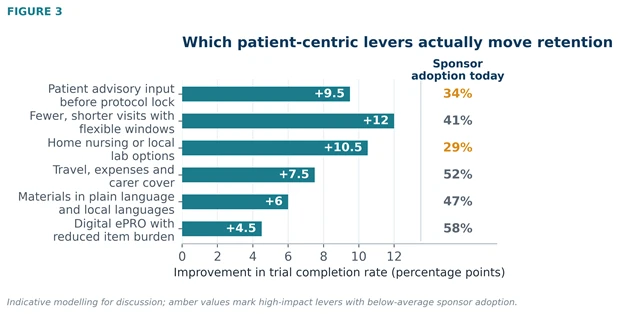
Figure 3: The highest-impact levers are among the least adopted, because they must be chosen before the protocol is locked rather than retrofitted
The implication for leadership is uncomfortable but useful: the patient-centricity agenda cannot be delegated to a patient engagement function operating downstream of protocol approval. The decisions that matter are taken by clinical development and biometrics teams under timeline pressure, months earlier.
The Pharma C-Suite Agenda for Patient-Centric Trials: Five Decisions
- Make patient input a gate, not a courtesy. No protocol should reach final approval without documented patient and treating-clinician review, and a record of which design changes followed.
- Budget burden reduction as an investment, not an overhead. Reimbursement, home visits and flexible scheduling are cheaper per participant retained than the screening and treatment cost of a replacement.
- Set representativeness targets at the design stage. Define the intended population against European epidemiology before site selection, and hold country strategy accountable for age, comorbidity and geographic spread.
- Fund the community and regional sites you keep excluding. Shared coordinators and satellite arrangements convert infrastructure gaps into access, and reach the patients pivotal trials most often miss.
- Measure what patients experience. Track screen failure by criterion, withdrawal reasons, visit burden hours and time to expense reimbursement — and report them to the executive alongside enrolment curves.
Conclusion
The case for patient-centric clinical trials no longer rests on ethics alone, which is precisely why it is finally being made in operational terms. Trials designed around what participants can realistically sustain recruit faster, lose fewer people, generate cleaner data and produce evidence that survives scrutiny from regulators, assessors and payers across very different European health systems.
What stands in the way is not conviction but sequence. Almost every meaningful patient-centric decision — how many visits, how tight the criteria, which languages, which sites, who pays for the train fare — is made in the weeks before a protocol is locked, by teams measured on speed to first patient rather than on completion rates two years later. Until those incentives are aligned, patient-centricity will keep arriving as a rescue measure instead of a design principle.
For European pharmaceutical leadership, the practical test is simple enough to apply at portfolio review: can the organisation show, for its next pivotal study, which design choices were changed because patients said they were unworkable? Sponsors that can answer will find recruitment, retention and representativeness improving together, because all three are consequences of the same decision to design the trial around the person expected to complete it.

Lakshmi is a science writer with a foundation in the laboratory. She earned her master's in biotechnology and trained through research internships at ICGEB (JNU) and DIPAS, DRDO, with her work appearing in the Egyptian Journal of Veterinary Sciences. Now APCRM-certified and part of the editorial team at Pharma Focus America and Pharma Focus Europe, she reports on pharmaceutical technology, research, and innovation — giving complex science a clear and confident voice for industry leaders.