

Overcoming Challenges in Cell and Gene Therapy Manufacturing
Lakshmi, Editorial Team, Pharma Focus Europe
Cell and gene therapies now reach only a minority of eligible European patients, and the reason is rarely scientific. Manufacturing slots, release testing, vector supply and fragmented national assessment consume weeks that critically ill patients do not have. This article examines where time and cost genuinely accumulate in advanced therapy production, what Europe's revised manufacturing rulebook will demand by 2027, and why production design has become a boardroom decision.
Introduction
Europe authorised its first chimeric antigen receptor (CAR) T-cell therapies in 2018. Eight years on, the science has settled far more convincingly than the supply chain. Between October 2009 and June 2025, the European Medicines Agency approved 29 advanced therapy medicinal products (ATMPs). Nine of them — 31 percent — later withdrew their marketing authorisations, and seven of those nine did so for commercial or reimbursement reasons rather than because the therapy had failed clinically.
That figure should unsettle any European executive committee, because it says something uncomfortable about this sector: in advanced therapies, a product can work and still not survive. The decisive variable is increasingly not the biology of the construct but the architecture of its manufacture — how long production takes, where it happens, how quickly a batch can be released, and what that delay does to the patient waiting at the other end of it. Manufacturing is no longer an operational matter to delegate and review quarterly; it determines whether an authorised therapy reaches patients, whether payers accept its price, and whether a decade of development capital is ever recovered.
Why Cell and Gene Therapy Manufacturing Became a Calendar Problem
Autologous cell therapy is the only pharmaceutical process in which the clock is a clinical endpoint. A conventional autologous CAR-T product typically requires 7 to 14 days of ex vivo culture, followed by a further 7 to 14 days of release testing. During that window, the patient — already relapsed or refractory, already out of alternatives — continues to progress.
The consequence is measurable. Comparative evaluations have shown that vein-to-vein times exceeding 40 days are associated with significantly lower overall survival than manufacturing cycles completed within 28 days. Patients whose performance status deteriorates during the wait can become ineligible for the very therapy they were approved to receive. Manufacturing lead time, in other words, is not a logistics metric. It is a determinant of outcome, and therefore of the evidence base that payers will later scrutinise.
The Release-Testing Trap Hiding Inside Cell and Gene Therapy Production
Executives reviewing manufacturing dashboards tend to focus on culture time, because that is the step that looks like production. It is rarely where the time goes. Viability, purity and transduction efficiency can be established by flow cytometry within roughly 24 hours, and vector copy quantification and potency assays need a minimum of 48 hours. Sterility testing by conventional microbiological culture is the step that quietly consumes weeks — particularly when outsourced, and especially when a borderline result requires a repeat.
The strategic implication is counter-intuitive: for many programmes the fastest available gain in time-to-treatment is not a faster bioreactor but bringing microbiological release testing in-house, qualifying rapid sterility methods, and designing a risk-adapted release strategy during process development rather than retrofitting one after authorisation. Capital spent on quality control capability frequently buys more days than capital spent on upstream automation.
Europe's Access Map for Cell and Gene Therapies Is a Manufacturing Map
The geography of European access does not track approval, or even reimbursement. It tracks delivery capacity. A 2025 health-system readiness assessment found that in 2023, despite full reimbursement, only a minority of clinically eligible patients in the five largest EU markets were treated:
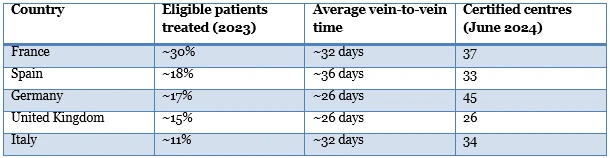
Selected access metrics for CAR-T therapies in Europe. Source: 2025 health-system readiness assessment of European CAR-T provision, as reproduced in peer-reviewed literature (2026).
Read across the rows and a familiar assumption collapses. Germany has the largest number of certified centres and among the shortest vein-to-vein times, yet treats a smaller share of eligible patients than France. Infrastructure alone does not convert eligibility into treatment: referral pathways, slot scheduling, certification heterogeneity and budget-impact negotiation all intervene.
Regulatory assessment adds its own interval, with health technology assessment timelines varying widely and lags exceeding 12 months between European authorisation and national listing in some jurisdictions. The EU Health Technology Assessment Regulation, applicable since 12 January 2025, was designed to compress that duplication and began with oncology medicines and ATMPs as its first in-scope cohort. Its first year supported 10 joint clinical assessments and seven joint scientific consultations — a modest start that will scale as orphan products enter scope in 2028 and all new medicines in 2030. For ATMP developers, the practical message is that joint scientific consultation now belongs inside pivotal trial design, not after it.
Case Study: How One Academic Unit Re-Engineered Its Own Cell Therapy Manufacturing Bottleneck
The most instructive European example of manufacturing redesign comes not from industrial scale-up but from a mid-sized academic hospital in southern Europe that developed, produced and administered its own anti-CD19 CAR T-cell product, later authorised by its national competent authority under the hospital exemption pathway.
The published figures are unusually candid. Of 58 patients who consented, 54 proceeded to apheresis and 47 were infused. There were 11 manufacturing failures, a 6 percent failure rate — a 94 percent success rate, comparable to commercial products reporting 91 to 99 percent. Nine of those failures, 82 percent, were caused by bacterial contamination; all occurred in the first year of operation and none recurred after 2019 as technical staff gained experience. Seven of the 47 treated patients, 15 percent, needed a repeat run.
The timings are where the lesson lies. Production took a median of 8.5 days, range 7 to 10. Vein-to-vein time was 42 days, and the interval from informed consent to infusion was 54 days — so production accounted for roughly a fifth of the wait. The dominant cause was quality control, specifically outsourced sterility testing, for which definitive results were unavailable in under 21 days and on a few occasions took longer than five weeks.
Two interventions changed the picture. Sterility testing moved into the institution's own microbiology laboratory, after which the median time from end of production to batch release fell to 8 days, bringing production-start-to-release to approximately 16 days. Separately, the unit expanded from a single bioreactor — which permitted only two products per month — to four by February 2019, lifting capacity to roughly 8 to 12 products per month and reducing waiting lists. That 83 percent of enrolled patients travelled from other regions is a reminder that geography remains a cost borne by families rather than manufacturers.
The 2027 Rewrite: What Regulators Will Expect of Cell and Gene Therapy Manufacturing
Europe's ATMP-specific manufacturing rulebook is being rewritten, and the timeline is now firm enough to plan against. Part IV of EudraLex Volume 4, the standalone good manufacturing practice guideline for ATMPs, was adopted in November 2017 — before the revised Annex 1 on sterile manufacture came into operation in August 2023. That gap left ATMP sites working to a text silent on contamination control strategy, on the quality risk management and pharmaceutical quality system concepts of ICH Q9 and Q10, and on isolators, restricted access barrier systems, advanced automation and rapid microbiological methods.
A concept paper agreed by the inspectors' working group in April 2025, consulted on between May and July 2025, set out the fix. The draft revised Part IV was released for public consultation in September 2026, with stakeholder comments due in December 2026 and adoption anticipated in March 2027. Alongside it, the regulation on substances of human origin becomes applicable on 7 August 2027, updating the legal basis for starting materials of human origin.
This is a budgeting instruction rather than a compliance footnote. A contamination control strategy written to Annex 1 structure, qualification evidence for closed and automated systems, and validated rapid microbiological methods must exist before inspection, not after. Sites completing a Part IV gap assessment during the consultation window will argue from evidence; those waiting for March 2027 will remediate under pressure.
Policy is moving the same way. The European Biotech Act proposal, published on 16 December 2025 and now in the ordinary legislative procedure, envisages centres of excellence for advanced therapies, proposes removing the additional 50-day assessment extension applied to ATMP clinical trials, and would more than halve timelines for substantial modifications from 96 to 47 days. None of this is law yet — but the direction of travel rewards companies whose manufacturing and trial designs are already built for speed.
Decentralised Cell and Gene Therapy Manufacturing: The Real Trade-Off
The most discussed answer to the time problem is to move production closer to the patient. Point-of-care programmes using closed, automated platforms have demonstrated median vein-to-vein times of 7 days in early-phase European trials, using fresh rather than cryopreserved infusion. On gene delivery, bioprocess and economic analyses suggest that replacing lentiviral or retroviral vectors with transposon and plasmid platforms can reduce vector-related manufacturing costs by roughly 60 to 80 percent, depending on scale and process assumptions.
The honest counterweight is that decentralisation redistributes complexity rather than eliminating it. Distributed manufacturing requires harmonised standards across sites, demonstrated inter-site comparability, clear allocation of batch release authority, interoperable traceability and coordinated pharmacovigilance — plus trained operators and local cleanroom capability in institutions that may lack both. European regulatory pathways for distributed ATMP manufacture remain under-defined, which is precisely the uncertainty the Part IV revision begins to address.
The strategic choice is therefore not centralised versus decentralised in the abstract. It is a judgement about which constraint binds hardest for a given indication: where patient attrition during the wait is destroying the value of the asset, proximity and speed justify the governance burden; where product consistency and inspection readiness are the fragile points, consolidating in fewer, better-controlled sites remains defensible.
Conclusion
The European record is unambiguous about where advanced therapies fail: after approval, in the space between an authorised product and a treated patient, and disproportionately for commercial and reimbursement reasons that trace back to manufacturing cost, time and geography. Nine withdrawals out of 29 approvals is not a scientific verdict on cell and gene therapy. It is an operational one.
The evidence also shows these bottlenecks are addressable, and often cheaper to address than assumed. One academic unit cut its release interval sharply by insourcing sterility testing and quadrupling bioreactor capacity. Rapid microbiological methods and closed automated platforms are now explicitly contemplated in Europe's revised manufacturing guideline.
The companies still selling advanced therapies in Europe at the end of this decade are unlikely to be those with the most elegant constructs. They will be the ones that treated manufacturing design, release strategy and access architecture as a single board-level decision — and made it early enough to matter.

Lakshmi is a science writer with a foundation in the laboratory. She earned her master's in biotechnology and trained through research internships at ICGEB (JNU) and DIPAS, DRDO, with her work appearing in the Egyptian Journal of Veterinary Sciences. Now APCRM-certified and part of the editorial team at Pharma Focus America and Pharma Focus Europe, she reports on pharmaceutical technology, research, and innovation — giving complex science a clear and confident voice for industry leaders.