Oral Obesity Medicines: How Pills Could Change the European GLP-1 Market
Lakshmi, Editorial Team, Pharma Focus Europe
Europe's first oral GLP-1 receptor agonist for weight management received marketing authorisation in July 2026, converting an injectable franchise into a tablet business. This article examines what that shift means for pharmaceutical leadership teams: active-ingredient economics, the collapse of the cold chain, pharmacy-channel and parallel-trade exposure, fragmented national reimbursement, and the adherence variable that will decide which European obesity portfolios actually earn their forecasts.
Introduction: Europe's Obesity Pill Moment Has Finally Arrived
For a decade, the European obesity market has been defined by a needle, a fridge and a specialist clinic. In July 2026 that definition broke. The European Commission granted marketing authorisation for a once-daily 25 mg oral semaglutide tablet, making it the first GLP-1 receptor agonist available in tablet form for weight management across every EU member state, following a positive CHMP opinion in May. Weeks later, in August, the United Kingdom became the first European regulator to authorise orforglipron, a small-molecule oral GLP-1 agonist that carries no food or water restrictions.
The clinical case behind the switch is not marginal. In its pivotal 64-week trial, the oral tablet delivered mean weight reduction of roughly 17% against about 3% for placebo — efficacy that sits comfortably inside injectable territory. The addressable population is enormous: 59% of adults in the WHO European Region are overweight or living with obesity, and excess weight is linked to more than 1.2 million deaths a year, over 13% of regional mortality.
For European pharmaceutical boards, the strategic question is therefore no longer whether oral obesity medicines arrive. It is which parts of the existing operating model they quietly dismantle — and how fast a competitor can exploit the gap.
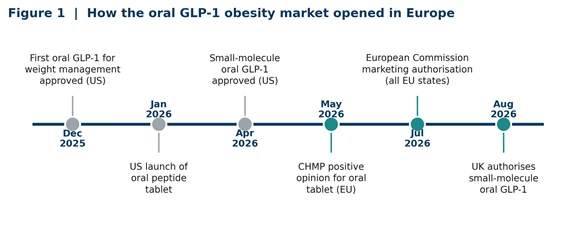
Figure 1: The regulatory sequence that opened Europe's oral GLP-1 obesity market between December 2025 and August 2026.
Why the Oral GLP-1 Switch Is a Manufacturing Decision Before It Is a Commercial One
Start with arithmetic that rarely reaches the commercial deck. A weekly injectable at 2.4 mg consumes roughly 125 milligrams of peptide per patient-year. A daily 25 mg oral tablet consumes about 9.1 grams — some 73 times more active ingredient for the same treated patient. Oral peptide bioavailability is low, in the region of 1%, and the dose is engineered upwards to compensate, with an absorption enhancer co-formulated into a comparatively large tablet.
The implication is blunt. For peptide-based orals, every patient converted from pen to pill consumes the active-ingredient supply of roughly seventy injectable patients. Peptide capacity, not prescriber enthusiasm, becomes the binding constraint on European market share — and capacity of that kind is built on three-year lead times, not three-month sales cycles.
Small-molecule oral GLP-1 agonists rewrite the equation entirely. They are produced by conventional multi-step organic synthesis in standard reactors: no fermentation, no solid-phase peptide manufacture, no sterile fill-finish, no device assembly and no 2–8 °C chain. Cost of goods falls by close to an order of magnitude, and production can be sited wherever solid-dose capacity already exists.
For peptide orals, capacity is destiny. For small molecules, price is the weapon. European executives should be clear which game their portfolio is playing, because the two demand different balance sheets.
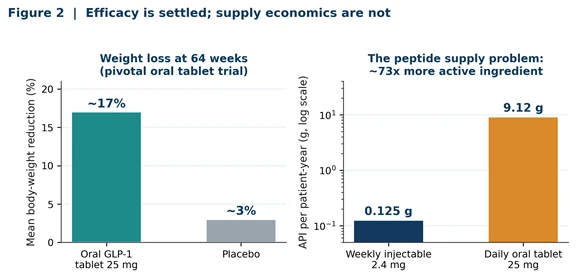
Figure 2: Trial efficacy is established, but the active-ingredient burden of a daily oral peptide is roughly 73 times that of a weekly injectable
The Pharmacy Counter Becomes Europe's New Obesity Battleground
A blister pack travels differently from a refrigerated pen, and that single fact reorganises European commercial strategy. Ambient distribution collapses the logistics cost base and moves dispensing from specialist clinics and hospital pharmacy into community pharmacy, mail order and telehealth. It also removes the physical bottleneck that has quietly rationed injectable supply across Europe since 2023.
What it introduces is arbitrage. Obesity medicines are priced very differently from Lisbon to Copenhagen, and a tablet in a carton is the easiest product in the pharmaceutical universe to parallel-trade across those corridors. Cold chain was an accidental defence against parallel distribution; oral formulations surrender it. Price corridors that were theoretical for an injectable become a live revenue leak for a pill, and launch sequencing across member states has to be designed accordingly.
The second exposure is falsification. High-demand, high-value oral products with a consumer-facing reputation are precisely what counterfeit networks target, and Europe has already seen falsified weight-loss pens reach legitimate supply chains. Serialisation and aggregation under the Falsified Medicines Directive stop being a compliance line item and start working as brand-protection infrastructure.
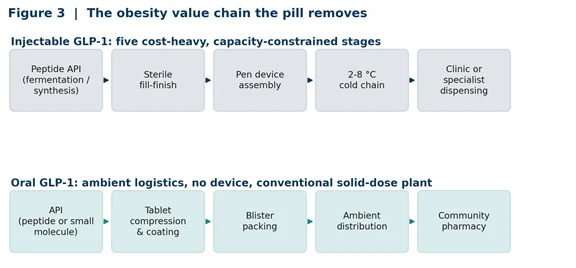
Figure 3: The oral switch removes sterile fill-finish, device assembly and cold-chain logistics from the obesity value chain.
Reimbursement Roulette: Europe's Payers, Not Its Prescribers, Set the Oral GLP-1 Ceiling
Europe does not have an obesity market. It has roughly thirty of them, each with its own answer to whether obesity is a disease worth funding. Germany's statutory system continues to place weight-management medicines outside reimbursable care, so uptake grows through narrow medical indications rather than population prescribing. The United Kingdom has become Europe's largest anti-obesity medicines market almost entirely on private money: by mid-2025, more than two million adults were paying out of pocket against roughly 220,000 supplied through the public system. Italy became the first country in the world to recognise obesity in law as a chronic, relapsing disease — a powerful signal, though recognition and reimbursement are not the same budget line.
Cheaper oral therapy does not solve this fragmentation. It sharpens it. Payers face a volume problem, not a unit-price problem: budget impact is price multiplied by an eligible population that, on WHO figures, runs into the hundreds of millions across the region. A lower-priced pill that triples eligible demand can cost a health system more than an expensive injectable that rationing keeps scarce.
The predictable payer response is tighter gatekeeping — stricter BMI and comorbidity criteria, documented prior lifestyle intervention, stopping rules for non-responders, and outcome-linked managed entry agreements. Percentage weight loss will not clear those hurdles alone. Cardiovascular outcomes, sleep apnoea, knee osteoarthritis, metabolic liver disease and renal endpoints are the currency European health technology assessment actually trades in.
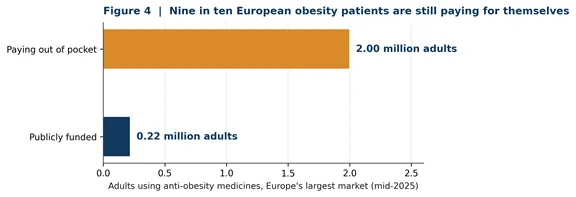
Figure 4: In Europe's largest anti-obesity medicines market, self-funded patients outnumbered publicly funded patients by roughly nine to one in mid-2025.
The Adherence Tax: Why Daily Dosing Rewrites Obesity Revenue Models
Obesity revenue is patients multiplied by persistence multiplied by price, and the industry has historically been weakest at the middle term. Real-world discontinuation on injectable GLP-1 therapy is high; a substantial share of patients stop within twelve months, which means a meaningful proportion of forecast revenue was never collectable in the first place.
Pills change the friction profile in both directions. They remove needle aversion, clinic dependence and refrigeration, all of which lowers the barrier to starting treatment. But they replace a weekly action with a daily one, and daily is where adherence traditionally decays. Dosing conditions matter commercially as well as clinically: the oral peptide requires an eight-hour fast, administration with a small amount of water and a thirty-minute wait before eating, drinking or taking other medicines, while a small-molecule alternative can be taken at any time of day with or without food.
That difference is a competitive asset independent of efficacy. Ten points of twelve-month persistence are worth more commercially than ten points of mean weight reduction, because persistence multiplies across the entire treated base while incremental efficacy mostly wins share at the margin. Organisations that cannot instrument adherence — refill analytics, pharmacist follow-up, digital titration support — will systematically misforecast their own market.
Case Study: How One European Manufacturer Rebuilt Its Obesity Franchise Around a Tablet
The following case is a composite, assembled from patterns visible across several European organisations during the 2025–2026 transition; figures are illustrative rather than reported.
A mid-sized European specialty pharmaceutical manufacturer with roughly €1.2 billion in revenue held an in-licensed injectable incretin in five markets. Its 2025 planning cycle assumed steady, clinic-led growth. A board review concluded the opposite: that an oral entrant would render its clinic-centred model structurally uncompetitive within two years.
Three decisions followed. First, supply was decoupled from certainty — rather than building new capacity, the company converted an under-utilised solid-dose line and reserved tablet capacity twenty-four months ahead of any approval, accepting idle cost as insurance. Second, evidence strategy was rebuilt around what payers had actually been asking for: instead of commissioning another weight-loss study, it funded a prospective persistence and comorbidity registry across three markets. Third, commercial deployment shifted from specialist detailing to community pharmacy engagement and digital refill support.
Twenty-four months after the switch, pharmacy accounted for 62% of dispensed volume against 18% at launch, twelve-month persistence reached 54% versus 38% in its injectable comparator cohort, and cost of goods per patient-year fell by roughly 40%. Two of three national payers granted restricted reimbursement, citing the registry data.
The transferable lesson is not clinical. It is that the company treated the pill as a different business rather than a different presentation of the same one.
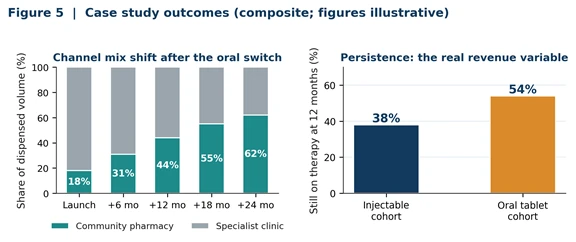
Figure 5: Composite case study outcomes — channel migration to community pharmacy and improved twelve-month persistence after the oral switch.
The C-Suite Agenda for Europe's Oral Obesity Decade
Four convictions separate the organisations positioned for this market from those narrating it. The first is that capacity is committed before certainty: European launches in this category will be won on allocation decisions taken twenty-four to thirty-six months before authorisation, whether through owned plant or contracted solid-dose partners.
The second is that evidence is built for payers rather than headlines, because the endpoints that unlock European reimbursement are cardiovascular, hepatic, renal, respiratory and musculoskeletal — and, increasingly, demonstrated persistence. The third is that price architecture must assume both volume and leakage, with launch sequencing, pack configuration and national contracting designed as one connected decision.
The fourth is that competition will arrive as chemistry. Small-molecule orals and the first generic semaglutide waves outside Europe will compress price expectations well before European exclusivity lapses. The premium pricing window for obesity therapy in Europe is narrower than most five-year plans currently assume.
Conclusion: The Pill Is Not a New Format, It Is a New Market
The arrival of oral GLP-1 medicines in Europe is often narrated as a convenience story — the same medicine, minus the needle. That framing is comfortable and wrong. Oral administration changes who manufactures, who distributes, who dispenses, who pays and who stays on therapy, and each of those shifts moves value to a different part of the chain.
Europe will not replicate the American adoption curve. Its growth will be slower, more clinically gated and far more dependent on national budget decisions than on consumer demand. It will also be more durable, because a market built on reimbursement and persistence does not evaporate when enthusiasm does.
The pharmaceutical companies that prosper in Europe's oral obesity era will not be those with the most attractive weight-loss percentage in a press release. They will be the ones that secured tablet capacity early, generated the outcome evidence European payers demand, defended their price corridors, and built a real capability to keep patients on therapy past month twelve. Those decisions are being taken now, and most of them are irreversible.
Frequently Asked Questions on Oral Obesity Medicines in Europe
Is an oral GLP-1 as effective as an injectable for weight loss?
In its pivotal 64-week trial, the oral tablet produced mean weight reduction of roughly 17% versus about 3% on placebo, within the range reported for injectable GLP-1 therapy. No head-to-head comparison has been reported, so cross-trial claims should be avoided in payer and promotional materials.
Which oral obesity medicines can be prescribed in Europe today?
A once-daily 25 mg oral semaglutide tablet has held EU marketing authorisation since July 2026 for adults with a BMI of 30 or above, or 27 and above with at least one weight-related comorbidity. A small-molecule oral GLP-1 agonist was authorised in the United Kingdom in August 2026 but is not yet authorised in the EU.
Will oral formulations reduce the price of obesity treatment in Europe?
Over time, particularly for small molecules, whose cost of goods is far below that of peptides. Near-term European prices are set by negotiation and budget impact rather than production cost, so expect volume-based access pressure before visible list-price cuts.
What is the biggest supply risk for a peptide-based oral obesity product?
Active-ingredient volume. A daily oral peptide consumes roughly seventy times the active ingredient of a weekly injectable per patient-year, so peptide capacity rather than demand usually determines achievable European market share.
How should pharmaceutical companies prepare for parallel trade in oral obesity medicines?
Treat launch sequencing, pack presentation and national price setting as one connected decision. Ambient-stable tablets cross EU price corridors far more easily than cold-chain pens, so protection once supplied by logistics must be replaced by commercial design.

Lakshmi is a science writer with a foundation in the laboratory. She earned her master's in biotechnology and trained through research internships at ICGEB (JNU) and DIPAS, DRDO, with her work appearing in the Egyptian Journal of Veterinary Sciences. Now APCRM-certified and part of the editorial team at Pharma Focus America and Pharma Focus Europe, she reports on pharmaceutical technology, research, and innovation — giving complex science a clear and confident voice for industry leaders.